


BlaBlaCar has been able to establish itself as a global transport network by focusing on the use of digital trust and community-driven technology as the basis for an effective business plan. It highlights what is possible when these two concepts are brought together to create a scalable business plan. For B2B partners, it also serves as a model of best practice for managing challenging, high-risk peer-to-peer relationships with respect to product quality.
We at Frugal Testing specialize in ensuring the security and performance of such complex digital ecosystems. By analyzing how BlaBlaCar achieves its authority in the modern sharing economy, we provide critical insights for companies looking to build resilient, high-trust platforms. This article breaks down the dual forces of affordability and social connection that are the bedrock of BlaBlaCar's global impact.
Key Insights from This Article
🚗 How BlaBlaCar turned empty car seats into a global affordability engine
🌍 A scalable, asset-light business model built entirely on community trust
🤝 Social compatibility features that convert strangers into trustworthy travel partners
🔐 A strong digital backbone ensures safety, secure payments, and seamless travel
🚌 Multi-modal expansion creates a unified network for affordable mobility
From a Christmas Trip to a Global Network: The Genesis
The genesis of BlaBlaCar can be traced back to 2003, when founder Frédéric Mazzella, unable to book a train to visit his family for Christmas in the French countryside, noticed that the cars passing him were mostly full of empty seats. This simple observation led to the realization of a massive market inefficiency-an abundance of underutilized assets (empty seats in automobiles) that could be matched with unmet demand (travelers seeking affordable transport). This insight in France was the foundation for one of Europe's most influential network-effect platforms.
The Peer-to-Peer Model that Defined BlaBlaCar’s Strategy
Covoiturage.fr started as a simple listing website, but the company made a strategic decision to change its business model and offer an online transaction capability (BlaBlaCar) to enable it to grow and provide greater service reliability. Changing from cash payments in cars to mandatory prepayment via the online site, along with a nominal transaction fee, was a major step toward correcting the problems of frequent cancellations and no-shows that existed in the peer-to-peer transportation sector.
- Co-founders Frédéric Mazzella, Nicolas Brusson, and Francis Nappez believed that they would need to use an online, non-refundable payment system to help build trust by creating a sense of mutual commitment and reliance between passengers and drivers.
- This transition to a commission-based revenue stream, charged to the passenger, provided the necessary capital for asset-light scaling and international expansion.
- The original model was tested and refined through various iterations before the final transactional model was adopted, embodying the "Fail, Learn, Succeed" value that drives its innovation.
- By focusing on long-distance travel (averaging around 300km per trip), the company deliberately carved out a niche distinct from urban ride-hailing platforms.
This transactional peer-to-peer network provided a scalable foundation for growth, transforming a simple cost-sharing idea into a robust, global marketplace. The early focus on system stability, driven by the co-founders, set the stage for the platform's technological dominance.
The Affordability & Efficiency Revolution in Shared Journeys
The platform's core appeal lies in its ingenious approach to cost-sharing, not profit-making, utilizing a true asset-light scaling model. This fundamentally shifts the economics of long-haul trips and is a key factor in its global success across diverse markets.
How Carpooling + Smart Pricing Reduce Costs for Everyone
BlaBlaCar effectively turns a driver's empty car seats into low-cost transportation for passengers. This is achieved through a proprietary cost-sharing algorithm-typically built using route-optimization logic and dynamic pricing models- that calculates the maximum fair contribution to cover variable costs like fuel and tolls, preventing the carpooling service from becoming a commercial taxi operation. The system is designed to maximize savings for all parties, utilizing existing resources to lower the collective cost of mobility.
- The platform’s regulated smart pricing technology analyzes factors like trip distances, tolls, and fuel costs to suggest a fare per seat, upholding the true spirit of shared travel.
- Passengers gain access to cheaper travel than traditional bus or train ticket sales, which is particularly impactful in budget-conscious regions.
- The system ensures high occupancy, which optimizes driver earnings by transforming a necessary long-distance journey expense into a cost-sharing opportunity.
- This dynamic pricing mechanism, while strictly regulated, allows for flexibility and high utilization of available seats, ensuring the integrity of the service.
By capping fares and ensuring fairness, BlaBlaCar maintains the integrity of its carpooling service, effectively subsidizing the journey for everyone involved. For a testing company like Frugal Testing, ensuring the fairness and accuracy of this complex, geo-specific algorithm is a central challenge in maintaining user trust.

Asset-Light Scaling: Growth Powered by Community
The BlaBlaCar business model is a masterclass in asset-light scaling, owning no vehicles or infrastructure. Its growth is powered purely by the network effect of its peer-to-peer network. The platform’s reliance on its existing community is the reason why it can expand so quickly and efficiently into regions like Brazil and India.
- The asset-light scaling model grants infinite scalability, allowing rapid expansion into new geographies without the heavy capital expenditure associated with traditional transport operators.
- Growth is driven by the network effect-as the number of drivers increases, the service becomes more valuable and attractive to passengers, reinforcing the growth loop.
- The business is focused entirely on the digital platform (mobile app), concentrating resources on technology, safety, and user experience (UX) improvements.
- A commission-based revenue stream (transaction fee) from completed bookings scales directly with the volume of successful, shared long-distance journeys.
By operating as a purely transactional marketplace, BlaBlaCar minimizes fixed costs and overhead. This resilience proves that the asset-light scaling business model is highly agile and can achieve a dominant position within the global sharing economy.
Cultivating Connection: The “BlaBla” Social Travel Experience
For the high-trust environment of shared travel, BlaBlaCar intentionally designs social interactions to move beyond mere transactions, fostering a genuine community.
Social Features That Turn Rides Into Shared Experiences
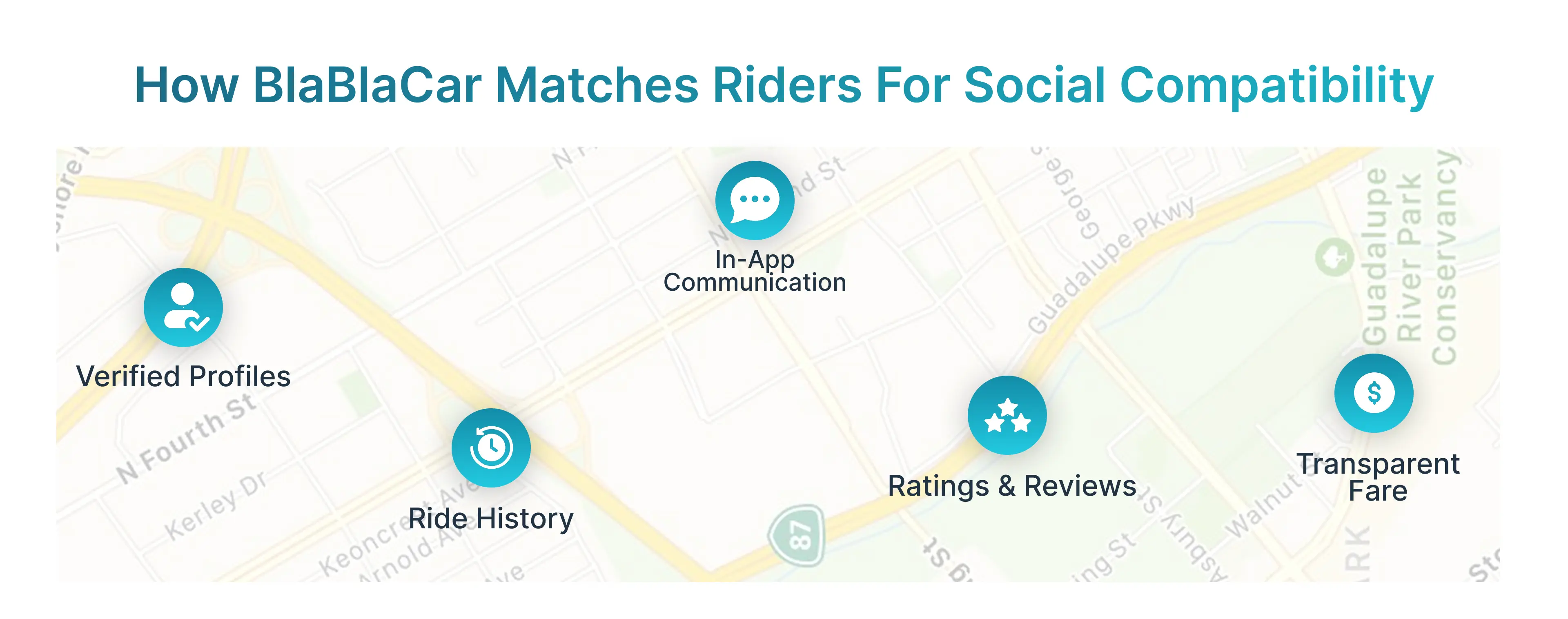
What strategies does BlaBlaCar use to help strangers trust each other before meeting? With the comprehensive profile requirements, which include photos, ID verification, and "Bla," "BlaBla," and "BlaBlaBla" preferences to indicate how chatty someone is, BlaBlaCar creates a framework where each user's profile will help alleviate that potential anxiety by allowing users to create connections and share experiences. This type of framework promotes a culture of relationships and creates shared perceptions of trust.
- Each profile contains detailed personal information, such as user-uploaded photographs, verification badges, and most importantly, ratings and reviews from co-travelers, as these reviews serve as the social currency of BlaBlaCar.
- The Bla Bla preference system is a valuable tool, as it enables members to indicate their level of interest in conversing with other members. Through this means, Bla Bla Car enables customers to find travel partners with similar personalities and enhance the entire shared car experience, and manage traveler expectations before travelling with an individual member.
- A comprehensive and transparent trust and safety rating system that holds active members accountable creates the foundation for building a strong reputation, which in turn is required for continuing to have access to the platform and for booking a successful trip on the peer-to-peer network.
- Coordinating pickup and drop-off information can be done via in-app chat and automated messages. This added level of personalization for both parties involved enhances the value of each transaction.
Overall, by creating an atmosphere for social compatibility, BlaBlaCar enables users to migrate from an impersonal carpool service to a trusted online community. Therefore, the platform's success and growth depend on the amount of trust that its members develop for each other, ultimately creating a trusted digital environment.
The Digital Backbone: Technology That Drives Convenience, Trust, and Safety
Through precisely coordinated digital solutions, millions of people travel around the world every day, relying on a highly innovative technology that prioritizes secure and seamless experiences via the mobile applications developed by BlaBlaCar.
BlaBlaCar offers technologically-enhanced solutions at each step of the travel journey. The technological architecture of BlaBlaCar was purposefully designed to accommodate the demands of enabling high-volume, complex route-matching while providing the highest standard of safety and transparency to every user who utilizes BlaBlaCar's global network.
- BlaBlaCar establishes the trust level that the users have in each other by requiring a thorough verification of the user through mandatory ID verification and rigorous moderation of the user's profile.
- BlaBlaCar uses a secure payment system that processes all digital payments made through the platform, thus reducing the likelihood of fraud and ensuring that the transaction fees are collected appropriately from users.
- Artificial Intelligence safety tools continuously audit the service for suspicious activity to support a robust level of protection throughout the trip.
- Through the use of sophisticated algorithms, including Boost matching technology and complex meeting-point logic, BlaBlaCar routes drivers to pick up and drop off multiple passengers quickly and efficiently.
By focusing on the technology that supports verifiable safety and transparency, BlaBlaCar is able to operate as a seamless, high-volume online marketplace. To build a scalable and credible business, businesses must commit to developing a strong digital platform.
Expanding Beyond Carpooling: A Multi-Modal Mobility Network
BlaBlaCar has grown to be a multi-modal provider for mobility services because it has matured to capture a greater share of the overall transportation market through its growth strategies.
BlaBlaBus and Integrated Transport Options
Through the development of BlaBlaBus as part of the BlaBlaCar offering, BlaBlaCar was able to strategically provide additional transportation options for high-volume long-distance routes in addition to its primary offering, which originally consisted only of carpooling.
- BlaBlaCar now offers a more complete travel solution by adding BlaBlaBus and integrating services like Ouibus alongside its carpool network.
- It has also partnered with additional local and third-party bus providers to expand user travel options.
- These integrations strengthen BlaBlaCar’s network in markets like India and position it as a key booking hub for shared mobility.
- Users can book both carpool and bus rides through a single app, enabling a seamless multi-modal travel solution.
The strategic expansion of BlaBlaCar through this new service provides users of BlaBlaCar with a reliable alternative to the traditional methods of carpooling for travel, where carpooling would not be considered the most efficient way to travel. This aggressive strategy allows the company to serve the full spectrum of long-distance travelers. This multi-modal approach significantly strengthens the platform’s dominant position in the shared mobility market.
A Unified Marketplace for Affordable Mobility
The future of BlaBlaCar is centered on creating a single, powerful marketplace that unites all modes of affordable shared travel. This concept is about using data and technology to present the optimal travel solution to the passenger.
- The platform acts as a digital-first distribution channel for both its peer-to-peer rides and its professionally managed BlaBlaBus routes.
- This integration gives BlaBlaCar a competitive edge over siloed transportation providers, offering a more flexible and robust low-cost transportation alternative.
- By combining multiple modes, the platform leverages the strengths of each-the flexibility and ubiquity of carpooling with the capacity and efficiency of long-distance buses.
- The goal is to provide a comprehensive and sticky user experience (UX), driving loyalty and reinforcing the platform’s role as the go-to provider for affordable mobility services.
Sustainability & Global Impact: Shaping the Future of Travel
The BlaBlaCar model is inherently a sustainability solution by optimizing resource utilization and minimizing waste.
Lower Carbon Footprint Through Shared Mobility
One positive impact that BlaBlaCar can have on the environment comes from its ability to increase the number of people in a vehicle, which will reduce the total number of private vehicles on the road, thereby reducing the overall amount of CO2 produced by the total number of vehicles. This is a significant and demonstrable benefit at an overall level.
By facilitating the use of empty seats in vehicles, BlaBlaCar helps to decrease the total number of vehicles needed to provide long-distance transportation for the same number of people. Consequently, this reduction in the number of vehicles results in a decrease in the overall carbon footprint of the transportation system. The efficiency of the BlaBlaCar platform to optimize shared transportation is regularly validated by independent research, which consistently confirms the large volume of CO2 that is saved as a result of its use every year.

Global Network with Local Adaptability
The platform's ability to maintain a strong global network with local relevance is key to its success. Achieving critical mass in diverse geographies, from Europe to Brazil and India, demonstrates the robustness of its core technology and peer-to-peer framework.
- The platform adapts its payment system to local norms, for instance, integrating with regional digital payment services in India to ensure the user experience is frictionless.
- Pricing strategies and commission models are carefully adjusted based on regional fuel costs and the competitive landscape of the local transport market.
- This local adaptability, built on a common, scalable technology backbone, ensures consistent, high growth and increases the base of active members.
Conclusion: The Road Ahead for BlaBlaCar
BlaBlaCar's journey is a blueprint for building a hyper-scalable digital platform that wins on both affordability and social trust. By masterfully blending advanced technology with community-centric features, the company has transformed travel economics and experience. For executives looking to invest in or build similar high-trust, network-effect platforms, the BlaBlaCar model provides the gold standard for asset-light scaling and responsible business model execution.
Moving forward, BlaBlaCar's combination of technology, trust, and social networking has created a complete mobility solution. The company's ability to deliver on the promise of affordable and sustainable travel will allow it to scale globally while remaining locally relevant. The company's business model can create the roadmap for developing high-trust and community-driven business models that will disrupt many traditional industries.
People Also Ask (FAQs)
Q. How does BlaBlaCar calculate the exact fuel consumption for every ride?
Ans. It uses a smart pricing algorithm based on distance, tolls, and average fuel costs instead of tracking real-time fuel usage to ensure fair cost-sharing.
Q. Can BlaBlaCar guarantee safety without any physical oversight of drivers or vehicles?
Ans. Full safety cannot be guaranteed, but digital verification, ratings, and AI monitoring help maintain trust and remove risky users efficiently.
Q. Why doesn’t BlaBlaCar replace traditional bus companies entirely if it’s more efficient?
Ans. Carpooling cannot match bus capacity or route consistency, so both coexist to serve different travel needs and high-volume corridors.
Q. Does the social rating system create biases or unfair exclusions among users?
Ans. Bias risks exist, but transparency, moderation, and accountability mechanisms help reduce unfair treatment and maintain platform fairness.
Q. What happens if the asset-light model collapses due to trust breakdowns in a region?
Ans. Platform usage would drop quickly, which is why BlaBlaCar emphasizes strong safety, secure payments, and verification to preserve user trust.