

When enterprises evaluate AI vendors, capability benchmarks come first context window, coding performance, and latency. Safety gets reviewed after the demo. That ordering has real consequences.
Anthropic built Claude on a different assumption: the safety work is the product. Constitutional AI, adversarial red teaming, and a formal Responsible Scaling Policy are engineering decisions that directly shape how Claude behaves in production, not positioning language added after the fact. This article breaks down each one and connects them to what enterprise teams actually need before deploying AI: evidence of structured testing, and governance that holds under real conditions.
What Is AI Safety in Large Language Models?
AI safety in large language models (LLMs) refers to the methods, processes, and policies used to ensure a model behaves reliably, honestly, and within defined boundaries across all conditions including edge cases, adversarial inputs, and real-world production environments.
For enterprises, AI safety is not a single feature. It covers three distinct layers:
- Model-level safety: How the model is trained to avoid harmful, dishonest, or unpredictable outputs methods like Constitutional AI and adversarial red teaming operate at this layer.
- Deployment-level safety: How the model behaves in your specific environment, with your data, your users, and your system configuration.
- Governance-level safety: The policies, controls, and accountability structures that define who can deploy AI, what it can do, and how failures are handled. Understanding all three layers is necessary before evaluating any AI vendor including Anthropic.
What Is Constitutional AI and How Does It Train Claude?
Constitutional AI is an alignment method where the model evaluates and rewrites its own outputs against a defined set of principles, rather than relying on human raters to review responses at scale. Introduced by Anthropic researchers Bai et al. in their 2022 paper Constitutional AI: Harmlessness from AI Feedback, it replaced a significant portion of manual human labeling with a principle-based self-critique loop.
The process runs in two stages. First, the model generates a response. Then it critiques and rewrites that response using the constitution. Over many training iterations, this produces outputs that are more useful, honest, and less likely to cause harm not because humans flagged specific failures, but because the model learned to reason about its own outputs rather than match patterns from approved examples.
For enterprises, the practical consequence is more consistent refusal behavior on ambiguous inputs the edge cases that blocklist-based filtering consistently misses.
Why this matters for enterprises: Most content filtering systems work on keyword matching. They block specific words or phrases but fail on rephrased versions of the same request. Constitutional AI trains the model to evaluate intent and context, not just surface patterns. In production environments handling sensitive data or regulated content, that difference has direct operational consequences fewer false positives blocking legitimate work, and fewer false negatives allowing harmful outputs through.
How Is Constitutional AI Different from Standard Human Feedback Training?
Standard RLHF requires human annotators to compare large volumes of model output. That process is expensive, slow to scale, and produces inconsistent results when inputs are ambiguous. Constitutional AI shifts the evaluation task to the model itself. Before any human sees the output, the model has already measured its draft against the defined principles and revised it.
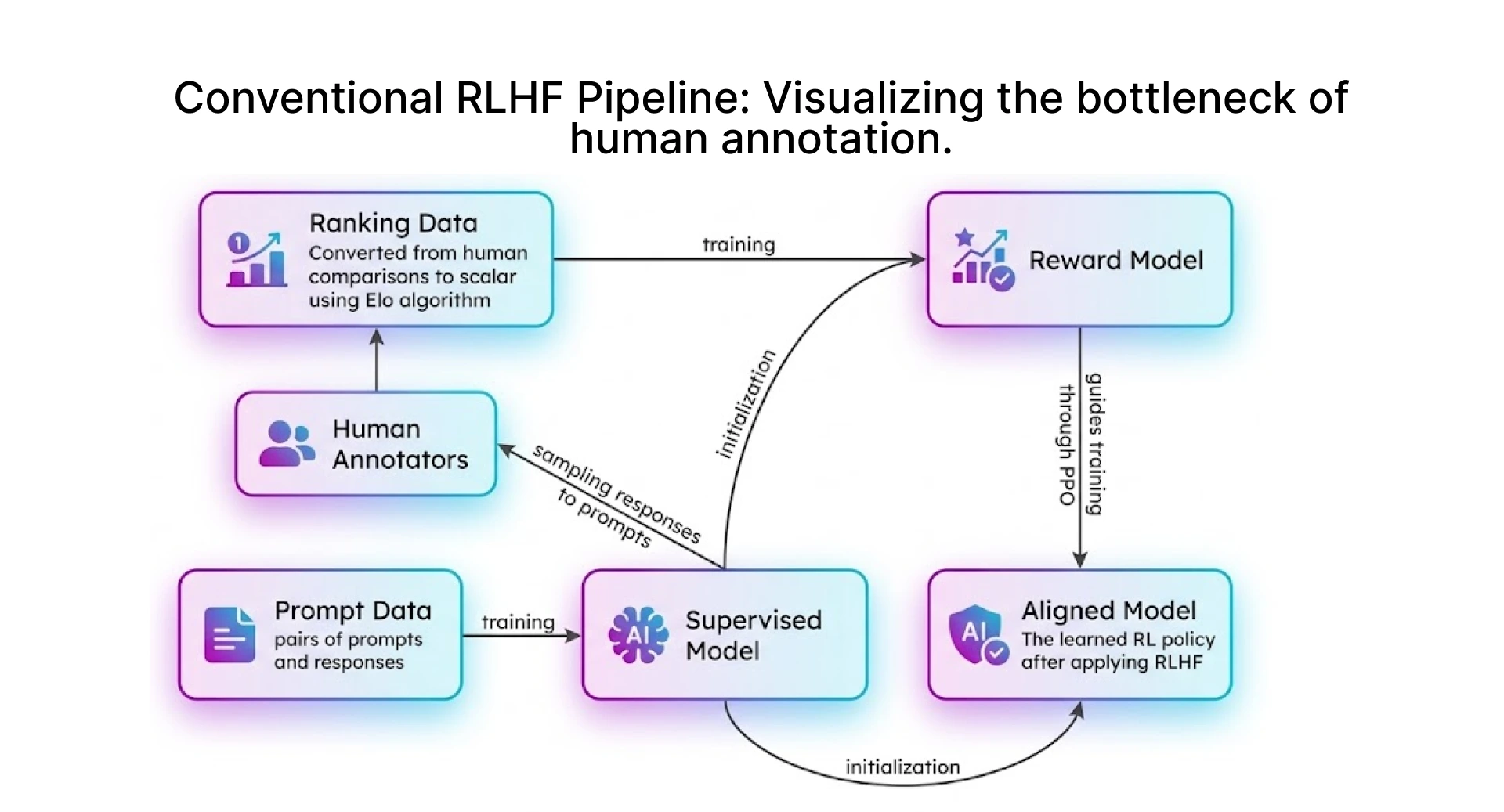
This has three concrete effects on how the alignment work scales. Principle-based critique reduces inconsistency on ambiguous inputs because the evaluation criteria are fixed. Self-revision at training scale means alignment quality does not degrade as output volume grows. Human reviewer effort concentrates where it has the most leverage defining the principles themselves, rather than reviewing every response the model produces.
How Is Claude Trained From Pre-Training to Reinforcement Learning?
Claude's training follows the standard large language model pipeline, with Anthropic-specific changes at the alignment stage.
Pre-training builds the model's foundational capabilities, language structure, factual knowledge, and reasoning patterns from a large text corpus. Supervised fine-tuning then trains the model on curated examples of high-quality, aligned responses. After that, the Constitutional AI critique loop runs: the model revises its outputs against the defined principles before human reviewers are involved. Human preference data from RLHF shapes behavior further. Finally, safety fine-tuning addresses refusal accuracy, honesty, and specific harmful output categories.
The result is a model that has passed through multiple independent alignment stages not a pre-trained base model with a single safety layer applied at the end.
Anthropic's Responsible Scaling Policy: AI Standards for Every Safety Level
The Responsible Scaling Policy (RSP) is Anthropic's formal commitment to evaluate each Claude version against defined safety thresholds before releasing more capable models. First published in September 2023 and updated with Claude 3, it sets specific requirements that must be met before a model proceeds to deployment including direct evaluations for biological, chemical, and nuclear risk categories.
The policy ties deployment decisions to measured thresholds rather than internal judgment calls. It addresses catastrophic risk categories that fall outside standard content policy. And it is publicly available, which means enterprise procurement teams can read it, reference it, and use it to assess whether Anthropic's risk criteria align with their own. For a vendor assessment, a written commitment to specific evaluation standards is more useful than a general statement about safety priorities.
How Is Claude's AI Model Built for Safe Enterprise Use?
Safe enterprise deployment requires more than benchmark scores. It requires a model that responds predictably across diverse inputs, handles edge cases without failing silently, and stays within the constraints a team has configured across an entire session, not just the first few turns.
Claude is designed with steerability as a core property. A system prompt can define role, scope, and constraints, and Claude holds to those instructions throughout the session. A model that drifts from its configuration mid-conversation creates downstream operational risk regardless of how strong its evaluation scores look. Enterprise teams also need to understand a model's failure modes before deploying it specifically how and when it refuses, and whether those refusals are calibrated to actual risk rather than surface-level keyword matches.
Why Context Window and Coding Reliability Matter for Safe Production Deployment
Claude's large context window supports long documents, multi-file codebases, and extended conversations. The relevant question for deployment is not the size of the window but whether instruction-following holds as context grows. That property does not transfer reliably from short-context benchmark results it needs to be tested at the context lengths your actual workloads will use.
Coding reliability carries similar weight. Inaccurate generated code in a production pipeline does not produce a visible error; it produces wrong behavior. Both properties require realistic testing under realistic conditions before you trust the model in production.
Constitutional AI shapes how Claude is trained to evaluate its own outputs. But training alone cannot surface every failure mode. That is where adversarial testing comes in.
What Is AI Red Teaming and How Does Anthropic Use It?
AI red teaming is a structured method for finding model failures before they reach production. It works by using adversarial prompts, edge cases, and deliberate misuse attempts to test how a model behaves outside normal conditions not just how it performs on well-formed inputs.
The method comes from cybersecurity, where red teams probe systems as simulated adversaries to find weaknesses before real attackers do. Applied to AI, the attack surface shifts. There are no firewall rules to bypass. The attacks are prompts, and the vulnerability is model behavior.
For enterprises evaluating AI vendors, the seriousness of a company's red teaming program is a meaningful signal. It separates vendors who test for failure from vendors who only test for expected performance.
What Is Red Teaming in AI Security?
Traditional security red teaming identifies system vulnerabilities before an attacker can exploit them. An adversary is simulated, defenses are probed, and what breaks gets documented and fixed.
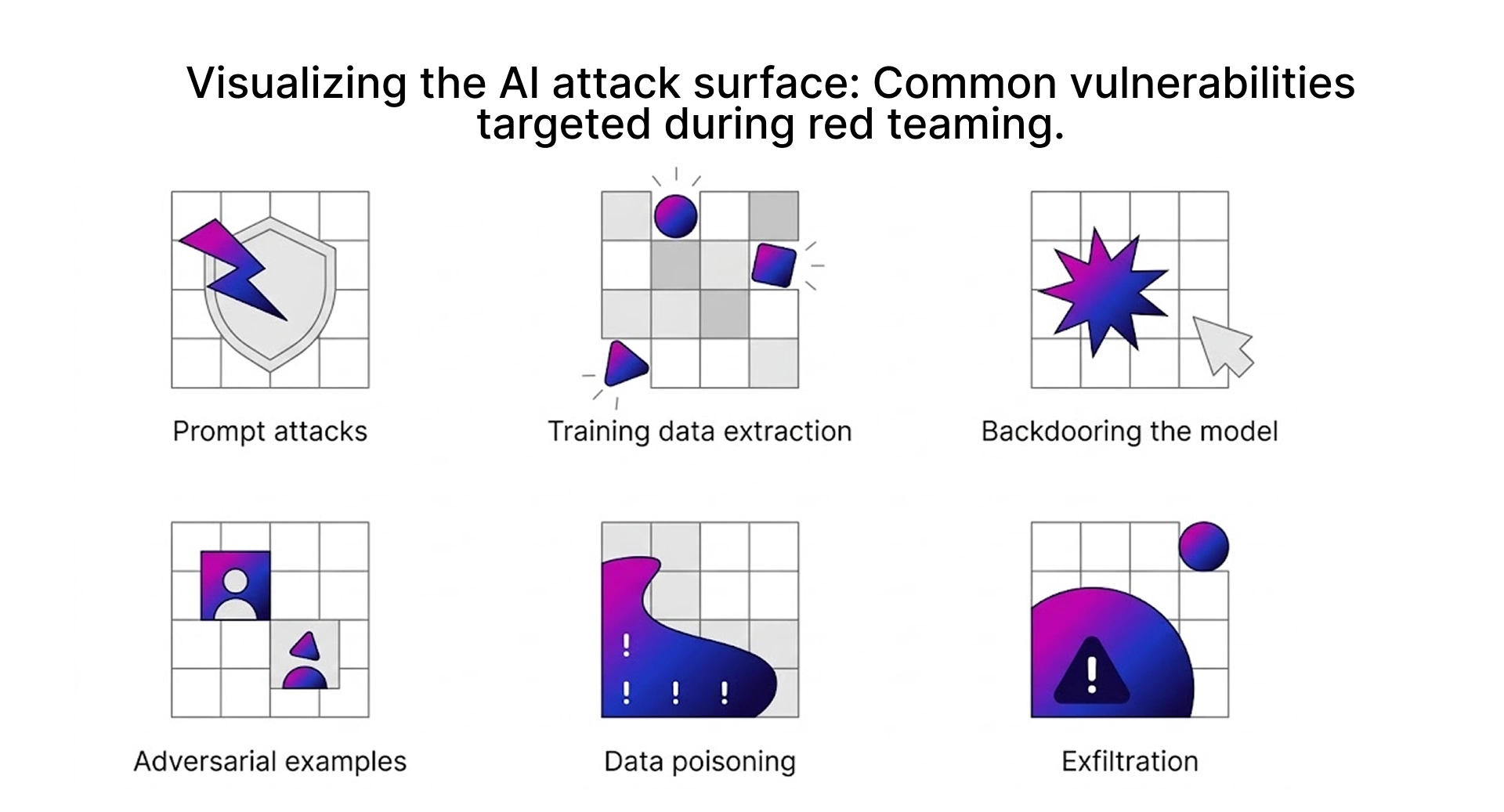
AI red teaming applies the same adversarial logic to model behavior.
According to a 2023 report by Google's AI Red Team, which reviewed red teaming programs across multiple frontier labs, the most effective programs test five specific failure categories:
- Jailbreak attempts: Prompts designed to bypass the model's safety training and extract restricted outputs.
- Prompt injection: Malicious instructions hidden inside user input or retrieved data that redirect model behavior.
- Hallucination under pressure: Cases where the model generates confident-sounding but factually incorrect information.
- Harmful output generation: Responses that include dangerous instructions, discriminatory content, or other policy-violating material.
- Policy violations: Outputs that breach deployment-specific rules, even when they don't fall into the above categories.
Finding these failures internally is always preferable to having them surface after deployment.
How Does Anthropic Test Claude With Red Teaming?
Anthropic uses both internal adversarial teams and external researchers for red teaming exercises on Claude. They construct prompts designed to evade safety behaviors through direct attacks, indirect framing, and multi-turn manipulation testing whether Claude stays consistent when harmful requests are restructured across a conversation rather than made in a single direct prompt.
This testing runs throughout training and evaluation, not only before public releases. Failures feed directly back into training and fine-tuning, which means red teaming results are not just documented, they change the model.
Why this matters for enterprises: A vendor that runs red teaming only before release is testing a snapshot. Anthropic's continuous testing means the model is being evaluated against new attack patterns throughout its lifecycle, not just at launch. When evaluating AI vendors, ask whether red teaming results feed back into training or simply get filed as reports. The answer tells you whether safety testing is an engineering input or a compliance checkbox.
Understanding how Anthropic tests Claude is useful context. But it does not replace testing your own deployment. Here is what that looks like in practice.
Common Risks in Enterprise AI Deployment
Most AI deployment failures are not model failures. They are process failures gaps in testing, governance, and oversight that exist independently of how good the underlying model is. These are the most common risks enterprise teams encounter after going live.
- Over-reliance on vendor safety: Anthropic's safety training covers the model. It does not cover your deployment. System prompts, user inputs, and integration architecture introduce risks that vendor testing was never designed to catch.
- Lack of deployment-specific testing: A model that performs well on benchmarks may behave unexpectedly on your data, your edge cases, and your user base. Generic evaluation results do not transfer automatically to your environment.
- Missing monitoring: Pre-deployment testing catches known failure modes. Production monitoring catches the failures that only appear at real-world scale, under real user behavior. Without it, issues accumulate silently.
- Weak governance: Deploying an AI tool and running a governed AI deployment are not the same thing. Without defined accountability, access controls, and incident response procedures, teams have no structured way to handle failures when they occur.
- Poor data handling: Personally identifiable information appearing in logs, user data reaching unintended pipelines, and inadequate access controls around model inputs are operational risks that sit entirely outside the model itself.
Recognizing these risks before deployment is significantly cheaper than discovering them after.
How to Test AI Applications Before Enterprise Deployment
A vendor's safety testing does not cover your deployment. Once you run a model in your environment with your data, your users, your edge cases you are responsible for how it behaves. Enterprise AI testing needs to cover safety, functionality, reliability, and the failure modes that are specific to your context.
This is where most organizations underinvest. The demo works. They deploy. Something unexpected happens at scale.
A pre-deployment testing checklist should cover core use case accuracy, refusal behavior (does it refuse what it should, and only what it should?), hallucination testing with prompts built on false premises, edge case and adversarial inputs, sensitive data handling, and latency under realistic load conditions.
How Does Automated Test Case Generation Work for AI Safety?
Manual testing cannot cover every input variation. As an AI application grows, automated test case generation becomes necessary to maintain coverage.
Refusal tests generate prompts likely to trigger refusals and verify the model declines them without rejecting legitimate inputs. Jailbreak tests check whether your deployment holds against known bypass patterns. Hallucination tests use prompts built on verifiably false premises to see whether the model accepts or challenges them. Policy compliance tests build cases from your organization's acceptable use policy. Domain risk tests address the specific exposure of your industry whether healthcare, legal, or finance.
Automated evaluation does not replace human review. It closes the gaps human review inevitably leaves.
How Should You Monitor AI and Govern Data in Production?
Pre-deployment testing is necessary but not sufficient. Once an AI application is live, ongoing measurement catches behavioral drift, misuse patterns, and failures that only appear at real-world scale.
Production AI monitoring should include automated API testing to confirm responses conform to expected formats and content policies, functional regression testing after system prompt or model updates, output quality monitoring that tracks degradation over time rather than just errors, and anomaly detection to flag usage patterns that suggest misuse or adversarial probing. Data handling should be continuously verified that personally identifiable information does not appear in plain-text logs and that user data does not reach unintended pipelines.
This is not a setup task. It is an ongoing operational responsibility.
Testing tells you how the model behaves. Governance defines what happens when it doesn't behave as expected.
Generative AI Governance: What a Safe Deployment Framework Actually Requires
Testing models is necessary. Testing your specific use cases is also necessary. Neither is enough without governance the policies, procedures, and controls that define how AI is deployed, who can deploy it, what it can do, and who is accountable when something goes wrong.
Deploying an AI tool and running a governed AI deployment are not the same thing. Governance means defined accountability, oversight built into the process, and a clear plan for how failures get handled.
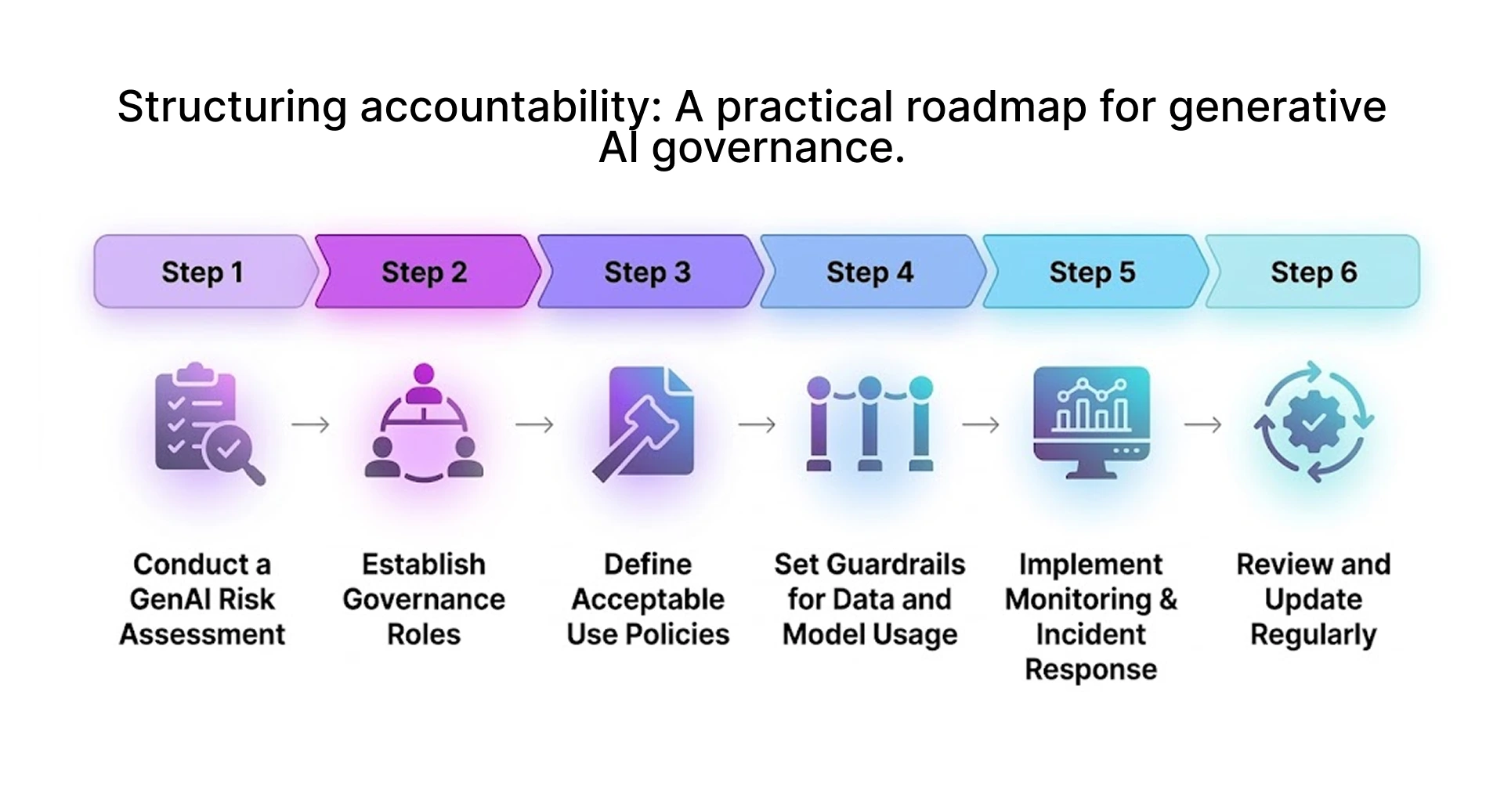
An enterprise AI governance framework needs to cover six core areas:
- Approved use cases: A defined list of what AI is permitted to do in each deployment context, so teams aren't making ad hoc decisions at the point of use.
- Risk classification: A system that distinguishes high-risk from low-risk applications and applies proportionate controls to each.
- Human review checkpoints: Clear requirements specifying which model outputs must be reviewed by a person before any action is taken.
- Access controls: Defined permissions for who can configure system prompts, change model settings, or modify deployment parameters.
- Audit logs: Full tracking of inputs and outputs so behavior can be reviewed, investigated, and evidenced when needed.
- Incident response: A documented plan for how incorrect or unsafe model behavior gets reported, investigated, and resolved.
How to Build a Generative AI Governance Policy for Your Organization
A generative AI policy does not need to be comprehensive on day one. It needs to address your current deployments and be specific enough that people can follow it.
Approved use cases define what AI is permitted to do in each deployment context. Risk classification rates those use cases by potential harm so oversight scales appropriately. Human review requirements specify when a person must check the model's output before action is taken. An incident response plan defines how unsafe behavior gets reported and investigated. Compliance ownership assigns responsibility for maintaining and monitoring the policy over time.
Conclusion: Why AI Safety Should Be a Vendor Selection Criteria for CTOs
CTOs evaluating AI vendors should ask the governance questions directly: What is your approach to safety testing? How do you handle misuse? What happens when the model fails in production? Anthropic's approach Constitutional AI, adversarial red teaming, and the Responsible Scaling Policy gives procurement and engineering teams concrete, documented answers to those questions.
That does not eliminate enterprise risk. Safe deployment requires an aligned model, deployment-specific testing, and governance infrastructure. Most organizations have selected a model but skipped the testing layer and governance structure that make it safe to run in production.
How Frugal Testing Helps Enterprises Build Safe, Production-Ready AI Systems
Selecting a model is the starting point, not the finish line. The gap between choosing Claude and safely running it in production is where most enterprise AI deployments run into trouble and where Frugal Testing operates.
We work with enterprise teams across three areas:
- Pre-deployment safety testing: Adversarial test case generation, refusal behavior validation, hallucination testing, and jailbreak resistance checks specific to your deployment context not generic benchmarks.
- Functional and API testing: Verifying that your AI application behaves correctly under realistic load conditions, across edge cases, and through model or system prompt updates.
- Governance readiness: Helping teams build the policy framework, audit structure, and incident response procedures that turn an AI tool into a governed production system.
If your team is preparing to deploy an AI application or has already deployed one without a structured testing and governance layer we can help you assess where the gaps are and close them before they become incidents.
Get in touch to discuss your deployment and what structured testing would look like for your specific use case.
People Also Ask (FAQs)
Q1.What is Constitutional AI, and how is it different from regular AI training?
Ans: Constitutional AI trains a model to critique and revise its own outputs against a defined set of principles, removing the need for human raters at every step. Standard RLHF requires humans to score outputs at scale Constitutional AI replaces most of that annotation with the model's own principle-based evaluation.
Q2.What is Anthropic's AI accountability framework, and what does it mean for enterprise buyers?
Ans: Anthropic's accountability framework consists of Constitutional AI, the Responsible Scaling Policy, and published evaluation standards. The RSP is a written commitment with specific release criteria enterprise buyers can read it, reference it in vendor assessments, and use it to verify that Anthropic's risk thresholds match their own.
Q3.What is AI red teaming, and how does Anthropic use it to test Claude?
Ans: AI red teaming uses adversarial prompts and edge cases to find model failures before deployment. Anthropic runs both internal and external red teaming exercises on Claude, testing for jailbreaks, harmful outputs, and policy violations and feeds failures directly back into training.
Q4.Can Claude still be jailbroken despite all the safety training?
Ans: No AI model is fully jailbreak-resistant. Anthropic's testing raises the difficulty significantly, but new methods continue to appear. Enterprise deployments should add their own testing and monitoring layer vendor safety training alone does not cover deployment-specific risks.
Q5.What is Anthropic's Responsible Scaling Policy, and why does it matter?
Ans: The RSP defines safety evaluation criteria that must be met before Anthropic releases a more capable model. It is publicly available and version-controlled, which means enterprise teams can reference a specific written commitment rather than a general statement about safety intentions.