

What if every deployment your team ships carries a hidden assumption: that the tests running in CI actually reflect what production looks like?
Most QA teams reach a point where automated tests pass, the release ships, and something breaks in production within hours. Not because test execution failed - because the tests were never measuring the right things at the right stages of the Software Development Lifecycle. That is the problem continuous testing in DevOps solves: quality signals wired into every pipeline gate, from pre-commit to continuous deployment.
TLDR: QAOps embeds software quality into the software delivery pipeline as an operating model - shift-left gates at Pull Request, merge, and pre-deploy stages, a properly structured test pyramid, contract testing replacing slow integration suites, and observability closing the loop.
What QAOps Means - and Why It Is Not Just Automation
QAOps is more than a tooling upgrade. Understanding what it actually means - and what it replaces - is the prerequisite for building a pipeline that works at scale.
Meaning: An Operating Model, Not a Tool
QAOps embeds software quality into the DevOps pipeline as a continuous feedback mechanism. Not a team. Not a test automation tool. A model that determines how, where, and when automated tests run across the Software Development Lifecycle - and what happens when they fail.
Traditional manual testing was a gate at the end: a regression testing phase, a sign-off checklist, a handoff between Dev and Test. QAOps removes the handoff. Quality signals become pipeline events, triggered automatically from version control commit to continuous deployment.
DORA's State of DevOps research shows elite teams deploy multiple times daily with change failure rates below 5%. That frequency is not achievable with a manual regression gate at the end of continuous delivery. The operating model has to change first.
The Cost of Not Running Continuous Testing
The cost pattern is consistent across software development: defects found in production cost significantly more to fix than those caught earlier in the pipeline. Without shift-left QAOps, defects surface after code is merged, after test environments are configured, after context is gone.
The failure mode is familiar. The CI suite runs 40 minutes. The team moves on. Test results arrive too late to influence anything except an incident ticket under Agile methodologies.
The Test Pyramid and Automation Framework - Getting the Ratio Right
Getting the test pyramid ratio wrong is the most common reason CI pipelines become liabilities. The right automation framework per layer fixes that before it compounds.
Test Pyramid Layers and Why the Ratio Matters More Than the Count
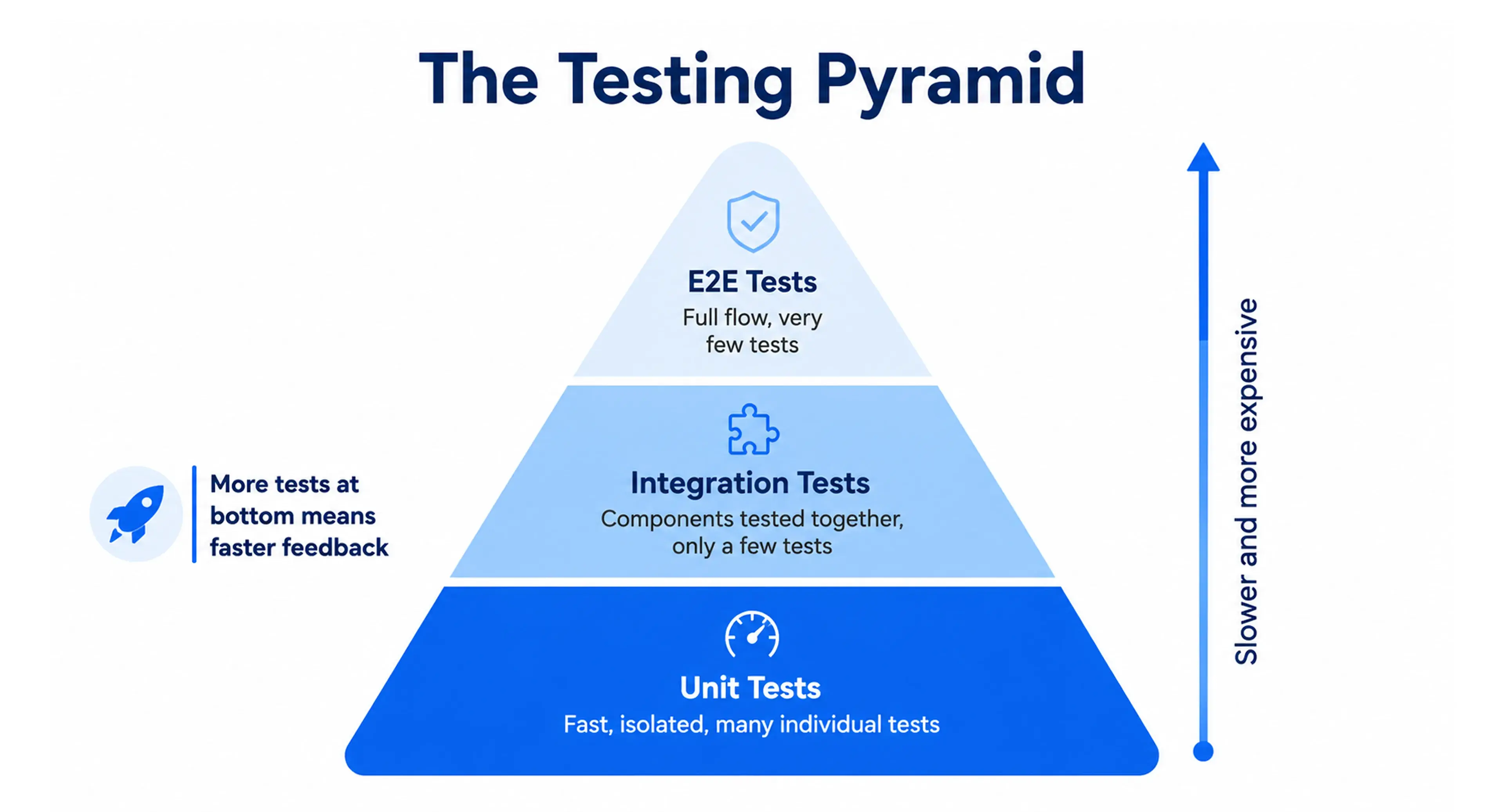
The test pyramid is a resource allocation model. Unit tests run in milliseconds. End-to-end tests require a live environment, real data, and a browser - and they slow continuous integration to a crawl when overused.
A sustainable ratio: 70% unit tests, 20% integration tests, 10% end-to-end tests. For API-heavy microservices with a thin UI surface, shift to 60/30/10. Avoiding the inverted pyramid - where end-to-end tests dominate, CI takes 45 minutes, and engineers batch commits to skip the wait - matters more than hitting exact percentages.
According to the Stack Overflow Developer Survey, slow CI consistently ranks among the top developer productivity friction points. A 40-minute pipeline changes behaviour in ways that compound over months.
Picking the Right Automation Framework Per Layer
Not every layer needs the same tool. The right test automation framework depends on your stack, CI/CD integration capability, and execution time targets - not on what's trending.
One workflow worth implementing early: import your OpenAPI specification into Postman, auto-generate a collection, and run it via Newman in CI. Postman API testing coverage then grows with the API surface - not six months behind it.
Shift-Left Gates and CI/CD Pipeline Testing Best Practices
Shift-left only delivers value when test gates are mapped to the right pipeline stages. Without that mapping, teams move tests earlier but catch defects just as late.
What Shift-Left Testing Actually Changes in the Pipeline
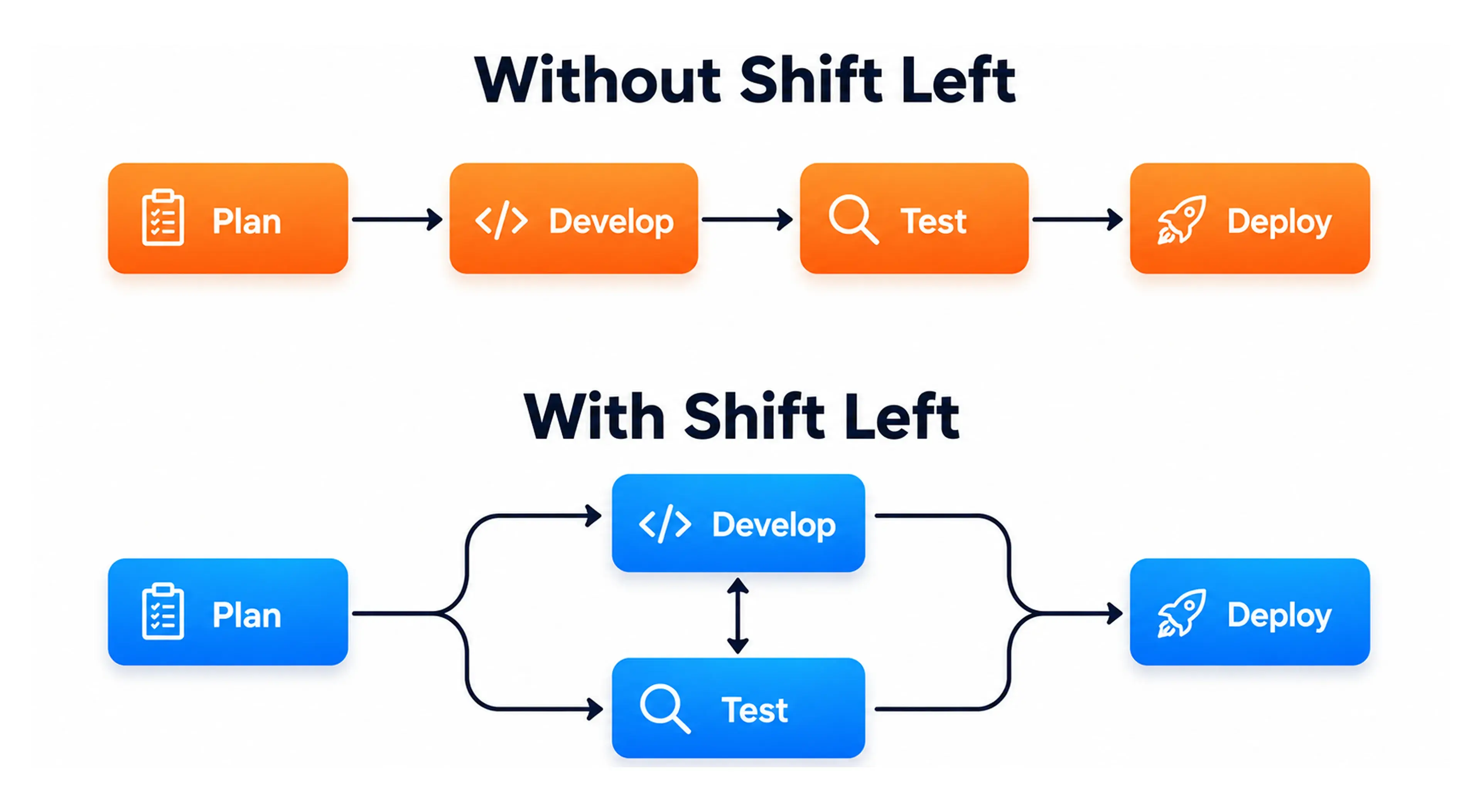
Shift-left testing strategy means mapping specific automated tests to specific deployment pipeline stages and enforcing them as blocking gates in continuous integration.
Stage-to-test mapping for CI/CD pipelines:
- Pre-commit: linting, type checking, unit tests for changed files
- Pull Request gate: unit suite plus integration tests for affected modules
- Merge gate: full integration suite plus contract tests and acceptance tests
- Pre-deploy: regression testing suite plus API smoke tests
- Post-deploy: observability checks, synthetic monitoring
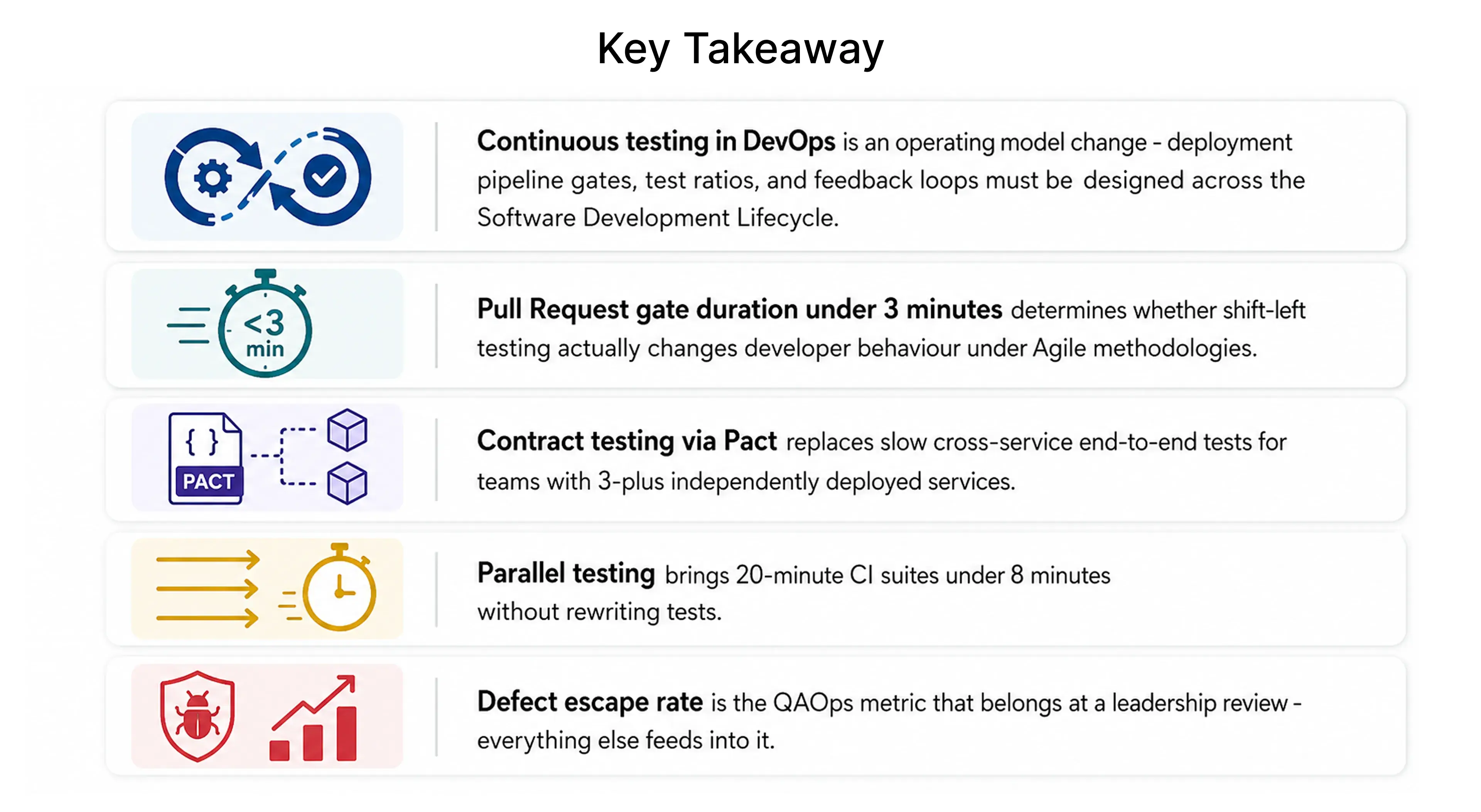
If Pull Request gates exceed 3 minutes, developers stop waiting - they batch commits or push without reviewing results. The shift-left benefit reverses. Under 3 minutes is the target; under 90 seconds is achievable with parallel testing.
Parallelisation and Flakiness as Pipeline Health KPIs
GitHub Actions matrix builds, and Jenkins parallel stages reduce pipeline duration by 60 to 70% on test suites of 200-plus tests - often bringing a 20-minute suite under 8 minutes without changing a single test.
Flakiness is more insidious. A test that fails intermittently has stopped carrying signal. Based on internal benchmarks from teams we have audited, investigating spurious CI failures without a flakiness policy costs 4 to 6 hours per engineer weekly.
Four KPIs for engineering managers to track:
- Defect escape rate - defects found in production vs. caught in pipeline
- CI pipeline duration trend - week-on-week, not point-in-time
- Flakiness rate per test - above 5% triggers quarantine and triage
- MTTD for integration failures - mean time to detect, not fix
These four KPIs tell you whether your software delivery pipeline is healthy. Everything else is noise.
Environment Strategy, API Testing, and System Integration Testing
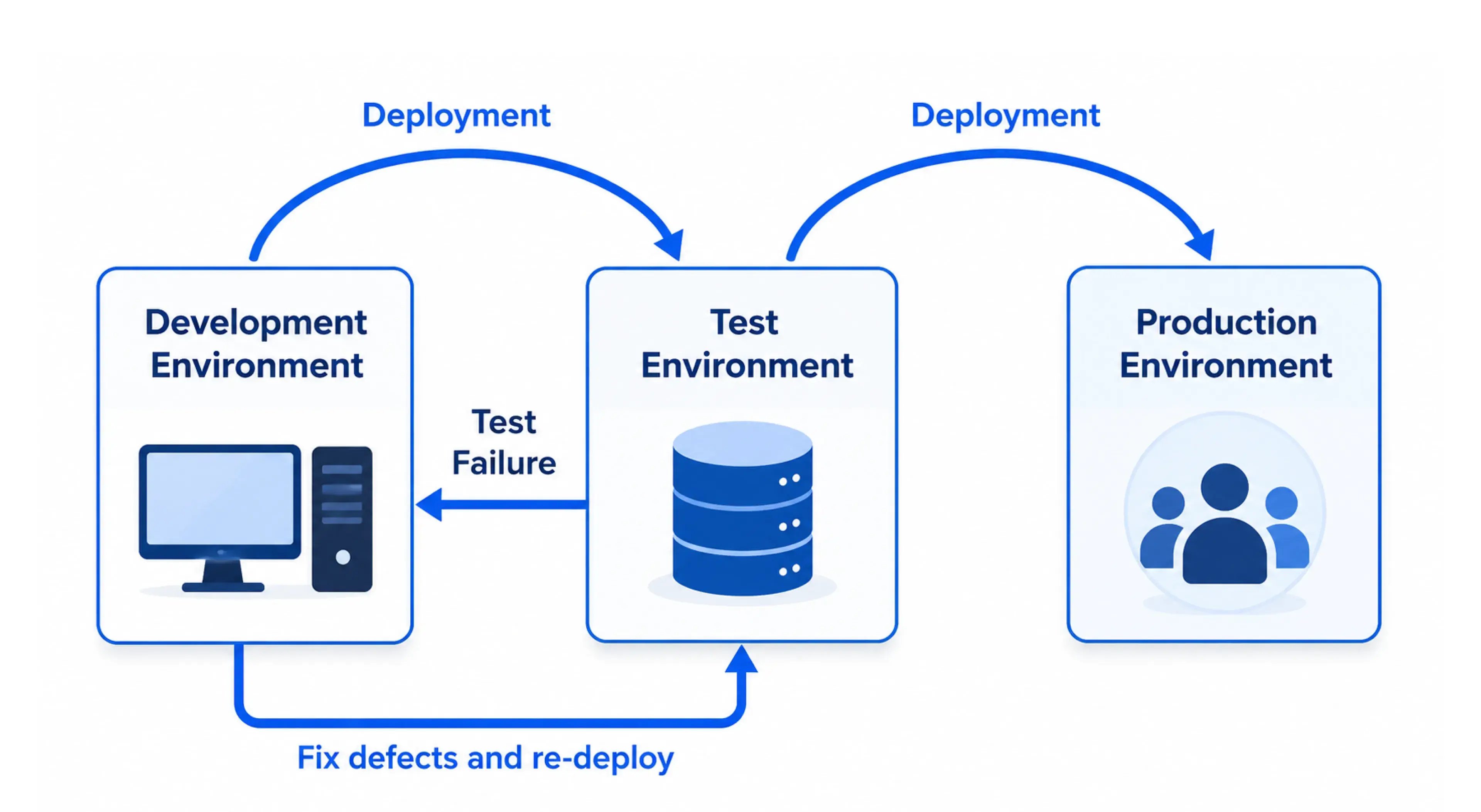
Most CI failures that escape into production trace back to environment mismatches, not bad code. Getting this layer right is what separates a reliable pipeline from a fragile one.
Sandbox Testing and Environment Parity - Where CI Confidence Breaks Down
A QA engineer we worked with put it precisely: "Our automated tests pass in CI because CI is nothing like production." Config drift, data mismatches, stale mocked contracts - these are the reasons a green CI build does not mean a stable deployment.
Three test environment options:
- Shared staging: lowest cost, highest flakiness risk; suitable for teams under 10 engineers
- Ephemeral environments per Pull Request branch: higher cost, lower collision risk; right for 3-plus independently deploying services
- Service virtualisation: replaces third-party dependencies with contract-compliant stubs; essential when external APIs have no sandbox testing environment
Contract Testing and API Testing as System Integration Test Replacements
System integration testing in a live environment is slow and expensive. Consumer-driven contract testing via Pact replaces most of it - each service publishes what it expects, and each dependency verifies that contract on every build, without a live multi-service environment.
Across 40-plus engineering teams we have worked with, contract tests replace the majority of slow cross-service end-to-end tests for teams with three or more independently deployed services, cutting integration suite duration by 40 to 60%.
Performance Testing and Observability as the Final Pipeline Gates
Performance and observability are not post-release concerns. In a mature QAOps pipeline, they are blocking gates - the last line of defence before continuous deployment reaches users.
Where k6 and Load Testing Belong in a Continuous Testing Pipeline
Performance tests do not belong on every commit. The placement model for continuous deployment:
- Smoke test (k6): every pre-deploy to staging; 10 virtual users, 60 seconds, verifies critical paths under minimal load
- Load test: nightly or pre-release gate for significant features
- Stress test: before major releases or infrastructure changes
Threshold rule: set p95 latency at production baseline plus 20% as a hard pipeline gate - not a monitoring alert. A 400ms production p95 means a 490ms pre-deploy result should block the release.
Closing the Loop with Observability Monitoring
Production observability and monitoring is the last test gate in QAOps. For each production incident category - latency regression, API error spike, failed transaction rate - identify which pipeline stage should have caught it. If nothing in the pipeline would have caught it, that is the next test layer to build.
Defect escape rate is the one metric worth presenting at a leadership review. A QAOps investment that meaningfully reduces defect escape rate translates directly to lower incident response cost and faster release cycles across software enterprises. That is the ROI case for a CTO or VP of Engineering.
How Frugal Testing Builds Your QAOps Pipeline - End to End
Here is what an 8-week QAOps build looks like in practice - from test suite audit through to a fully handed-over, production-ready continuous testing pipeline.
Most engineering teams lack QAOps architecture expertise between sprints. Building a continuous testing pipeline while shipping product costs more than it saves - in engineering hours, deferred incidents, and test debt accumulated when test automation framework decisions are made reactively.
We design, build, and hand over fully integrated qa automation services pipelines for software enterprises across the US. A working pipeline with runbooks and a KPI dashboard - not a consulting report.
What Our QAOps Engagement Looks Like
- Weeks 1 to 2: Audit of test suites, CI/CD pipeline config, and test environments. Deliverable: gap analysis and architecture plan.
- Weeks 3 to 4: Test automation framework built and wired into Pull Request and merge gates. Continuous integration running unit and integration suites as blocking checks.
- Weeks 5 to 6: Postman/Newman API testing, Pact contract tests, and sandbox testing environment configuration. Exploratory testing coverage mapped.
- Weeks 7 to 8: k6 performance gates, monitoring and observability hooks, AI-powered testing instrumentation, full documentation, and handover.
Target outcomes: Pull Request gates under 10 minutes, flakiness below 3%, shift-left gates blocking defects before merge.
Who This Is For
- Engineering teams shipping weekly or more who still run a manual testing phase before each release.
- Teams with CI/CD pipelines running 30-plus minutes - a reliable indicator of an inverted pyramid.
- Startups and scale-ups between 20 and 200 engineers who have outgrown their initial test automation approach but lack a dedicated QAOps architect
Conclusion
QAOps is not a new tooling category. It is the recognition that deployment frequency and software quality are the same problem - and solving it requires a continuous testing operating model, not a better test automation tool.
The decisions you make now - which automated tests gate which stages, how the test pyramid is weighted, whether observability maps back to pipeline coverage - determine your test debt for the next three years. Teams that build this deliberately ship with confidence. Teams that bolt test suites onto a software delivery pipeline never designed for them keep solving the same incidents with different names.
People Also Ask (FAQs)
Q1. What is QAOps and how is it different from DevOps?
Ans: QAOps is the quality assurance operating model inside DevOps. It defines how automated tests run as deployment gates throughout continuous integration and continuous delivery, not as a separate testing phase.
Q2. How long should a CI/CD test pipeline take to run?
Ans: Pull Request gate: under 3 minutes. Merge gate: under 10 minutes. Pre-deploy: under 20 minutes. Longer durations signal an inverted test pyramid or a missing parallel testing configuration.
Q3. What is the difference between shift-left testing and continuous testing?
Ans: Shift-left defines placement - moving test gates earlier in deployment pipelines. Continuous testing ensures automated tests execute at every stage. One describes where; the other describes how consistently.
Q4. When should we add performance testing to the CI/CD pipeline?
Ans: When deploying weekly or more with any endpoint handling 500-plus concurrent users. Start with a k6 smoke test with a p95 latency threshold on your three most critical user flows.
Q5. What metrics show that a continuous testing pipeline is working?
Ans: Track defect escape rate, CI pipeline duration trend, flakiness rate per test, and MTTD for integration failures. Defect escape rate is the metric that belongs in a leadership-level review.