

Digital messaging has become a core part of modern communication, shaping how individuals, communities, and institutions exchange information. Over time, messaging platforms have prioritized global reach, speed, and ease of use. However, this evolution has also introduced structural trade-offs that affect privacy, resilience, and user autonomy. As awareness around surveillance, centralized control, and network fragility grows, researchers are increasingly questioning whether current messaging architectures truly serve long-term communication needs.
- Widespread reliance on centralized servers creates single points of failure
- Metadata collection enables large-scale surveillance and behavioral profiling
- Internet-dependent systems fail in low-connectivity or restricted environments
- Users have limited visibility into how messaging platforms handle their data
Bitchat emerges in response to these challenges by revisiting peer-to-peer and offline-first communication principles. By shifting control back to users and minimizing dependence on centralized infrastructure, it reflects a broader movement toward resilient and privacy-preserving messaging systems. Understanding this shift requires examining how messaging technologies evolved and why decentralized alternatives are gaining renewed attention today.
The Evolution of Messaging Technologies
The technological and political environment has influenced the development of messaging systems. Each transition from early internet protocols through mobile platforms marks a distinct evolution within the realm of messaging architecture that illustrates competing values of scale versus control; privacy versus resilience; etc. These very important lessons will provide context for why peer-to-peer and offline-first solutions, such as Bitchat, are receiving renewed interest from researchers and practitioners alike.
Related: research on the evolution of digital messaging architectures
From Centralized to Decentralized Systems
Traditionally, the structure of digital messaging has been centrally organised. When a user sends a message, that message travels from the sender's device to a server where it is processed and stored before being delivered to the end-user. While applications such as WhatsApp and other Social Media platforms allow users to communicate in real time at scale, they also create vulnerabilities that weaken messaging systems. The existence of centralised messaging servers increases the likelihood that these servers will become both:
- Points of failure for the messaging system
- Targets of practical surveillance as well as places where information about individual user behaviours (e.g., contact lists, location history) are stored
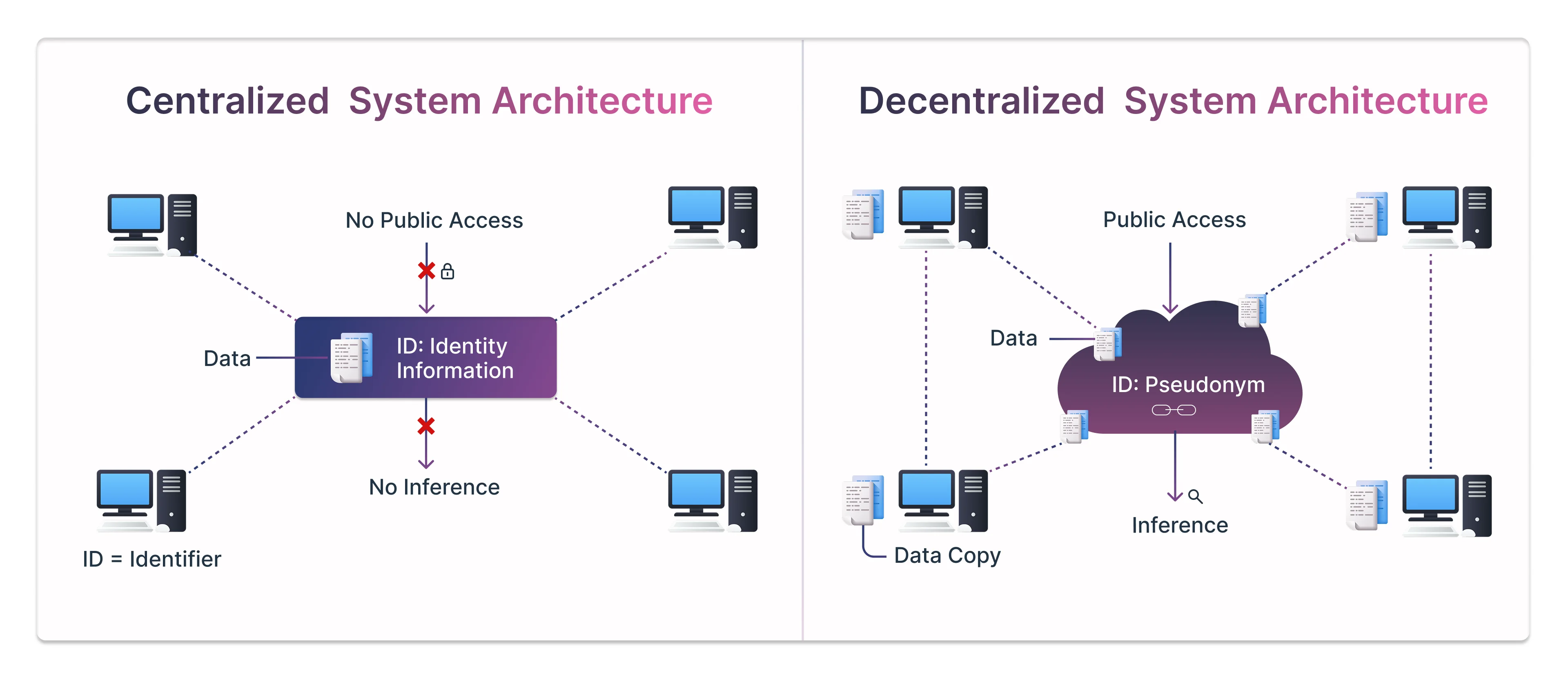
In addition, by centrally storing the metadata of users, companies have created new opportunities for abuse (surveillance) as a result of their ability to use the metadata they collect on users. As well, centralised messaging platforms create significant risk to users because when an outage or significant problem occurs within the messaging system, the entire network is rendered unusable. Finally, because users cannot be certain about how companies will use or apply their rights, many users are losing faith in the very companies that provide messaging services.
Related: documented risks of centralized messaging platforms
The Rise of P2P and Serverless Messaging
The idea of peer-to-peer messaging allows users to communicate directly with each other rather than through a centralized server. This new type of messaging application uses P2P networks to allow devices to communicate without the use of a central server. P2P messaging uses various methods for device discovery, such as local Bluetooth clusters, WiFi Direct, and peer-discovery. The serverless model of messaging applications is very similar to the offline-first principles of application development.
- Devices connect directly using Bluetooth LE, WiFi Direct, or mesh networking
- Messages propagate via multi-hop communication across a mesh topology
- Store and forward techniques allow delayed delivery without internet connectivity
- Local Bluetooth mesh networks reduce dependency on cloud infrastructure
This shift mirrors trends seen in blockchain and cryptocurrency communities, where decentralized protocols replaced trusted intermediaries. Much like Bitcoin challenged centralized finance, decentralized messaging protocols challenge platform-controlled communication. For researchers, these systems offer a living laboratory for studying resilience, intelligent message routing, and cryptographic techniques under real-world constraints.
Related: research on peer-to-peer network design
Understanding Bitchat
Bitchat represents a return to the roots of networking by focusing on direct connections between devices, rather than relying on a centralized foundation to facilitate device communications. To fully appreciate the impact of Bitchat, it is important to evaluate the design choices, network architecture, and foundation of cryptography, in addition to examining the potential of Bitchat in the marketplace.
Key Features of Bitchat
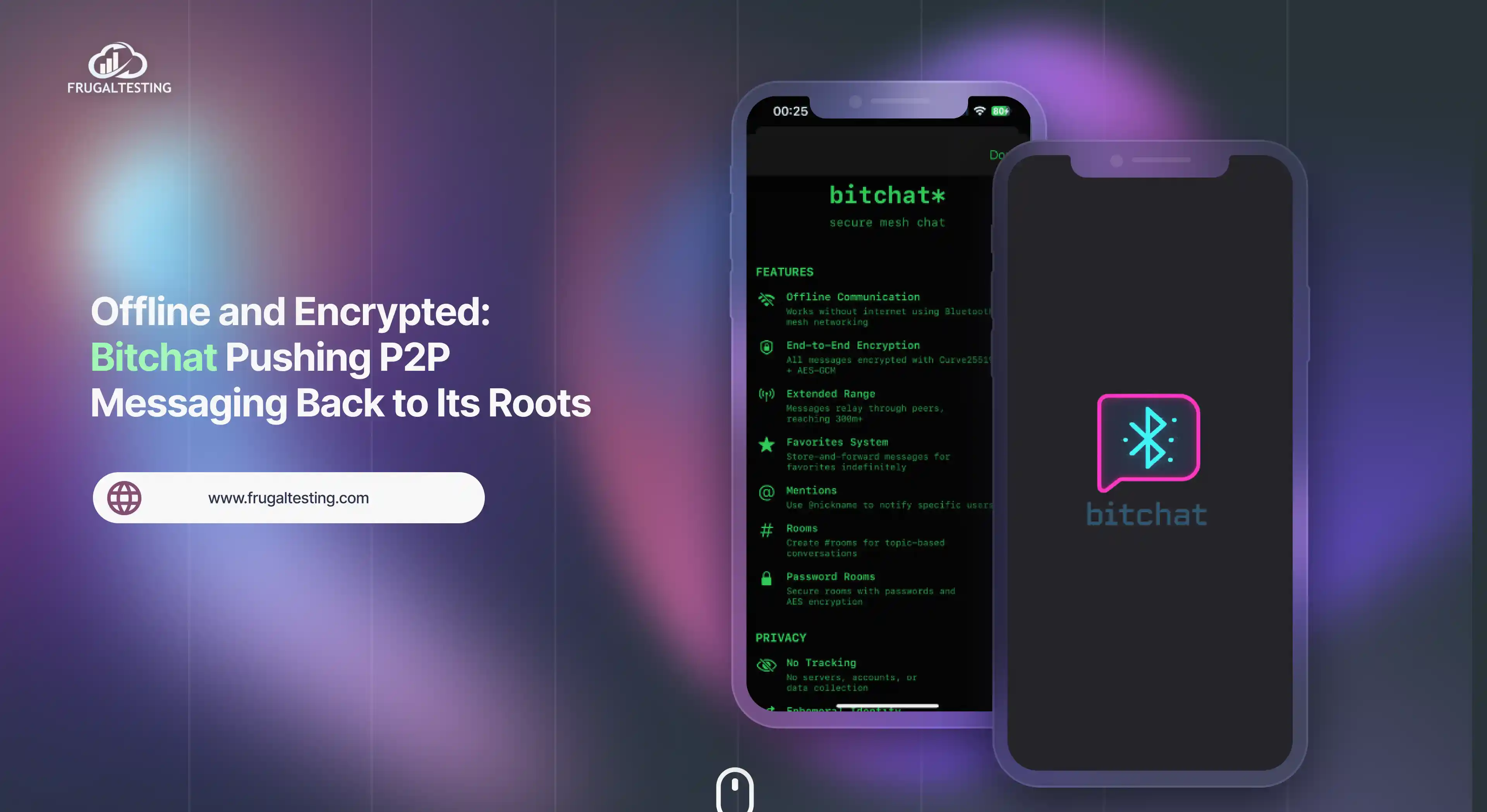
Bitchat is positioned as a peer-to-peer messaging app designed for privacy, resilience, and offline communication. Emerging from privacy-focused developer circles and often associated with ideas championed by Jack Dorsey, Bitchat reflects a broader push toward decentralized communication beyond traditional platforms like Twitter.
- Fully offline communication using Bluetooth Low Energy and WiFi Direct
- End-to-end encrypted sessions with modern encryption models
- Group chats supported without centralized servers
- Minimal metadata exposure and no persistent user identities
The project, shared through a whitepaper and early TestFlight builds on iOS, has attracted security experts, activists, and researchers interested in surveillance-resistant communication. By focusing on accessibility and low-power protocols like Bluetooth LE, Bitchat aims to function where connectivity is limited or intentionally restricted. This makes it relevant not only for protesters and activists, but also for healthcare, retail, and smart buildings operating in constrained environments.
Bitchat’s Network Architecture
At its core, Bitchat relies on a mesh network architecture built around Bluetooth LE Mesh Networking and WiFi Direct. Each device acts as both client and relay node, forming a self-healing mesh topology. Messages move through the network using intelligent message routing rather than fixed paths.
- Dual Transport Architecture combining Bluetooth LE and WiFi Direct
- Multi-hop communication enables wider coverage without internet access
- Relay network behavior adapts dynamically as nodes join or leave
- Local clusters can bridge to larger networks when possible
This design resembles research prototypes seen in LoRaWAN, Waku, and Arti, but optimized for consumer mobile devices running Android (API 26+), iOS, and macOS. From a systems perspective, Bitchat demonstrates how decentralized messaging protocols can balance energy efficiency, latency, and resilience. Researchers examining mesh poisoning, Sybil attacks, and network partitioning will find Bitchat’s architecture particularly instructive.
The Role of Cryptography in Bitchat
Cryptography underpins every layer of Bitchat. The application uses well-established primitives from the Noise Protocol Framework to secure peer-to-peer messaging. Rather than inventing new cryptography, it composes proven components.
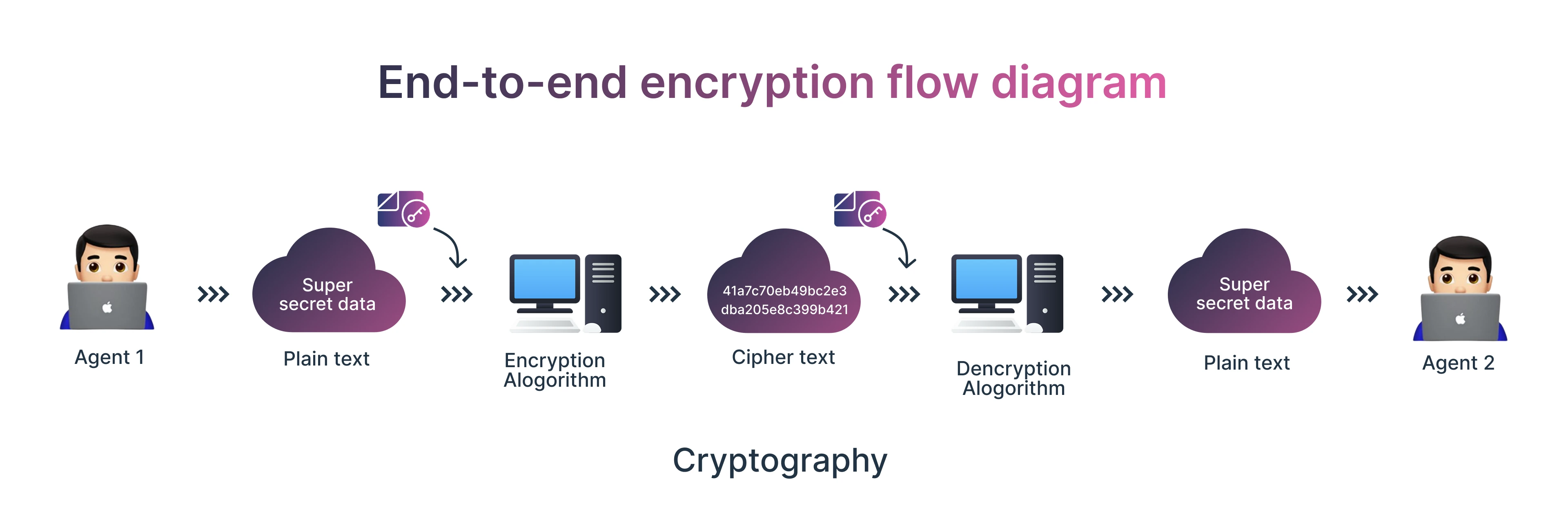
- Key exchange via X25519 and Curve25519
- Message encryption using AES-256-GCM / AES-GCM
- Identity signatures with Ed25519
- Noise Protocol and NIP-17 inspired session handling
These cryptographic key pairs enable end-to-end encryption while limiting metadata leakage. Cover traffic and session-based identifiers help obscure communication patterns, a critical defense against surveillance. For researchers, Bitchat offers a practical case study in applied cryptography, demonstrating how theoretical encryption models behave in mobile, resource-constrained environments.
Advantages of Offline and P2P Messaging
Offline and peer-to-peer messaging systems challenge many assumptions built into modern internet applications. By removing constant connectivity and centralized servers from the equation, these systems introduce new advantages that are particularly relevant for researchers studying privacy, resilience, and communication under constrained or adversarial conditions.
Ensuring Privacy and Anonymity
Offline peer-to-peer messaging changes the privacy equation. Without central servers, there is no single point collecting metadata or enforcing identity linkage. This aligns with decentralized platforms like Nostr protocol and apps such as Damus.
- Reduced metadata exposure compared to centralized apps
- No account-based user identities required
- Resistance to mass surveillance and traffic analysis
- Strong alignment with privacy research goals
For activists and journalists operating under surveillance, these properties are not theoretical benefits but operational necessities. From an academic standpoint, Bitchat provides empirical grounding for long-standing claims about decentralized communication improving user privacy.
Resilience without Internet Connectivity
One of Bitchat’s defining strengths is resilience. In environments where connectivity is unreliable or intentionally disrupted, offline communication becomes essential.
- Functions during internet shutdowns or disasters
- Supports off-grid communication via Bluetooth LE Mesh
- Store and forward enables delayed message delivery
- Suitable for conflict zones and emergency response
Researchers studying disaster response, satellite backhaul integration, or hybrid systems combining Satellite links with mesh networks can use Bitchat as a reference model. It demonstrates how decentralized software can maintain continuity when centralized networks fail.
Field Coordination and Real-World Applications
Beyond activism, offline P2P messaging has practical applications across industries.
- Healthcare teams coordinating inside large facilities
- Retail staff communication without relying on cellular data
- Smart buildings and IoT coordination
- Hackathon submissions and field research projects
By integrating with mapping tools like Organic Maps, OsmAnd, or MapLibreGL using geohash coordinates and PMTiles, Bitchat-style systems could support location-aware coordination without exposing geolocated data. This opens new research avenues at the intersection of accessibility, resilience, and decentralized apps.
Challenges in P2P Messaging Technologies
Despite their promise, peer-to-peer messaging technologies are not without significant challenges. Technical constraints, security risks, and governance questions complicate real-world deployment and adoption. A balanced analysis requires acknowledging these limitations alongside the benefits, especially from a research and systems-design perspective.
Privacy Concerns and Security Risks
While decentralized messaging improves privacy, it introduces new risks. Mesh networks are vulnerable to Sybil attacks, mesh poisoning, and malicious relay nodes.
- Lack of centralized moderation complicates abuse prevention
- Relay nodes may attempt traffic analysis
- Peer discovery can expose presence information
- Cryptographic misuse can undermine guarantees
These challenges require careful protocol design and ongoing security research. Bitchat’s open discussions around source code and threat models make it valuable for academic scrutiny.
Technical Limitations and User Adoption
P2P messaging also faces adoption barriers. Bluetooth LE bandwidth is limited, and multi-hop routing increases latency.
- Slower delivery compared to cloud-based apps
- Battery consumption concerns
- Complex UX for non-technical users
- Platform constraints on iOS, Android, and App Store policies
Researchers in human-computer interaction and mobile app development can study these constraints to improve usability without compromising decentralization.
Navigating Legal and Ethical Issues
Decentralized messaging raises legal and ethical questions. Without central control, compliance with regulations becomes ambiguous.
- Jurisdictional challenges across regions
- Ethical use by protesters versus criminal misuse
- Balancing free expression and harm prevention
- Policy responses from governments and platforms like Meta
These issues highlight the need for interdisciplinary research combining law, ethics, and distributed systems.
Bitchat's Place in the Digital Ecosystem
Bitchat sits at a fascinating junction within the broader digital ecosystem, wherein it challenges established norms around communication infrastructure through its radical departure from centralized systems. By offering offline, peer-to-peer messaging capabilities, Bitchat underscores the potential of network resilience and user autonomy. This innovation not only reinvigorates the original intent behind P2P technology, often overshadowed by mainstream communication platforms but also prompts a reevaluation of messaging paradigms in the context of privacy and accessibility.
Comparing Bitchat with Traditional Messaging Apps
Compared to mainstream apps, Bitchat prioritizes resilience over convenience.
- No cloud backups or centralized servers
- Stronger resistance to censorship and outages
- Fewer features than feature-rich platforms
- Designed for niche but critical use cases
This trade-off positions Bitchat as complementary rather than competitive, filling gaps left by traditional messaging software.
Emerging Use Cases and User Scenarios
New scenarios continue to emerge as researchers experiment with decentralized messaging protocols.
- Field research teams sharing data offline
- Financial transactions coordination in fintech contexts
- Community networks in remote regions
- Integration with decentralized apps and blockchain systems
These scenarios underscore Bitchat’s relevance beyond activism, extending into enterprise and research domains.
Industry Perspectives and Influences
The resurgence of decentralized messaging is shaped not only by technology but also by ideology, industry leadership, and advocacy for digital rights. Examining the perspectives of industry leaders and privacy advocates provides context for why projects like Bitchat resonate with certain communities and research domains.
Insights from Industry Leaders
The ideas behind Bitchat echo long-standing positions held by leaders in decentralized technology. Figures associated with Block and Bitcoin communities have consistently argued for minimizing intermediaries in digital systems.
- Emphasis on user sovereignty
- Alignment with cryptocurrency and blockchain philosophies
- Skepticism toward data-hungry platforms
These perspectives shape how decentralized messaging evolves.
The Influence of Digital Privacy Advocates
Privacy advocates and security experts continue to influence adoption.
- Push for transparent cryptographic techniques
- Demand for open protocols and audits
- Focus on metadata minimization
The Future of Messaging with Bitchat
Their involvement ensures projects like Bitchat remain grounded in rigorous security principles.
As communication technologies continue to evolve, systems like Bitchat offer a glimpse into alternative futures that prioritize autonomy, resilience, and cryptographic trust. These shifts are not happening in isolation. They intersect closely with broader trends in software development, where decentralization, offline-first design, and privacy-by-default architectures are becoming increasingly relevant. For researchers and practitioners working within modern software development services and digital transformation services, Bitchat presents an opportunity to rethink how communication layers are designed as part of next-generation applications.
Exploring these potential impacts and innovations helps assess whether peer-to-peer, offline-capable messaging will remain niche or meaningfully influence mainstream communication paradigms across industries.
Potential Impacts on Communication Trends
Bitchat signals a broader trend toward decentralized communication models that are beginning to influence how software development companies approach system design.
- Increased interest in serverless messaging apps that reduce infrastructure dependency
- Greater focus on resilience and offline-first design in modern web development services
- Integration with decentralized protocols such as Waku and Nostr within experimental platforms
For researchers and teams at a software development company or AI development company, these trends suggest fertile ground for innovation, particularly where communication reliability and privacy are critical. As software development companies explore decentralized architectures, messaging layers like Bitchat may increasingly serve as reference implementations rather than standalone tools.
Innovations and Emerging Technologies
Future iterations of Bitchat-style systems may incorporate emerging transports and protocols that further expand their applicability across platforms and environments.
- Hybrid Bluetooth and Satellite routing to support extreme connectivity constraints
- Integration with LoRaWAN for long-range, low-power communication
- Advanced cover traffic techniques to further reduce metadata leakage
- Improved accessibility and UX across platforms supported by iOS app development companies and Android app development companies
At Frugal Testing, we view Bitchat as a compelling case study in decentralized messaging protocol design and applied cryptography. For researchers, it represents both a practical tool and a research platform. For organizations involved in software development, AI development companies, and broader digital transformation services, it highlights how communication infrastructure itself is becoming a critical layer of innovation—pushing peer-to-peer messaging back to its roots while opening new paths forward.
People Also Ask
Can messaging really survive without the internet?
Yes. Peer-to-peer and mesh-based systems enable devices to communicate directly using local connectivity, allowing messaging to function even when the internet is unavailable.
Are centralized messaging platforms becoming a single point of global risk?
Increasingly so. Centralized servers create choke points where outages, policy changes, or surveillance can disrupt communication for millions at once.
Is metadata more dangerous than message content?
Often, yes. Metadata can reveal communication patterns, relationships, and behaviors even when message content itself is encrypted.
Could mesh networks replace the internet for local communication?
Not entirely, but they can effectively supplement it by enabling resilient, infrastructure-independent communication within localized environments.
Why are privacy-focused tools often harder to use?
Because decentralization shifts complexity from centralized services to users and devices, making usability and seamless coordination harder to achieve without compromising security.