


Lyft’s ride-sourcing services operate across dense cities, sprawling suburbs, and multimodal transportation systems. To guarantee reliable rides at scale, Lyft, Inc. invests heavily in a modern testing ecosystem grounded in telemetry, simulations, and real-time data validation. This ensures accurate pricing, stable payment systems, and safe mobility services across electric bikes, shared scooters, and ride-hailing vehicles.
As urban planning evolves and the built environment changes, Lyft Urban Solutions supports transportation system growth, reduces traffic congestion, minimizes vehicle ownership dependency, and promotes smarter Mobility as a Service (MaaS).
To support millions of Lyft rides daily, the company combines load testing technologies, machine learning models, Apache Kafka–based data pipelines, autonomous vehicle research, and cloud-driven simulations. Lyft’s real-time testing system not only validates functional flows but also prevents fraud patterns, GPS spoofing, payment fraud, account takeovers, and other anomalies through advanced anomaly detection and digital monitoring systems.
The sections below break down Lyft’s testing architecture and how SimulatedRides is shaping the future of mobility engineering.
How Lyft’s Modern Testing Ecosystem Powers Reliable Rides
Lyft’s modern testing ecosystem is designed to ensure consistent performance—even under extreme peaks of public transit demand. The backbone includes:
- Cloud load testing for testing service reliability
- Website load testing tools to validate operational dashboards
- k6 load testing and JMeter-based load testing to simulate high-traffic events
- Apache Kafka integration for real-time event ingestion
- Machine learning technology for predictive maintenance, fraud detection, and route optimization
- Digital twins to mirror real-world scenarios
This multi-layered system provides Lyft engineers with a complete view of how apps, autonomous vehicles, and backend services behave under load.
Even elements like electric vehicle charging stations ,with their OCPP gateway , fast-charging networks, solar-powered components, and Pillar Charging Docks indirectly influence ride availability and are modeled in demand simulations.
The Importance of Real-Time Validation in Dynamic Ride Environments
Real-time validation is critical as urban conditions, traffic congestion, and rider behavior change constantly. Lyft ensures accuracy and reliability by leveraging SaaS application testing company solutions and cloud-based test automation services to monitor telemetry, validate ride flows, and detect anomalies instantly.
Lyft operates in an environment where trip route quality, rider safety, pricing, and ETAs depend on real-time data analytics. This is why real-time validation is crucial:
- Ride availability fluctuates dynamically with events, weather, and traffic.
- Vehicle miles traveled (VMT) shifts with demand surges.
- Public transportation delays or disruptions cause rapid spikes in Lyft requests.
- Shared autonomous vehicles and electric bikes introduce system complexity.
- Machine learning–driven predictions require constant validation against fresh data.
Real-time validation also helps detect anomalies like fraud patterns, GPS spoofing, or suspicious behavior-critical for maintaining trust in mobility services like Lyft and FREE NOW.
The Technology Backbone Behind Lyft’s Ride Testing Platform
Lyft’s testing ecosystem uses distributed systems, real-time telemetry, load testing, and simulation engines, connecting directly to:
- Autonomous vehicle platforms: Validated using LLM machine learning to improve safety and decision-making.
- Electric bikes and scooters: Monitored through telemetry and AI machine learning models for performance and predictive maintenance.
- API gateways: Optimized and tested to handle high traffic, leveraging machine learning developments for anomaly detection.
- Kafka streaming services: Process real-time ride and vehicle data efficiently for both human-driven and autonomous rides.
- Machine learning pipelines: Continuously updated with the latest machine learning developments and AI machine learning techniques to enhance routing, demand forecasting, and anomaly detection.
Each component contributes to real-time reliability.
Telemetry Integrity & Live Data Verification
Telemetry refers to the automatic collection, transmission, and analysis of data from remote sources in real time. In the context of mobility platforms like Lyft, telemetry gathers continuous information from vehicles and the mobile app to monitor performance, safety, and system health.
Telemetry helps Lyft track GPS locations, speed, sensor data, and app interactions in real time. Engineers use k6 load testing to simulate high-demand scenarios and ensure system stability. JavaScript load testing are also applied to validate performance for both Lyft rideshare users and fully autonomous vehicles.

Telemetry is the foundation of Lyft’s operational intelligence. Lyft validates:
- GPS location accuracy
Ensures the Lyft rideshare app always knows the vehicle’s real-time position. Lyft validates GPS stability using cloud load testing, load testing SaaS, and load testing tools to handle city-scale demand.
- Speed and motion data
Tracks how fast the vehicle moves and detects stops or turns. This is vital for safe routing and validating fully autonomous vehicle behavior under load testing services.
- Sensor feeds from autonomous vehicle systems
Autonomous vehicles use sensors like lidar and cameras to detect surroundings. Lyft processes these feeds through Kafka Apache pipelines and tests reliability with cloud load testing.
- User interactions from mobile apps
Every tap or action in the app generates telemetry that helps improve performance and user experience. These flows are tested at scale using load testing SaaS platform
- Trip route continuity
Ensures every ride follows a clean, uninterrupted path from pickup to drop-off. Lyft validates route stability for both human drivers and fully autonomous vehicles using cloud load testing and load testing tools.
Telemetry ensures that Lyft’s mobility operations remain safe and stable. For ML models like random forest and LLM-driven machine intelligence, telemetry data is essential for training, anomaly detection, and forecasting-driven solutions.
Lyft uses Apache Kafka, Apache Flink, and streaming analytics to process telemetry at scale.
Scenario Modeling Through Advanced Ride Simulations
Lyft’s simulation ecosystem supports:
- High-density traffic simulation
- Weather-impacted road conditions
- Road closures
- EV battery depletion
- Surge pricing events
- Public transportation disruptions
Digital twins help simulate complex real-world mobility problems. These simulations allow testers to analyze trip failures, identify bottlenecks, and fine-tune operational costs.
They also support autonomous vehicle companies by providing a controlled environment to validate self-driving behavior.
High-Impact Ride Scenarios Lyft Tests Daily
Lyft tests a variety of high-impact ride scenarios to ensure reliability under real-world conditions, including peak-demand surges, traffic congestion, and public transit disruptions. Engineers use functional testing services to validate ride flows, pricing, and payment logic.
They also leverage open source load testing tools to simulate thousands of concurrent rides, ensuring the system remains stable for both human-driven and fully autonomous vehicles. These tests help maintain accurate ETAs, route precision, and rider safety across all mobility services.

Peak-Time Demand Pressure Testing
Peak-time demand pressure testing focuses on ensuring Lyft can handle sudden spikes in ride requests during commuter rush hours, transit breakdowns, or large public events. These scenarios often create unpredictable surges that stress both backend systems and ride-matching algorithms.
To validate this, Lyft uses large-scale simulations that recreate real-world demand bursts, including morning/evening commute loads and event-driven spikes. Kafka-based streaming replays real historical traffic patterns, allowing engineers to measure response times, system stability, and matching performance under extreme pressure.
Route Precision & Real-World ETA Validation
Route precision testing ensures that Lyft delivers accurate navigation and reliable ETA predictions under diverse real-world conditions. This includes handling GPS drift, route changes, and varying city layouts that can affect navigation quality. Reliable route optimization also depends on testing how routing systems respond to traffic congestion, GPS drift, route changes, city layouts, and real-time ETA updates.
For validation, Lyft runs tests across different geographic environments, simulates poor GPS zones, and evaluates machine-learning ETA models against real trip data. Continuous real-time failure detection flags deviations so ETA accuracy remains stable even in dense downtown areas or low-signal regions.
Stable Payments, Pricing Logic & Billing Accuracy
Payment and pricing validation ensures that every trip is billed correctly, surge pricing behaves as expected, and fraud is detected proactively. Since pricing errors can lead to losses and customer dissatisfaction, this system must remain extremely accurate.
To validate this, Lyft runs regression tests on pricing engines, monitors for anomalies, and applies machine-learning models to detect fraud and inconsistent charges. Functional checks verify stable payment flows, correct fare calculation, and alignment with surge pricing rules across all regions.
How SimulatedRides Is Transforming Lyft’s Testing Strategy
SimulatedRides is Lyft’s next-generation testing framework designed to recreate real-world mobility conditions at scale. It generates synthetic ride requests, traffic patterns, driver behaviors, and city-level scenarios so engineers can test features without relying on live trips.
By running thousands of automated simulations, SimulatedRides helps Lyft validate ride-matching, routing, ETAs, pricing logic, and system stability under controlled but realistic conditions. This framework enables faster testing cycles, safer experimentation, and more reliable performance across both human-driven and autonomous fleets.
The Four Core Concepts: Simulations, Clients, Actions & Behaviors
SimulatedRides is built around four elements:
- Simulations: city-scale test environments
- Clients: real devices like smartphones, electric bikes, scooters
- Actions: riders requesting, canceling, paying for trips
- Behaviors: realistic multi-minute or multi-hour ride activity patterns
This structure makes it ideal for testing ride-sourcing services in realistic scenarios.
Clients as Real Devices in Lyft’s Service Mesh (Apps, Bikes & More)
In Lyft’s ecosystem, a “client” refers to any device or interface that interacts with the platform—including the rider app, driver app, electric bike onboard systems, and autonomous vehicle (AV) sensor hubs. Treating all of these as real clients ensures Lyft captures authentic behavior across different mobility modes.
By modeling each client type within the service mesh, Lyft can accurately replicate how users, vehicles, and edge devices communicate in real time. This approach helps engineers test request patterns, connectivity issues, and device-level interactions, resulting in a more reliable and unified mobility experience.
Auto-Scaling Simulations to Match Real-World Demand
Lyft auto-scales its simulations to mirror real-world demand patterns, from quiet hours to extreme peak surges. This ensures backend systems, matching services, and routing engines are tested under the same load they experience in live operations.
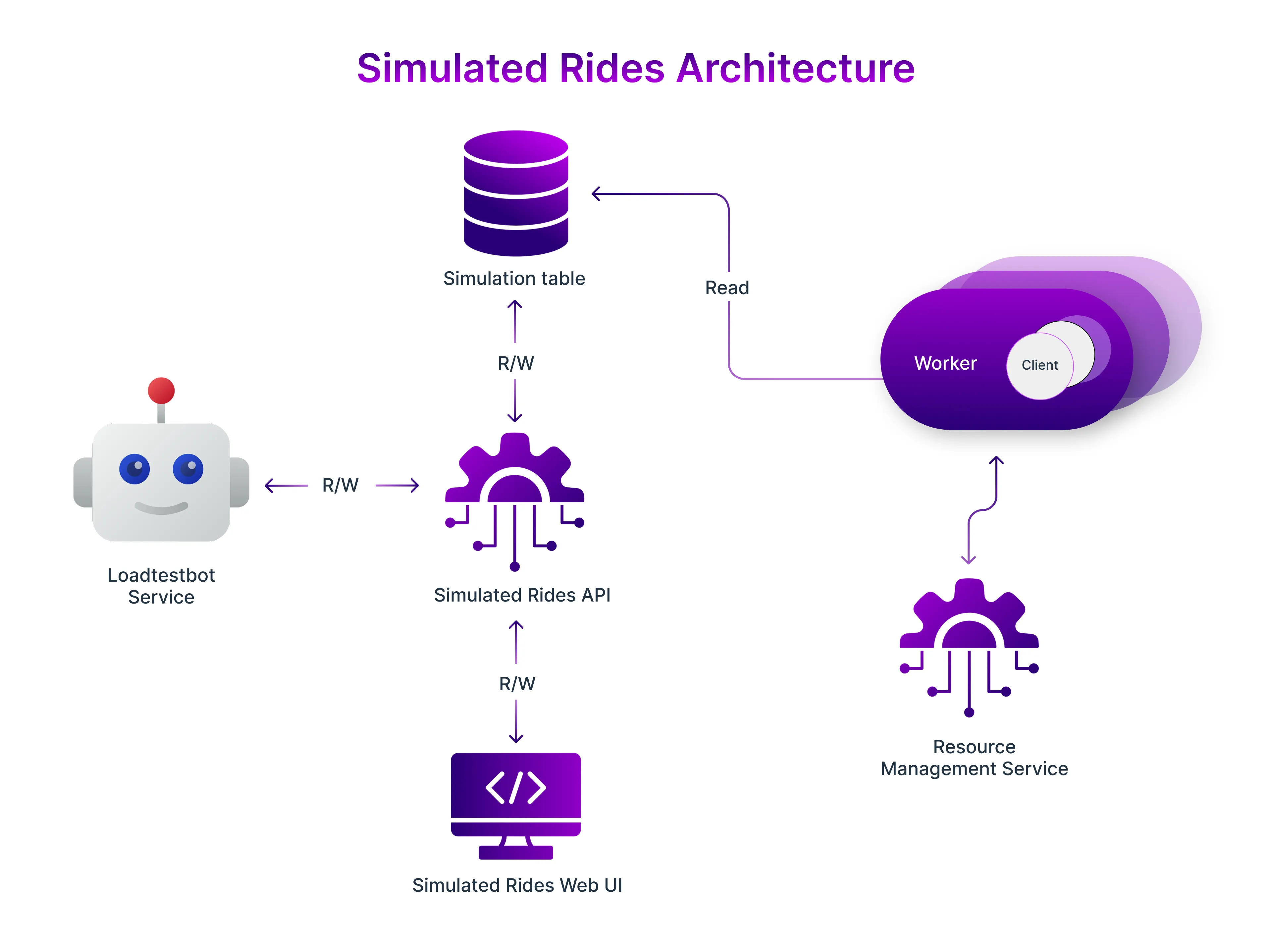
SimulatedRides automatically scales based on:
- traffic congestion levels
- public transit delays
- event-driven mobility surges
- seasonal patterns
Cloud scaling ensures tests remain accurate even when modeling millions of mobility events.
Toward a Fully Automated Future with SimulatedRides
Lyft aims to make SimulatedRides completely automated, enabling:
- end-to-end scenario creation
- autonomous vehicle testing
- real-time stress tests
- ML model validation
- predictive maintenance simulations
This reduces manual testing effort and accelerates mobility innovation.
Challenges of Maintaining Accuracy in Live Ride Testing
Maintaining accuracy in live ride testing is challenging due to unpredictable traffic, GPS drift, and fluctuating rider behavior. Lyft addresses these issues by collaborating with top software testing service providers to ensure telemetry, autonomous vehicle systems, and app interactions remain reliable and consistent..
Lyft faces several challenges:
- Unpredictable urban planning impacts: Sudden changes in city infrastructure or traffic layouts that affect ride routes.
- Inconsistent rider behavior: Variations in how riders request, cancel, or interact with rides that impact system predictions.
- GPS spoofing or signal degradation: Interference or loss of GPS accuracy affecting vehicle tracking and navigation.
- Fraudulent activities: Unauthorized actions such as payment fraud or account takeovers that compromise system security.
- Rapidly changing built environments: Urban developments, construction, or new structures that influence navigation and routing.
- Integrating autonomous vehicles: Challenges in incorporating fully autonomous vehicles safely into existing mobility networks.
- Rising operational costs: Increased expenses for fleet management, maintenance, software, and infrastructure.
Testing must constantly evolve to address these complexities.
What’s Next for Lyft’s Intelligent Ride Testing Framework
Lyft plans to expand its testing ecosystem with more advanced load testing service integrations, enabling real-time validation of rides, autonomous vehicle safety models, and electric vehicle operations. Future developments will include enhanced machine learning AI systems, predictive maintenance, and digital twins for multimodal city simulations to ensure safe and efficient urban mobility.
Lyft will expand:
- Digital twins for multimodal city simulations help model real-world traffic and public transit interactions.
- Machine learning AI systems optimize routing, ETA predictions, and anomaly detection.
- Predictive maintenance identifies potential vehicle or system failures before they happen.
- Fraud detection systems monitor for payment fraud, account takeovers, and unusual trip patterns.
- Autonomous vehicle safety models validate AV behavior under complex urban scenarios.
- Charging station networks modeling ensures efficient electric vehicle deployment.
Future platforms will unify Lyft cars, shared scooters, shared autonomous vehicles, and electric bikes into a cohesive Mobility as a Service system.
Final Thoughts
Lyft continues to reinvent mobility through engineering excellence, real-time data, and simulation-driven testing. From website load testing to Apache Kafka to machine learning and autonomous vehicle systems, the company is building a resilient mobility platform capable of supporting millions of daily rides.
Cities are moving toward sustainable mobility, less vehicle ownership, and integrated transportation systems. Lyft's advanced ride-testing framework ensures the mobility infrastructure is reliable, safe, and efficient for future urban transportation.
Lyft’s commitment to innovation ensures its systems evolve alongside the rapidly changing transportation landscape. By integrating digital twins, predictive analytics, and autonomous vehicle testing into its core workflows, Lyft strengthens the reliability of every ride—from shared scooters to fully autonomous fleets. As mobility networks expand and cities adopt smarter infrastructure, Lyft’s intelligent testing framework positions the company to deliver seamless, safe, and scalable transportation for the next generation of urban travelers.
Frequently Asked Questions
1: What is real-time ride testing at Lyft?
Real-time ride testing ensures that Lyft’s system can handle live traffic, rider requests, and vehicle operations simultaneously. It validates ride matching, ETA predictions, pricing, and safety for both human-driven and autonomous vehicles.
2: How does Lyft use simulations in testing?
Lyft uses large-scale simulations, called SimulatedRides, to model city traffic, rider behavior, and vehicle performance. These simulations help engineers test extreme scenarios without affecting actual rides.
3: Why is telemetry important for Lyft rides?
Telemetry tracks GPS location, speed, sensor data, and app interactions in real time. This data ensures accurate routing, safe rides, and reliable operation of electric bikes, scooters, and autonomous vehicles.
4: What technologies support Lyft’s testing framework?
Lyft uses tools like Apache Kafka for streaming data, machine learning pipelines for predictions, and load testing frameworks such as k6 and JMeter to ensure system stability under heavy demand.
5: How does Lyft prevent fraud during rides?
Fraud detection layers monitor payments, account activity, and unusual trip patterns. The system can flag suspicious behavior, preventing payment fraud, account takeovers, and other security issues.