

The best enterprise sanity testing services combine automated CI/CD-integrated test suites with hybrid human coverage, delivering validation cycle times under 20 minutes and integrating natively with Jenkins, GitHub Actions, or Azure DevOps. They focus on critical workflow coverage, real-time reporting, and scalability across complex enterprise environments.
Enterprise applications carry the weight of business operations every single day. From processing financial transactions to managing healthcare records and running SaaS workflows, these systems cannot afford to break after a routine deployment. Yet that is exactly what happens when teams skip structured quality checks. Research by the National Institute of Standards and Technology (NIST) found that software defects cost the U.S. economy an estimated $59.5 billion annually, with a significant portion of that cost driven by defects found late in the release cycle rather than during development. That gap is exactly where sanity testing delivers its greatest value.
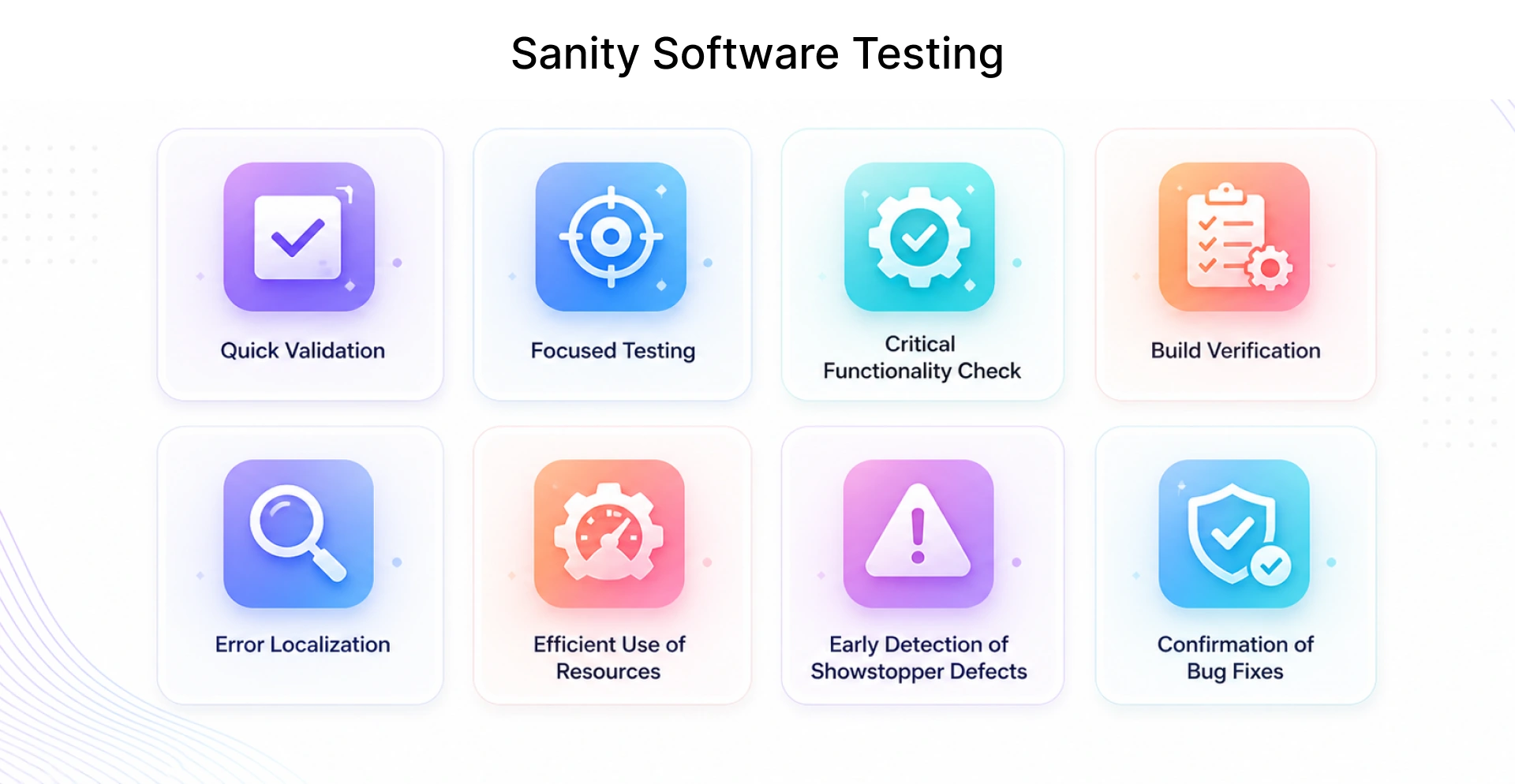
Sanity testing is a quick, targeted subset of software quality assurance. After a bug fix, patch, or minor code change, sanity testing confirms that the impacted area of the application still works as expected without requiring a full regression suite run. For enterprise teams operating under tight release windows, it serves as a fast, reliable sanity check before any build reaches production.
This guide covers everything QA engineers, CTOs, and DevOps leads need to know: what to expect from top sanity testing services, which tools leading providers use, how pricing works, and how to select the right partner for your enterprise.
What Enterprises Expect from Sanity Testing Services
Enterprise teams evaluate QA and testing services differently from small development teams. The stakes are higher, the systems are more complex, and the consequences of a missed defect are far more significant. Understanding what enterprises genuinely expect from a sanity testing partner is the starting point for making the right decision.
Core Expectations: Speed, Stability, and CI/CD Compatibility
Speed is the first and most visible expectation. Enterprises deploying multiple times per week need sanity test suites that complete in minutes, not hours. A testing cycle that delays deployments by half a day defeats the purpose of a continuous integration and continuous deployment workflow entirely. Stability is equally critical. The testing service must deliver consistent, repeatable results across builds, because flaky tests that pass one day and fail the next without any code change create noise in the pipeline and erode developer trust over time.
.webp)
CI/CD compatibility is what separates modern software testing services from outdated ones. Whether a team runs Jenkins, GitHub Actions, or Azure DevOps, the sanity testing solution must plug into those pipelines as a native gate, not an afterthought. DevOps automation only works when testing is embedded in the workflow, not bolted on after the fact.
Enterprises evaluating test automation services should prioritize providers that combine deployment speed, CI/CD integration, and scalable workflow coverage. Together, they define what enterprise-grade application quality assurance actually looks like in practice.
When Enterprises Typically Need Sanity Testing Services
Sanity testing is not triggered on a fixed schedule. It is triggered by risk. The highest-risk moments in the software release cycle are precisely when sanity checks deliver their greatest value.
The most common trigger is after a critical bug fix or patch. When a developer pushes a change, the team needs immediate confirmation that the fix works without introducing new failures in adjacent modules. Another key scenario is before a hotfix deployment to production, where there is no time for a full regression pass and a targeted sanity test is the only practical option.
For enterprises running agile testing and continuous integration testing workflows, sanity checks happen at every sprint boundary or merge event. In complex environments such as ERP testing services platforms, CRM testing systems, and FinTech software testing setups, even a minor code change can cascade across modules. At that scale, skipping a sanity check is not a time-saving decision. It is a risk-amplifying one.
Tools and Technologies Used by Leading Sanity Testing Providers
The tool stack a provider uses tells you a great deal about their maturity level. Top QA testing companies do not rely on a single framework for every project. They maintain a layered, modern stack that covers automation, pipeline integration, cloud execution, and AI-powered maintenance.
Modern Automation Frameworks: Selenium, Playwright, and Cypress
Selenium remains the most widely deployed test automation framework for enterprise web applications. Its support for Selenium Grid enables parallel execution across multiple browsers and environments, making it well-suited for large-scale automated regression testing. However, modern providers do not stop at Selenium.
Playwright has become a strong alternative for enterprise teams dealing with dynamic, JavaScript-heavy applications. It handles shadow DOM, network interception, and multi-tab workflows more reliably than older tools, and its execution speed makes it ideal for tight CI/CD pipelines.
Cypress is the go-to test automation framework for teams building SaaS application testing workflows. It runs directly in the browser, provides real-time reloading during test development, and integrates naturally with JavaScript-based front ends.
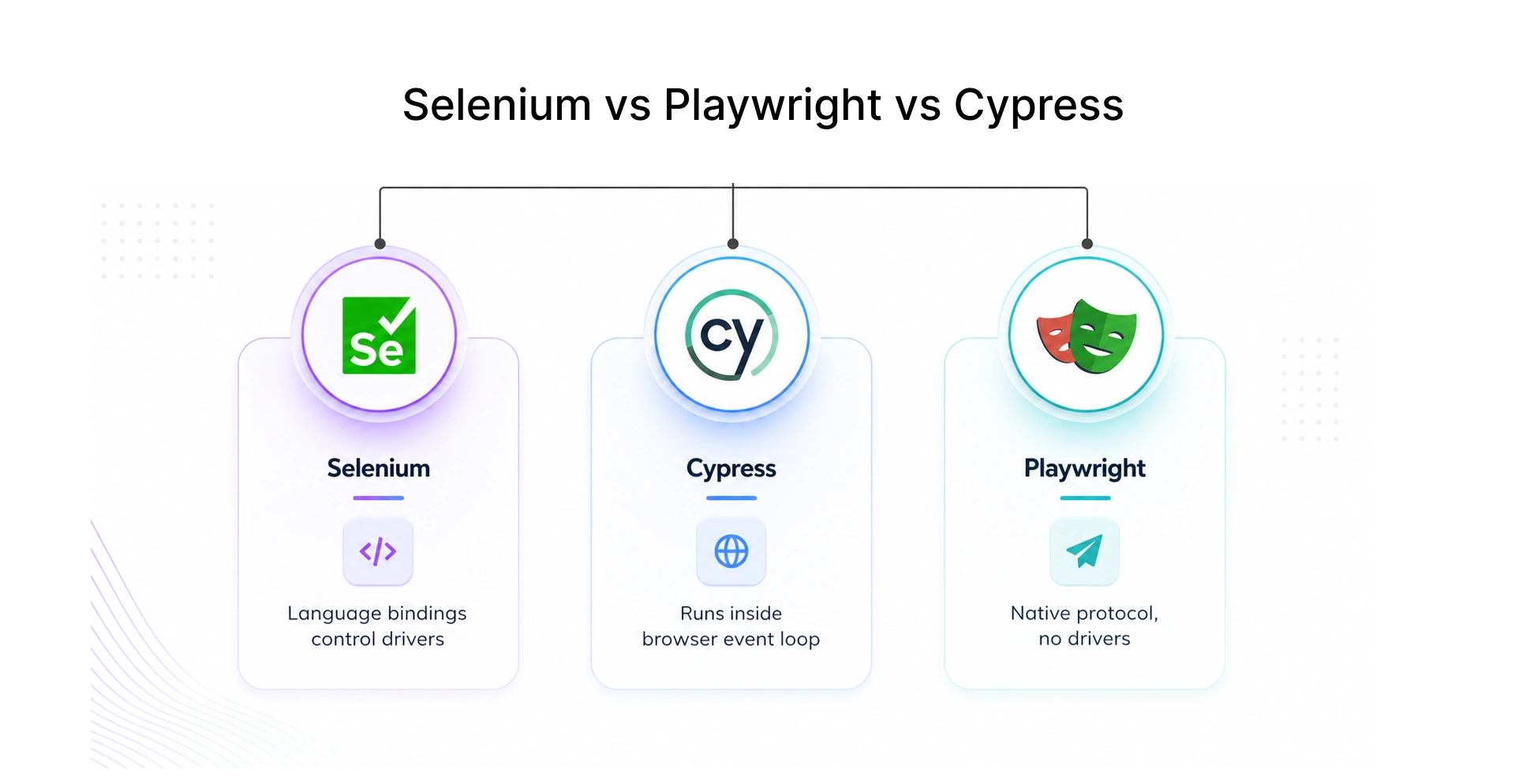
For most enterprise web applications, a Selenium and Playwright dual-framework approach provides the broadest coverage with the lowest maintenance overhead.
CI/CD Orchestration: Jenkins, GitLab CI/CD, and Azure DevOps
Running sanity tests on demand is useful. Running them automatically on every code change is transformative. CI/CD orchestration tools are what make that automation possible at enterprise scale.
Jenkins is the most widely used open-source DevOps testing server. It supports hundreds of plugins, integrates with virtually every version control and testing tool, and can trigger sanity suites as a mandatory pipeline stage before any build proceeds.
GitLab CI/CD is the preferred choice for teams that want version control and pipeline management on a single platform. It simplifies continuous testing by keeping test configuration close to the codebase. Azure DevOps serves enterprises running Microsoft infrastructure, offering tight integration with Azure-hosted applications and full visibility across the release pipeline.
Providers that truly understand DevOps automation configure these tools so that sanity testing becomes a mandatory pipeline gate rather than an optional manual step that teams skip when they are under delivery pressure.
Cloud and AI-Powered Testing: BrowserStack, Sauce Labs, and Self-Healing Scripts
Cloud-based testing platforms like BrowserStack and Suce Labs solve one of the most persistent challenges in enterprise software testing: cross-environment coverage. These platforms allow QA teams to execute sanity tests across hundreds of browser and device combinations simultaneously, without maintaining any on-premise lab infrastructure. This matters especially for healthcare application testing and FinTech software testing, where consistent behavior across environments is a compliance requirement.
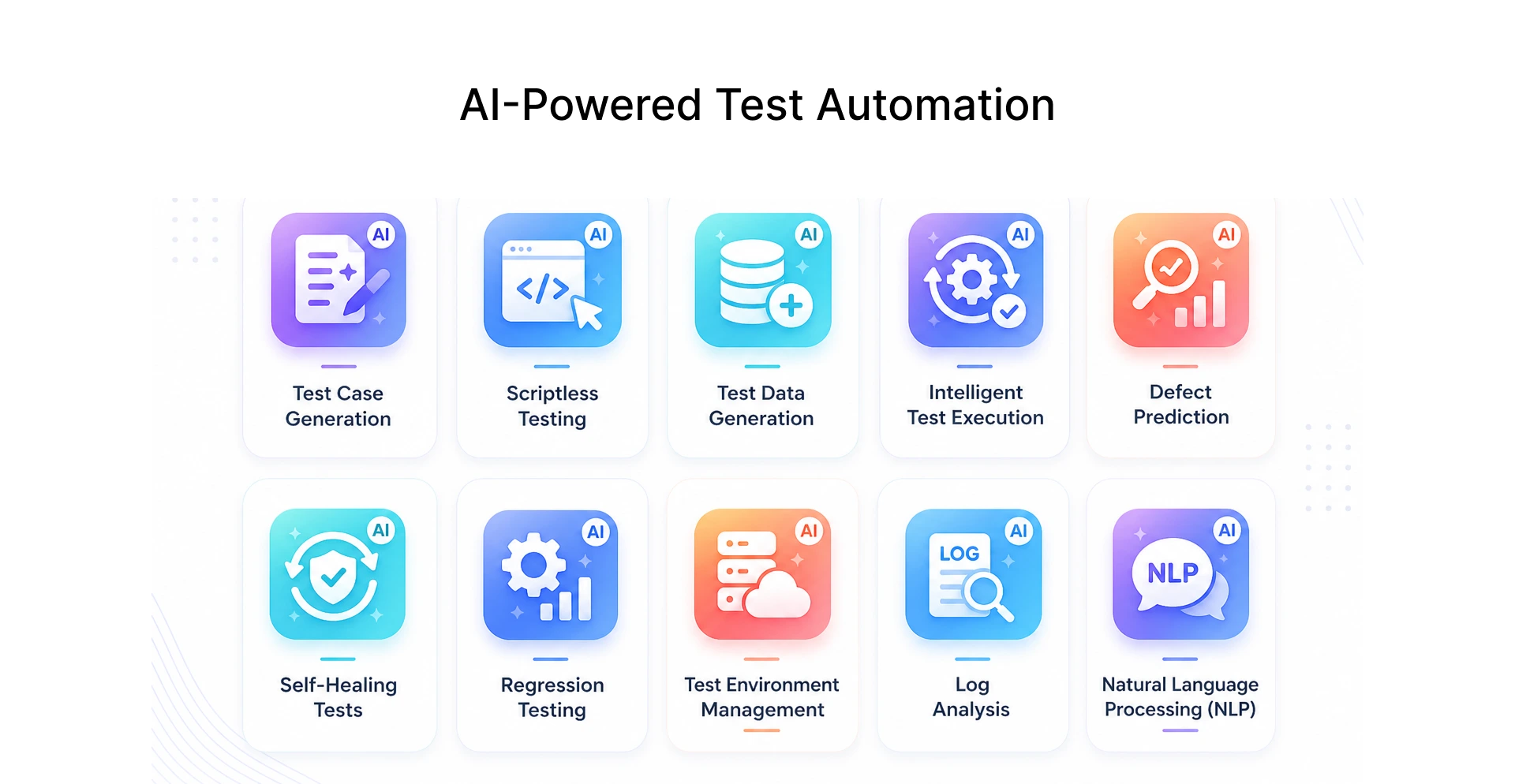
AI-powered testing is reshaping the long-term economics of sanity suite maintenance. Self-healing test automation uses machine learning to detect when a UI element has changed due to a front-end update and automatically updates the affected test script. This dramatically reduces the manual maintenance burden on QA teams. Intelligent test automation tools also use predictive failure analysis to identify which test cases are most likely to fail based on recent code changes, allowing teams to run smarter, more targeted sanity checks.
Across Frugal Testing's enterprise sanity testing engagements, the most common root cause of flaky suites is XPath-based locators that break on minor UI updates. Switching to data-attribute selectors as a standard reduces selector-related failures by approximately 70% and meaningfully cuts the maintenance overhead of automated sanity suites over time. These operational patterns are what separate a well-maintained sanity suite from one that creates more noise than signal.
Top Sanity Testing Service Providers for Enterprise Applications
The market for quality assurance testing services is large and varied. Choosing the right partner requires evaluating automation maturity, industry expertise, integration capability, and support models, not just pricing.
Leading Vendors: Strengths, Industries Served, and Automation Maturity
Frugal Testing is a specialized QA and testing services provider focused on delivering scalable, automation-first sanity testing for enterprise applications. Frugal Testing brings deep expertise in CI/CD integration, test automation framework setup, and regression testing services across FinTech, SaaS, and healthcare verticals. Their approach emphasizes test coverage optimization and real-time reporting, making them a strong choice for DevOps leads and CTOs who need both speed and traceability in their release pipelines.
QASource offers comprehensive software testing and QA services with a strong automation focus, serving enterprises in technology and financial services with dedicated QA team augmentation models.
Testlio combines automated QA testing with structured human testing to deliver hybrid coverage for complex enterprise applications across web and mobile platforms.
Codoid specializes in Selenium-based automation and CI/CD integration, making them a solid option for teams looking for reliable software testing outsourcing at a competitive price point.
Cigniti Technologies is a large managed testing services provider with an enterprise-grade portfolio covering functional testing services, performance testing tools, and end-to-end testing across multiple industry verticals.
Side-by-Side Comparison: Tool Stack, Scalability, Support, and SLAs
The table below compares leading sanity testing providers across tool stack, scalability, support model, and SLA — use it as a first-pass filter before requesting a pilot engagement.
This comparison provides a structured starting point for evaluation. Each vendor's actual fit depends heavily on your application's complexity, your team's existing tool stack, and your reporting and SLA requirements. A provider with strong automation maturity and proven CI/CD integration will consistently outperform a cheaper alternative that relies on manual processes. Use this table as a filter, not a final decision. Once you have a shortlist, validate through a pilot engagement or reference call with a client in your industry before signing a long-term contract.
Pricing Breakdown of Sanity Testing Services
Pricing for QA as a service varies widely, and understanding the underlying structure helps enterprises avoid underestimating costs or overpaying for capacity they do not need.
Pricing Models: Hourly, Dedicated QA Teams, and Project-Based Engagements
The three dominant pricing structures in the testing as a service market are hourly billing, dedicated QA team retainers, and project-based engagements. Hourly pricing typically ranges from $20 to $75 per hour, with offshore QA services at the lower end and onshore specialists at the higher end. This model suits teams with intermittent or unpredictable testing needs.
Dedicated QA team models operate on a fixed monthly retainer. The enterprise gets a full-time embedded testing function with consistent capacity and deep familiarity with their application. This is the most practical structure for teams running agile testing and continuous testing workflows, where QA needs to keep pace with frequent deployments.
Project-based engagements work best for one-time releases, major feature launches, or migrations with a defined scope and timeline. The provider quotes a fixed price based on the deliverables, making budget planning straightforward. This model works well for enterprises that need a full sanity suite built and handed over, rather than ongoing testing support. Each model has tradeoffs, and the right choice depends on your release frequency, team size, and how tightly testing is integrated into your development workflow.
Cost Factors: Application Complexity, Automation Level, and SLA Requirements
Several variables determine where your engagement falls within these ranges. Application complexity is the biggest driver. An ERP testing services engagement covering 50 interconnected modules will cost significantly more than a focused sanity suite for a single-module SaaS application. Critical workflows, environments, and integration points all add to the scope.
The level of automation coverage also shifts the cost curve. Higher automation requires upfront investment in test automation framework setup and script development, but it reduces per-release costs significantly over time. A team that invests in codeless test automation or self-healing test automation may pay more in month one but far less by month six.
SLA requirements, including response time guarantees, dedicated account management, and uptime commitments, add to the base cost but provide assurance that matters at enterprise scale. Evaluate total cost of ownership across a 12-month horizon rather than comparing headline hourly rates.
Case Study: Improving Release Confidence with Sanity Testing
Challenge and Solution: Frequent Failures Fixed with an Automated Sanity Suite
In Q1 2026, a Series B FinTech payments platform processing over 2 million transactions per month was struggling with repeated production failures following routine bug fixes. Their 6-person internal QA team relied on manual sanity checks that were inconsistent in coverage and slow in execution. Every deployment required over four hours of manual validation before the team felt confident enough to go live. Despite that effort, defects still slipped through to production, triggering rollbacks that damaged customer trust and increased operational costs. (Client details are anonymised at their request.)
The company engaged Frugal Testing to design and implement an automated sanity suite covering their 14 most critical transaction and reporting workflows. Using Selenium with Jenkins integration and Azure DevOps pipeline triggers, Frugal Testing delivered a working sanity suite within three weeks. The suite was configured as a mandatory pipeline gate, meaning no deployment could proceed without a passing sanity result. Every code merge from that point forward triggered an automated run that completed in under 20 minutes, giving developers and DevOps leads a clear, actionable result before any build reached production.
Results: Faster Validation Cycles and Reduced Production Incidents
The results were measurable and immediate. Release validation time dropped by 62%, from four hours of manual effort to under 20 minutes of automated testing per deployment. Production incidents attributed to post-fix regressions fell by 38% in the first quarter after implementation. Developer confidence improved significantly, as teams could push fixes during business hours and receive same-day feedback rather than waiting for overnight manual QA windows.
The broader impact was on release cadence. The team went from deploying once per week, constrained by manual QA, to deploying three times per week with confidence. That shift in release management capability translated directly into faster time-to-market for new features and faster resolution of customer-reported issues.
How to Evaluate and Choose the Right Sanity Testing Service
Choosing between QA testing companies is not just a procurement decision. It is a strategic one. The right partner will accelerate your release cycles. The wrong one will create bottlenecks and false confidence.
Must-Have Features: Hybrid Testing, CI/CD Fit, Reporting, and Scalability
Any enterprise shortlist for sanity testing services should be filtered against four non-negotiable capabilities. First is hybrid testing capability, meaning the ability to run both automated testing and exploratory testing in a coordinated workflow. Automation handles repeatable sanity checks efficiently at scale, but human judgment remains essential for edge cases, new UI flows, and scenarios where context matters more than speed. A provider that only offers automation or only offers manual testing is not truly enterprise-ready.
Second is genuine CI/CD fit. This means proven, working integrations with the specific pipeline tools your team uses today, not just compatibility claims on a feature sheet. Third is real-time reporting and test case management, including dashboards that give QA engineers and CTOs immediate visibility into test results, failure trends, and coverage gaps. Fourth is scalability. A provider that manages a 15-workflow sanity suite today must be capable of scaling to 100 workflows 18 months from now without requiring a full contract renegotiation.
These four capabilities together define an enterprise-ready QA strategy.
Key Questions to Ask and Red Flags to Avoid
Before selecting any software testing company, ask these questions directly during evaluation: What automation frameworks do you use, and how do you decide which one fits our application? How do you handle test maintenance when our UI or APIs change between sprints? Can you share client references from our industry? How quickly can a working sanity suite be live after onboarding?
Watch for red flags too. Providers with no documented automation strategy, heavy reliance on manual testing, infrequent reporting, and no enterprise-scale experience are not ready for your environment. Lack of pricing transparency or vague SLA terms are also clear signals to keep looking. The right partner operates as an extension of your team.
Conclusion: Choosing the Best Sanity Testing Service for Your Enterprise
Sanity testing is one of the most practical investments an enterprise can make in its software quality management strategy. It catches critical defects fast, protects release confidence, and keeps CI/CD pipelines moving without adding friction to the development process.
The right sanity testing service provider brings more than a test suite. They bring automation maturity, domain expertise, pipeline integration, and a QA strategy that scales with your application and your organization. Whether you run a SaaS platform, a FinTech system, a healthcare application, or a complex ERP environment, the fundamentals remain the same. Fast feedback, reliable test coverage, and a clear path from defect detection to resolution are what separate a functional QA program from a great one.
Frugal Testing partners with enterprise teams to build sanity testing strategies that are lean, automated, and production-ready from day one. A practical starting point is a sanity suite scope review against your three most critical user workflows that scoping exercise is what Frugal Testing conducts in every initial engagement before a single test script is written.
People Also Ask (FAQs)
Q1. What is the cost of sanity testing services for enterprise applications?
Ans: Sanity testing services for enterprise applications typically cost between $20 and $75 per hour, depending on the provider and engagement model. Dedicated QA support usually starts from $3,000 to $8,000 per month, while project-based pricing varies based on application complexity and automation needs.
Q2. How do I choose between manual and automated sanity testing for my project?
Ans: Choose automated sanity testing if your project has frequent releases, CI/CD pipelines, and stable workflows that require fast, repeatable validation. Manual sanity testing is better for early-stage applications, rapidly changing UI, or scenarios needing human judgment. Most enterprise projects use a combination of both approaches.
Q3. Can sanity testing be performed in a CI/CD pipeline without slowing deployments?
Ans: Yes, sanity testing can be integrated into a CI/CD pipeline without slowing deployments when the test suite is optimized and focused on critical workflows. A well-designed automated sanity suite usually completes within 15–20 minutes, making it effective as a fast deployment validation step.
Q4. What tools are used in enterprise sanity testing?
Ans: Common tools used in enterprise sanity testing include Selenium and Playwright for automation, Jenkins and Azure DevOps for CI/CD integration, and BrowserStack or Sauce Labs for cross-browser and device testing. AI-powered tools like Testim and Mabl are also used for self-healing test automation and reduced maintenance effort.
Q5. How many test cases are usually included in a sanity testing suite?
Ans: A sanity testing suite usually includes 10 to 30 test cases focused on critical business workflows impacted by recent changes. The objective is quick validation of core functionality rather than full application coverage.


.webp)