

.webp)
Which football team do you support?
Argentina? Brazil? France? England? Portugal (siuuuu)? Or are you already waiting to see who creates history in 2026?
The drama has already started. Messi is lighting up scoreboards, Mbappé is chasing another Golden Boot, Haaland is making his mark, and Ronaldo is fighting to silence the doubters. Every match feels like a final, and every goal becomes a headline.
Now imagine the moment a major match announcement goes live. Fans from every corner of the world rush in at once. Some are trying to buy tickets. Some are checking fixtures. Some are refreshing live stats. Some are streaming updates while already arguing in group chats about who will win.
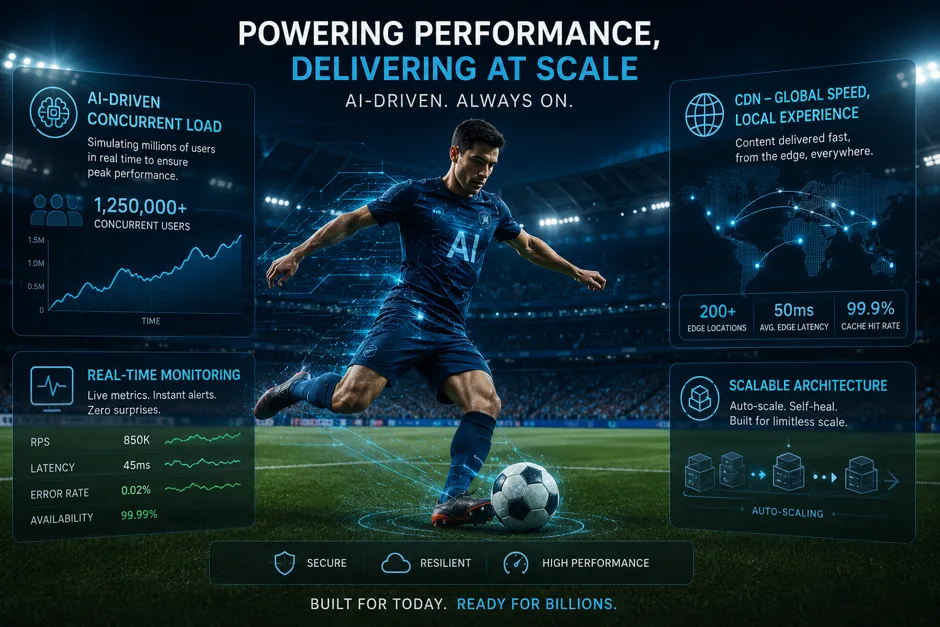
A ticketing platform crashes 40 seconds after match announcements go live. Five million fans refresh simultaneously. The live stats feed drops mid-match. The 2026 FIFA World Cup raises every one of those stakes: 48 teams, 16 host cities across the United States, Canada, and Mexico, a projected 5 billion viewers, and a digital infrastructure that must hold under concurrent load profiles most engineering teams have never tested against.
Every pattern that breaks a World Cup platform (CDN cache-miss cascades, API gateway timeouts, database connection pool exhaustion) is the same pattern that breaks a SaaS product launch at far more modest scale. The preparation framework is identical. Only the numbers differ.

Why FIFA World Cup 2026 Is a Performance Testing Stress Test at Global Scale
The Infrastructure Footprint Behind a World Cup Digital Experience
The 2026 FIFA World Cup deploys artificial intelligence across officiating, broadcast, and fan engagement at a scale no previous tournament has attempted. The semi-automated offside system uses optical tracking cameras and a sensor-equipped match ball with an inertial measurement unit to generate offside line decisions in under a second. The VAR room runs officiating technologies including computer vision systems and high-speed cameras to power the Referee View interface. Football AI tools generate AI-enabled 3D player avatars from body cameras and optical sensors, pushing real-time updates across broadcast and fan platforms.
Every decision event triggers cascading API calls across stats feeds, broadcast integrations, and mobile apps simultaneously, multiplying real-time data testing requirements in ways that have no precedent in previous World Cup digital infrastructure. These failure modes are recurring patterns that the 2026 edition's digital technology layer makes more likely for unprepared platforms. A product launch or flash sale shares the same topology as a World Cup kickoff, compressing every failure scenario into a 90-minute window with global sporting events-level visibility.
What "Concurrent User Testing" Means at FIFA Scale
Concurrent user testing at World Cup scale is millions of simultaneous sessions across web, iOS, Android, and connected TV, each carrying different payload sizes and API call frequencies. A stadium check-in flow that works fine at 1,000 VUs frequently degrades at 8,000 VUs because the session management layer was never tested under real concurrent pressure.
Bored a bit ! Let’s play a Match
The Performance Testing Stack Required to Simulate a World Cup Traffic Event
Realistic load generation for a global event requires distributed test execution across cloud regions. Single-region load testing produces artificially clean latency numbers. Google Cloud provides the infrastructure for FIFA's 2026 data processing pipeline, handling event-driven data from computer vision systems, sensor feeds, and officiating technologies.
Our standard toolchain uses k6 load testing for scripted load generation, Grafana for real-time metrics visualisation, and distributed execution across AWS regions. Dolby Vision HDR and Dolby Atmos delivery pipelines are now validated under load as distinct scenarios, since broadcast quality standards have become contractual in many rights-holder agreements.
Building a Load Testing Script That Mirrors Real Fan Behaviour
We model three VU ramp profiles: a gradual ramp for steady background traffic, a spike profile simulating the surge at match start, and a soak profile sustaining load across the full 90-minute match window to catch memory leaks and connection pool degradation.
For example, thousands of users may simultaneously generate posts after a last-minute goal using a social media post generator, making realistic traffic simulation just as important as testing ticket purchases or live score APIs.
k6 Load Testing Configuration for High-Traffic API Endpoints
javascript
export const options = {
  scenarios: {
    spike_test: {
      executor: 'ramping-arrival-rate',
      startRate: 100,
      timeUnit: '1s',
      preAllocatedVUs: 500,
      maxVUs: 5000,
      stages: [
        { duration: '2m', target: 100 },
        { duration: '30s', target: 4000 }, // kickoff spike
        { duration: '5m', target: 4000 },  // sustained match load
        { duration: '1m', target: 100 },
      ],
    },
  },
  thresholds: {
    http_req_duration: ['p(95)<300'],
    http_req_failed: ['rate<0.01'],
  },
Stress Testing Software Under World Cup Conditions: What Breaks First
The failure hierarchy in stress testing software at scale follows a predictable sequence. CDN cache-miss cascades cause origin server traffic to spike beyond modelled levels. That drives database connection pool exhaustion, which produces API gateway timeouts, which propagate failures downstream into microservices that were individually healthy. Teams that instrument only the API layer and skip CDN and database metrics miss the actual failure origin in most outage post-mortems.
Payment gateway testing deserves its own load profile. Checkout flows under a World Cup ticketing system load test spike hit payment infrastructure at rates that differ fundamentally from steady-state commerce traffic, and most payment gateway testing strategies are built around the latter.
Identifying Latency Bottlenecks Before the Match Kicks Off
Latency testing tools worth integrating before any high-traffic event: distributed tracing via Jaeger or Zipkin, APM via Datadog or New Relic, and synthetic monitoring for continuous pre-event baseline calibration.
CDN Performance Testing for a Multi-Region Streaming Delivery Model
CDN performance testing under surge load requires synthetic origin-pull stress, cache-fill latency measurement, failover path verification, and geographic distribution testing from representative PoPs. Cache warming strategies implemented pre-event prevent the origin-pull cascade that caused several major streaming video testing failures in recent World Cup cycles.
Real-Time Monitoring: How You Know the System Is Holding During a Match
Real-time monitoring software is not just a DevOps concern. It is the mechanism that separates a 5-minute incident from a 5-hour outage.
Observability Dashboards for Live Traffic Events
The observability stack required: metrics via Prometheus and Grafana, logs via ELK or Splunk, traces via Jaeger or Datadog APM, and synthetic uptime checks against critical user journeys every 30 seconds.
Observability in software testing must now account for AI-driven feature layers. The introduction of conversational AI fan interfaces, generative AI highlight generation, and Football AI data pipelines creates dependencies that did not exist in previous World Cup cycles. Application monitoring must treat each AI feature as an independent service with its own failure modes.
Incident Response Testing: Validating Your Runbook Before the Whistle Blows
Incident response testing is the step most teams skip. Chaos engineering principles, implemented through tools like Gremlin or Chaos Monkey, provide the methodology for structured failure injection. An incident runbook that has never been tested under load is a document, not a plan.
Mobile Performance Testing: The World Cup Is Won on the Phone
Over 70% of World Cup digital consumption is mobile. iOS and Android apps handle live score push notifications, in-app ticket purchases, and streaming video clips simultaneously across networks ranging from stadium Wi-Fi to 4G in a crowd of 80,000 people. The sports tourism economy around the 2026 FIFA World Cup involves millions of international fans on roaming data accessing mobile app testing services for the first time. Network condition simulation must account for high-density stadium Wi-Fi, not just generic slow 4G.
Simulating Real-World Network Conditions for Mobile Load Testing
We build a specific stadium Wi-Fi profile: 40 to 60ms latency, 5 to 10% packet loss, and bandwidth throttled to 2 to 4 Mbps per device. Tools include Charles Proxy and Network Link Conditioner for iOS, Android Emulator network profiles, and cloud device farms via BrowserStack or AWS Device Farm.
QA Automation for Mobile Apps Under Live Event Load
Our automated mobile regression suite uses Appium or Detox for UI layer automation, API mock injection for backend isolation, and background push notification delivery verification against a production-equivalent backend. QA automation for mobile apps must run against production-equivalent environments during load. Software testing for sports apps without stadium Wi-Fi simulation consistently underestimates the failure rate in real deployment conditions.
Chaos Engineering and Scalability Testing Before Tournament Day
Load testing validates capacity. Chaos engineering validates resilience and recovery. The Summer Olympics digital platform teams and UEFA Champions League streaming operators have both learned this distinction under production conditions. Scalability testing confirms that the platform grows capacity correctly under load. Chaos engineering confirms it degrades gracefully when components fail unexpectedly. Both are required for global sporting events at this scale.
Designing Chaos Experiments for a Live Streaming Platform
Digital twins of the production environment make chaos validation significantly safer. Testing CDN origin failover, database primary failover, and broadcast software testing integration timeouts in a production mirror is standard practice for high-stakes event preparation.

Why Frugal Testing Is a Killer Performance Testing Partner
Performance testing is one of Frugal Testing's core strengths. We've helped European platforms prepare for high-profile launches by successfully validating systems against 150,000+ concurrent users and traffic surges exceeding 1.2 million sessions in a matter of hours. For fast-growing Indian startups, we've optimized applications to deliver 60% faster response times under peak load while maintaining stability and reliability. Our expertise goes beyond generating traffic we simulate real user behavior, uncover critical bottlenecks, and help engineering teams fix issues before they impact customers. When scalability, speed, and uptime matter most, performance testing is our forte.
Who This Is For
The team profile: 20 to 500 engineers, B2C or B2B SaaS, shipping weekly, with a high-stakes traffic event within 90 days and no dedicated performance engineering function.
"The World Cup's biggest software risk is not the traffic. It is the teams that prepared for traffic without preparing for failure."
Key Takeaways
- Concurrent user testing must model complete user journeys, not raw VU count. Journey-accurate models surface failure modes that endpoint hammering misses.
- CDN performance testing requires geographic distribution testing from representative PoPs. Single-region tests produce misleading results for globally distributed platforms.
- Chaos engineering and load testing answer different questions. Both are required. Neither substitutes for the other.
- Continuous testing in DevOps with performance threshold gates in CI/CD prevents launch-day outages. AI-driven features, including Football AI data pipelines and real-time updates, create API performance testing requirements most pre-event checklists do not yet account for.
Conclusion
The 2026 FIFA World Cup is the most demanding real-time software stress test ever staged. The artificial intelligence layer across officiating technologies, broadcast systems, and fan engagement platforms makes it more complex than any previous edition. But the engineering principles it demands are not unique to a 5 billion viewer event. Realistic load modelling, multi-layer observability, chaos validation, and continuous performance gating in CI/CD are the standard framework for any platform where downtime carries genuine cost.
Your World Cup moment is not 48 teams across three countries. It is the launch, the sale, the integration. The preparation window is always shorter than the roadmap suggests.
People Also Ask (FAQs)
Q1. What is performance testing and why does it matter for high-traffic events?
Ans: Performance testing validates that a system meets its SLAs under the actual load profile of the event it must serve. For a World Cup kickoff or a product launch, that means modelling the exact concurrency, geographic distribution, and user journey mix of real traffic, not a simplified approximation.
Q2. What is the difference between load testing, stress testing, and soak testing?
Ans: Load testing validates capacity under expected peak conditions. Stress testing identifies the breaking point beyond expected load. Soak testing runs sustained load over hours to surface memory leaks and gradual degradation. All three serve different purposes in a pre-event preparation plan and should not be treated as interchangeable.
Q3. How do we test CDN performance before a high-traffic event?
Ans: Run synthetic origin-pull stress, measure cache-fill latency, verify failover paths, and conduct geographic PoP testing from the regions where your audience originates. Implement cache warming strategies before the event, not reactively.
Q4. What observability tooling should we have before a major traffic event?
Ans: The minimum viable stack: Prometheus and Grafana for metrics, Datadog APM or Jaeger for distributed tracing, and synthetic uptime monitoring running against critical user journeys. All of it must be baseline-calibrated during load testing, before the event window opens.
Q5. How does chaos engineering differ from stress testing?
Ans: Stress testing finds your capacity ceiling. Chaos engineering validates whether your system degrades gracefully under failure conditions that are not volume-related. Both are required. They address different failure classes.