

I've spent enough time in API testing pipelines to know the exact moment things fall apart usually right before a release, when one upstream service goes down and takes three test suites with it. That's not a testing problem. That's an architecture problem dressed up as a testing problem.
That's where MCP changes how teams work. Whether you're building AI applications, running web automation at scale, or just trying to get your CI/CD integration to stop failing randomly, this post breaks down what MCP is, why it matters, and how to actually use it.
What is MCP and How It Fits into API Testing
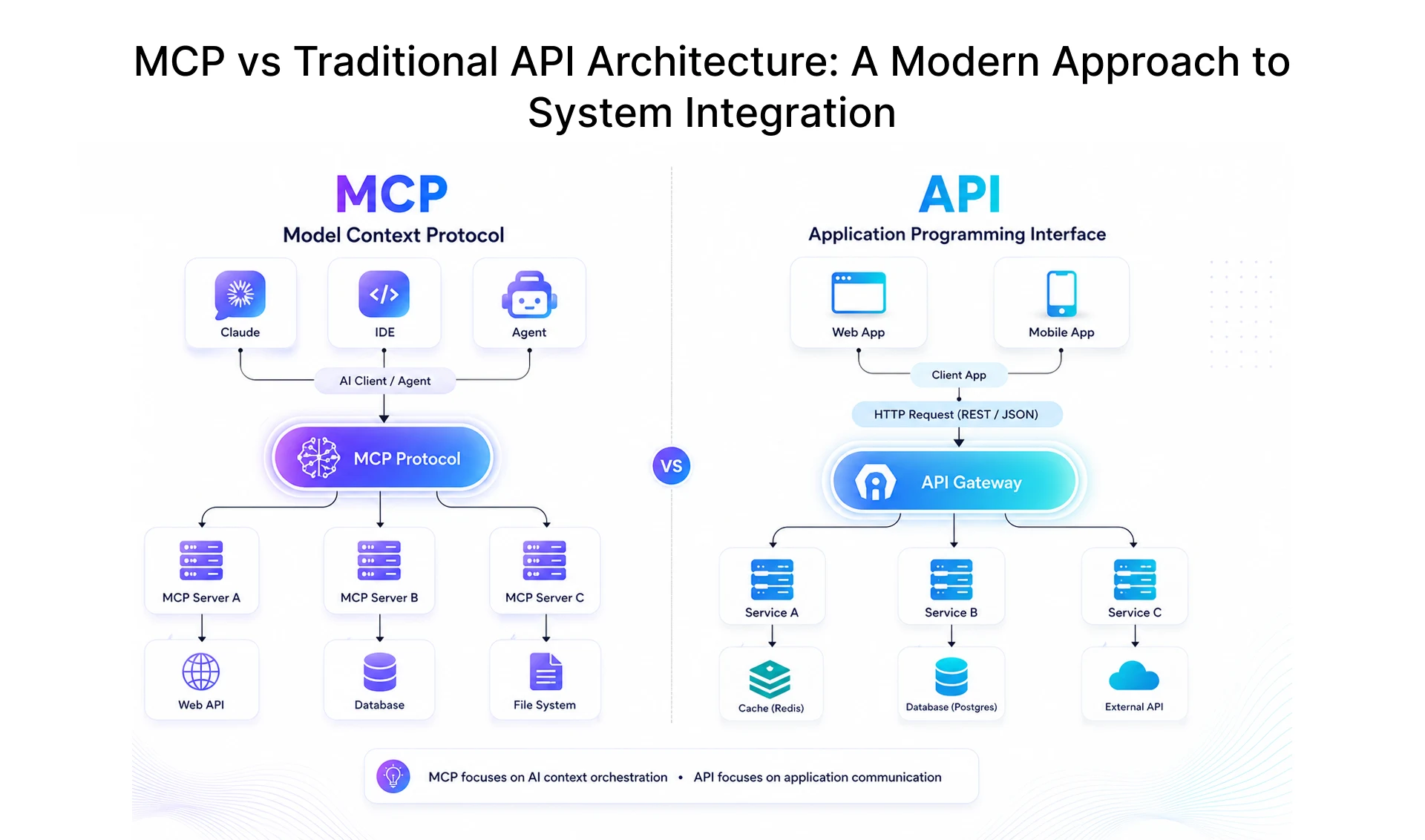
If you search "MCP" today, you'll find the Model Context Protocol - the open standard for connecting AI models and AI agents to external tools via MCP servers. In the world of API testing, MCP's design principles - standardised communication, tool abstraction, orchestrated workflows - map directly onto modern test infrastructure.
Think of it this way: just as MCP gives AI assistants and Large Language Models a structured, secure way to call external systems using JSON-RPC sessions, standard input/output streams, and Server-sent events for real-time communication - your test pipeline needs that same discipline. MCP also introduces semantic descriptions for tool use, so AI models understand what a tool does before calling it. That same principle - describing intent before execution - is what contract testing brings to REST API validation. When your JSON interfaces are documented and verified, both your test suite and your AI agents consume them predictably. This matters now: AI applications increasingly sit behind APIs in production, and endpoints consumed by AI generate high-frequency, non-deterministic call patterns that traditional test cases were never built to handle.
In this guide, we use MCP's principles - standardised communication, tool abstraction, and orchestrated execution - as the framework for modern API test architecture. The patterns work whether or not your stack uses MCP servers directly.
Core Concept: Mocking, Contracts, Orchestration
MCP-style API testing runs on three pillars:
Mocking
Mocking replaces a real service with a controlled stand-in. You're not testing the payment gateway - you're testing how your code handles a 402, a 500, or a malformed response. Tools like WireMock, MockServer, and n8n MCP integrations all support this
Contracts
Contracts are formal agreements between a service consumer and provider. Instead of hoping both sides "just work," contract testing encodes the expected request/response structure and verifies it independently. API specifications (OpenAPI, AsyncAPI) become the source of truth. Here's a Pact example:
await provider.addInteraction({
  state: 'payment service is available',
  uponReceiving: 'a valid payment request',
  withRequest: {
    method: 'POST',
    path: '/payments',
    body: { orderId: '12345', amount: 99.99, currency: 'USD' }
  },
  willRespondWith: {
    status: 200,
    body: { transactionId: 'TXN-001', status: 'confirmed' }
  }
});
The payment team verifies against this file. Neither team needs the other to be online.
Orchestration
Orchestration is the glue - coordinating which mocks run when, injecting test data, and reporting results back to your CI/CD pipelines. Workflow automation tools like n8n drive this layer, managing the workflow management side of your testing lifecycle. Without it, mocking and contracts are isolated tools. With it, they become a real workflow.
How MCP Differs from Traditional Approaches
Traditional API testing gives you two options: hit live endpoints, or maintain static mocks that go stale in weeks. The difference with MCP-style testing is fourfold - mocks are dynamic not static, contracts replace tribal knowledge stored in Postman collections, execution is orchestrated across services not run in isolation, and API security checks (auth headers, token validation, scope enforcement) are part of the contract definition from the start.
Why API Testing is Getting Harder
A checkout flow today might touch inventory, pricing, fraud detection, payment, notification, and analytics - each with its own API endpoints and deployment schedule. This is horizontal integration at its messiest. Add vertical integration down to databases and third-party data sources, and now try writing a reliable end-to-end test suite for all of it.
Every test is only as stable as its most unstable dependency. Running full API integration tests against Stripe or Twilio in CI/CD pipelines is slow, expensive, and non-deterministic. Cloud integration with AWS Lambda or Azure Functions adds another tier that behaves differently across environments. Legacy systems - the SOAP services, on-prem databases, and external services nobody wants to touch - introduce the M x N problem: every new service needs a custom integration with every other, complexity growing exponentially. External data from these systems is inconsistent, access-controlled, and often unavailable in test environments entirely.
The majority of flaky tests aren't caused by poor test logic - they stem from environmental instability. A service isn't ready when the test executes, a shared database carries residual state from previous runs, or an external API behaves unpredictably. MCP-style orchestration addresses all three: service virtualization ensures dependencies are always available, centralized test data management maintains clean and consistent environments, and dynamic mocking stabilizes external interactions - resulting in reliable, repeatable, and production-grade test outcomes.
Key Problems MCP Solves
Dependency Management and Service Virtualization
Service virtualization gives you a stateful simulation of a downstream service - not just one stubbed endpoint, but the whole thing. This is solid enough for both unit testing and regression testing to run against in isolation:
{
  "request": { "method": "GET", "urlPattern": "/users/[0-9]+" },
  "response": {
    "status": 200,
    "jsonBody": { "id": "{{request.pathSegments.[1]}}", "name": "Test User" },
    "transformers": ["response-template"]
  }
}
In a Frugal Testing engagement with a mid-sized SaaS team, 400 API tests had an 18% failure rate - nearly 1 in 5 runs failing for environmental reasons unrelated to bugs. After virtualizing three unstable dependencies, the failure rate dropped below 3% within a month. The tests didn't change. The environment became predictable.
Faster CI/CD and Stable Pipelines
Real network calls at 200ms each add up fast. With mocked dependencies, those same calls complete in under 1ms. On a large test suite, that's the difference between a 4-minute pipeline and a 12-minute one. In GitHub Actions or Azure DevOps pipelines, that multiplies across every PR and every developer. Modern deployment platforms and DevOps tooling support automatic deployments triggered by pipeline success - and every minute you shave off the test run is a minute faster your release candidate goes live.
Here's an Azure DevOps pipeline with proper environment variables, build commands, and service containers:
yaml
# azure-pipelines.yml
services:
  payment-mock:
    image: wiremock/wiremock:latest
    ports: [8080:8080]
    volumes:
      - $(Build.SourcesDirectory)/mocks/payment:/home/wiremock/mappings

variables:
  PAYMENT_SERVICE_URL: 'http://localhost:8080'
  NODE_ENV: 'test'

steps:
  - script: npm ci
    displayName: 'Install deps'
  - script: npm run test:api
    displayName: 'Run API tests'
    env:
      PAYMENT_SERVICE_URL: $(PAYMENT_SERVICE_URL)
  - task: PublishTestResults@2
    inputs:
      testResultsFiles: '**/test-results.xml'
No live services. Clean pipeline every run.
Practical Workflow: How MCP Fits End to End
Dynamic Mocking with Playwright
Playwright testing including Playwright JS/TS tests with visual assertions handles more than browser automation. Its request interception API makes it a strong tool for web automation and API-level mocking in full-stack tests:
javascript
await page.route('**/api/payments', async (route) => {
  const callCount = global.paymentCallCount || 0;
  global.paymentCallCount = callCount + 1;
  await route.fulfill({
    status: callCount === 0 ? 200 : 429,
    body: callCount === 0
      ? JSON.stringify({ transactionId: 'TXN-001', status: 'confirmed' })
      : JSON.stringify({ error: 'rate_limit_exceeded' })
  });
});
Now your retry logic actually gets tested, not just theorized.
Contract Testing in CI/CD
The flow in an agile DevOps pipeline: consumer tests generate a pact file → publish to Pact Broker → provider CI/CD pulls and verifies → can-i-deploy gates the release. When this is wired up properly, a failed contract check blocks the GitHub PR automatically, creates a Jira ticket via webhook, and fires Slack notifications to team stakeholders - all before a human even reviews the code.
yaml
- name: Can-I-Deploy check
  run: npx pact-broker can-i-deploy --pacticipant PaymentService --to-environment production
Skip this step and you're guessing. Keep it and breaking changes can't ship undetected.
Real-World Impact
Fintech
In Frugal Testing's API testing engagements with payments companies, service virtualization made every payment scenario - successful, insufficient funds, fraud flag, timeout - fully reproducible. API security checks like token expiry and malformed auth headers were simulated consistently across runs. In one European payments engagement, production payment failures dropped by 40% without any changes to payment logic - purely from testing edge cases that had never been covered before.
E-commerce
In a Frugal Testing engagement with a retail platform, the team connected their orchestration layer to a workflow automation trigger in n8n to run load scenarios automatically after every deployment. The mock simulation surfaced a non-standard error from the inventory service under high load - a bug that would have gone undetected without it. It was fixed before Black Friday.
SaaS
In Frugal Testing's SaaS engagements, contract testing has enabled internal teams to refactor services without breaking external customer integrations. By wiring Azure API Management spec exports directly into the testing loop, API design and API testing stay in sync - provider-driven contract testing working as intended, with providers owning the spec and every consumer's tests running against it before any release ships.
MCP vs Traditional API Testing
The table below compares traditional API testing and MCP-style testing across five dimensions that most directly affect test reliability and CI/CD performance.
In Frugal Testing engagements, teams adopting MCP-style testing have seen 60–80% fewer flaky tests, 40–60% faster CI/CD pipelines, and 2–3x more edge cases covered.
This also closes DevOps security gaps. When API security - authentication tokens, scoped authorization, role-based access control - is encoded into contracts, it gets tested on every run, not just during penetration testing or periodic security assessments.
AI agents introduce a new class of risk that deserves its own mention. Unlike human users, agents make decisions autonomously - and a compromised or poorly scoped agent can become a security service bypass, not just a bug. The attack surfaces include prompt injection through API responses, command injection in tool parameters, SQL command manipulation via unvalidated inputs, and remote code execution through improperly sandboxed API functions.
The fix is agent-centric security: enforcing a clear security boundary between what an agent can read and what it can write, applying privilege separation so no single agent token has broad access, and using provenance tracking to audit which agent triggered which API call and when. Sensitive credentials should never travel through agent-visible API responses. Use proven testing standards to verify credential handling in every release candidate: simulate token exposure, validate scope limits, and confirm that function calling patterns can't be manipulated to exceed intended permissions.
When Traditional Testing Still Works
Simple monolith, one database, no external APIs - then this overhead isn't worth it. The rule of thumb: more than three external dependencies or a test suite longer than 10 minutes means it's time.
Best Practices
Keep Contracts Flexible
A contract that validates exact values breaks the moment the provider adds an optional field. Use type matchers instead:
javascript
body: like({ id: integer(), name: string(), email: email() })Manage Test Data Properly
Don't hardcode IDs in test files - use factories that generate valid data on demand. Keep development environments seeded consistently. API integration tests fail for the wrong reasons when a hardcoded ID already exists in the database.
Don't Over-Mock
Mock what you can't control - third-party APIs, payment gateways, external notification services. For internal services, run real integration tests at least nightly against actual deployed instances. Cloud integration tests against real staging infrastructure should be part of your release gate, even if they don't run on every PR. The trap many teams fall into: mock everything, all tests pass, real integrations break in production because the mocks weren't realistic enough. Contract tests keep both sides honest, but they're a safety net - not a substitute for occasionally running against the real thing.
Conclusion
Software testing basics still apply - get your unit testing and regression testing solid before layering orchestration on top. The software testing pyramid hasn't changed: unit tests at the base, integration in the middle, end-to-end tests at the top. MCP-style testing strengthens the middle layer - the one most teams neglect.
In Frugal Testing's engagements, the teams that move fastest treat testing infrastructure as a product - they shift from reactive debugging to catching integration issues before they reach staging. They invest in contracts early, version mocks alongside application code, use workflow automation to trigger verification after every deployment, and make it a non-negotiable gate in every DevOps deployment pipeline. The DevOps practices that actually stick remove friction - fast pipelines get used, slow ones get skipped, and when developers skip the pipeline, real bugs slip through undetected.
If you want to move in that direction but aren't sure where to start, the team at Frugal Testing has helped engineering teams at every stage - from getting API testing basics right to overhauling test reliability across dozens of microservices. The starting point matters less than starting.
The tools exist. The patterns work. Stop fighting your test suite and build one that helps you ship.
People Also Ask For (FAQ'S)
Q1. How does MCP handle API versioning across multiple environments?
Ans: MCP centralizes API contracts and routes requests to the correct version using environment-aware configurations. It ensures consistent behavior by isolating versions while allowing parallel testing across dev, staging, and production.
Q2. What security risks should be considered when using MCP for API simulations?
Ans: The primary security risks when using MCP for API simulations include data exposure through simulated endpoints, scope boundary violations, and audit trail gaps. Strong access controls, data masking, and audit logging are essential to prevent misuse.
Q3. Can MCP be applied to event-driven or asynchronous systems?
Ans: Yes, MCP can simulate message queues, event streams, and async workflows using event mocking and orchestration. This enables reliable testing of systems built on Kafka, queues, or webhook-based architectures.
Q4. What are the cost trade-offs of MCP compared to maintaining staging environments?
Ans: MCP reduces infrastructure and maintenance costs by minimizing the need for full-scale staging environments. However, initial setup and orchestration complexity may require upfront investment.
Q5. How can MCP support performance and load testing scenarios?
Ans: MCP enables controlled simulation of dependencies, allowing accurate load testing without external bottlenecks. It helps generate consistent traffic patterns and isolate performance issues within the system under test.

.webp)