

Every software team faces this question: should we invest in QA automation services or build an in-house software QA testing team? Corporate engineering budgets can take a big hit. In the World Quality Report 2023 by Capgemini and Micro Focus, 44% of companies report that budgetary constraints are their greatest challenge in QA - but few teams consider the real cost. In this article, we're giving CTOs, QA leads, and founders the numbers, trade-offs, and how to run the right tests to make a decision.
Why Most Teams Get QA Costs Wrong From the Start
QA costs are underestimated by teams because they only account for the headline costs (salaries or software licenses), but overlook infrastructure, training and opportunity costs. QA software testing services are never a one-off cost.
The Real Price Tag Behind "Just Hire a QA Tester"
It's easy to get started hiring QA engineers. The 2024 Stack Overflow Developer Survey estimates the average salary of a QA engineer in the US to be between $80,000 and $120,000 annually. But this is not the total cost of a QA engineer.
- Benefits, paid time off, and payroll taxes increase the total cost of a QA engineer by 25-35% of their base salary, or an additional $20,000-42,000 per engineer per year.(U.S. Bureau of Labor Statistics, 2023)
- Training and learning periods take 30-90 days for a QA engineer to be fully productive.
- 30-40% of a manual QA engineer's time is spent on maintaining test cases.(Capgemini World Quality Report, 2023)
- Hiring more engineers increases the bill in proportion - ten engineers are ten times the cost.
The total cost for hiring one QA engineer in the US is $110,000 - $165,000 a year. In India or Eastern Europe, this costs $15,000-$40,000, but there are still management costs and time-zone issues.
Why Automation Costs More Upfront Than You Think
Automated QA testing services offer faster, more scalable testing, but the sticker shock comes in the up-front cost. Industry research widely cited by test automation vendors suggests most companies take 6-12 months to see returns on automation investment - a timeline consistent with the break-even analysis in this guide.
- Software test automation tools such as Tricentis Tosca or Micro Focus UFT license for $15,000-$60,000+ annually.
- Free tools such as Selenium or Playwright require a $100,000-$140,000 salary for engineers.(Stack Overflow Developer Survey, 2024)
- CI/CD and cloud hosting may cost $12,000-$36,000 in the first year.
- Flaky tests and automation upgrades result in maintenance costs of 20-30% of the build cost every year.
Organizations that neglect the upfront costs of automation qa services either never complete their strategy or develop a fragile set of tests that do more harm than good.
QA Automation vs In-House QA: Full Cost Breakdown With Real Numbers
The table below outlines the cost comparison for software QA testing services - in-house vs. automation - based on compensation and industry data from Stack Overflow, Glassdoor, and the U.S. Bureau of Labor Statistics (2023-2024).
Upfront Costs: Setup, Tools, and Infrastructure (With Ranges)
In-house QA front-loads on recruiting; automation front-loads on technology and engineering. There's an up-front cost in both - it's just different.
- In-house QA recruiting fees: 15-25% of annual salary, or $12,000-$30,000 per hire.
- Automation framework: $20,000-$80,000 (depending on app complexity).
- Selecting the right automation tools for testing is the single biggest lever on your total setup cost.
- Automation qa testing services training: $2,000-$8,000/engineer.
Table 1: Upfront Cost Comparison Between QA Models
These start-up costs vary with app type. A SaaS application built on microservices needs more framework than a basic CRUD app - consider app complexity before comparing against these ranges.
Monthly and Annual Operational Costs Side by Side
Using automation, the cost of testing levels off over time while in-house QA costs increase with the number of staff. This creates a gap for frequent releases after 12-18 months.
- Two in-house US QA engineers: $18,000 - $25,000/month (loaded cost).
- Medium-sized automation suite (one SDET): $12,000 - $18,000/month.
- A large in-house QA team of 10+ engineers cost more than $1.2M annually, compared to $300,000-$500,000 for the same automation coverage.
The figures below reflect fully loaded costs salary, benefits, tooling, and infrastructure not headline salaries alone.
Table 2: Annual Operational Cost Comparison
Hidden Costs That Blow Most QA Budgets (And How to Avoid Them)
In Frugal Testing's QA consulting engagements, teams with an immature approach to QA consistently report 25-35% of engineering time absorbed by quality rework - a pattern echoed across the industry. The most consistently underestimated cost is test debt - teams that delay automation for 12+ months typically find their backlog costs 3-5x more to automate retroactively than building the framework from the start. Beware the hidden costs.
- Test debt: Not automating early: 3-5x more expensive backlog of tests.
- Regression gaps: Manual testers miss things prior to release, and bugs in production cost $4,000-$15,000 to resolve (IBM Systems Sciences Institute).
- Turnover: Hiring a QA engineer costs 50-200% of annual salary (SHRM, 2023).
Invest in QA infrastructure. Frugal Testing's software QA consulting services can help you identify these costs.
Break-Even Analysis: When Does QA Automation Actually Pay Off?
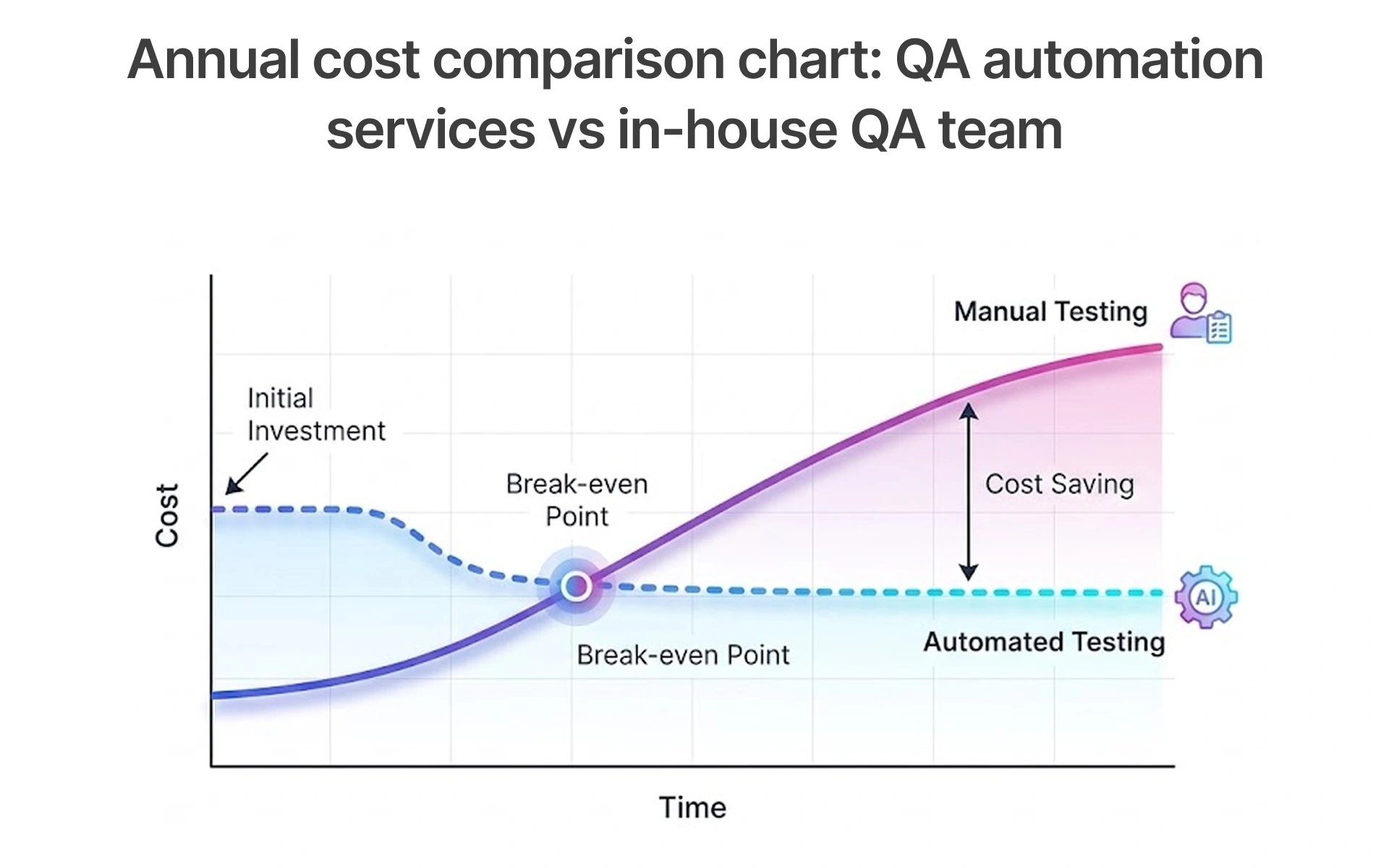
The break-even point is the point at which automation no longer costs money, but begins to save it - determining the cost-per-test, cost-per-release, and total investment.
Month-by-Month Cost Comparison: Automation vs In-House
Automation typically costs more in the first three months due to the cost of creating scripts and building the automation environment. Few teams anticipate this, and write it off as failure. The month-on-month curve helps avoid quitting the automation process too soon.
- Months 1 - 3: Automation has an upfront cost of $25,000-$60,000 more than in-house.
- Months 4 - 6: Costs are similar as scripts develop and coverage grows.
- Months 7 - 12: Automation is 30-50% less per release than in-house.
- Organisations with daily CI/CD may break even in months 5-7.
Cost-Per-Test and Cost-Per-Release Benchmarks You Can Use Today
Cost-per-test is a measure of QA efficiency. Advanced automation has 40-60% lower cost-per-defect than manual QA teams. (Capgemini World Quality Report, 2023).
- Cost per manual test run: $1.50-$5.00 per test (time, reporting).
- Cost of automated QA test run: $0.01-$0.15 (depending on infrastructure)
- Cost per release for 500 manual tests: $750–$2,500; automated equivalent: $50–$150.
- Based on Frugal Testing's AI-augmented engagements, teams adopting self-healing automation typically see a 40-60% reduction in maintenance effort within 6 months of deployment.
These benchmarks are based on 2023–2024 market data and assume a mid-size regression suite of 500 tests running on standard cloud infrastructure.
Table 3: Cost-Per-Test and Cost-Per-Release Benchmarks
The 12-Month Break-Even Point Most Teams Don't Plan For
The standard budgeted automation payback is 6 months. Historically it is 9 - 14 months for new projects. This mismatch in expectations is the main driver for automation initiatives failing.
- Starting from scratch: break-even in months 9 - 14.
- Existing partial automation: break-even at months 5 - 9.
- Legacy systems: break-even at 18 - 24 months.
Self-healing, AI-based test automation teams typically break even 2-3 months sooner than script-driven automation.
Real-World Scenarios: Which QA Model Wins in Your Situation?
The optimal QA strategy varies based on the company lifecycle, release cycle, and team structure. The scenarios below translate situations into cost.
Early-Stage Startup With a Tight Budget - What Makes Sense?
In-house QA is often better than automation for seed or Series A startups launching an MVP. The software evolves quickly, so automated tests break often - adding to technical debt until the product is more stable.
- Early-stage startups (less than 20 engineers) usually don't have enough test cases to justify expensive automation software.
- The most economical approach is a senior QA engineer ($90,000-130,000) and free tools such as Cypress.
- Software QA testing services from vendors can meet spikes without on-staff cost.
Wait until the product and release cycle settle down before investing in full automation - don't automate a moving target.
Scaling SaaS Company With Weekly Releases - The Numbers
The best return for automation qa services comes from a SaaS company shipping weekly. Manual QA can't keep up with 50+ releases annually without additional personnel.
- A SaaS team of 30-50 engineers needs 4-8 QA engineers for manual coverage: $440,000-$990,000 annually.
- Same coverage through software QA automation services with 2 SDETs: $250,000-$380,000 annually.
- Automation is paid back in 6-9 months for weekly release teams.
Automation is essential for growing SaaS teams - manual QA is the release bottleneck.
Enterprise Team Managing Legacy Systems - The Hidden Trade-Offs
Old applications may not have the API access required for modern automation tools, making automation more difficult and costly for enterprise teams.
- Legacy UI automation tools (Tricentis Tosca, IBM Rational): $40,000-$100,000+ per year.
- Legacy testing data management adds 15-25% to automation costs.
- Legacy code automation can take 12-24 months to gain traction.
Hybrid approaches (automating stable parts, manual QA for volatile parts) have superior ROI in legacy systems.
The Factors That Will Actually Decide Your QA Budget
Release Frequency, Team Size, and Test Volume - What Moves the Needle Most
The three most important factors affecting QA costs are release cadence, team size, and test volume.
- The most salient variable is release frequency - teams that release more than twice a week almost always see value from automation qa services.
- Testing more than 200 test cases justifies automation over manual testing on a per-test basis.
- Teams of over 20 engineers typically need automation infrastructure.
- CI/CD practices increase automation's impact, as tests run on every code commit.
If your team scores high on two of these three dimensions, automation is likely the more cost-effective approach within 12 months. Teams that score high on all three and delay automation past 12 months typically absorb $50,000–$150,000 in avoidable manual QA costs before switching based on the operational cost ranges in Table 2 above.
QA Automation vs In-House QA: Side-by-Side Comparison
Speed, Scalability, Coverage, and Cost at Every Stage of Growth
There is no one right model for QA - it depends on where you are now and where you anticipate being in 18 months. This table below shows how these performance indicators stack up against both models, so you can stress test your existing model against real data.
Table 4: QA Automation vs In-House QA - Full Comparison
Conclusion: Which QA Strategy Should You Choose Right Now?
The right QA strategy depends on where your team is today but the decision has a clear framework. Automate if you ship weekly with 200+ test cases. Stay lean if you're finding product-market fit. Take a hybrid approach if you manage legacy systems.
The Decision Checklist for CTOs, QA Leads, and Founders
Use this questionnaire to decide which QA model is right for you. Be grounded in your current situation - not your 12-month vision - to get a true sense of where you are now.
- Do you release software more than twice per week?
- Do you have more than 200 test cases in your regression?
- Do you have more than 40% of QA time spent on test execution?
- Do you have recurrent bugs in production?
- Are you using or evaluating the best CI/CD tools for the next 6 months?
- Have you tried or are you considering the top AI automation testing tools?
If you answered yes to 3 or more, it's time to consider QA automation. Three or fewer, a hybrid or manual approach is more appropriate for your current stage.
Ready to Right-Size Your QA Investment?
If you are looking for QA automation services, or comparing your current software QA testing services budget to others, we can help. Explore Frugal Testing's QA automation services and view our software QA testing service pricing. To learn more about our QA and testing services and how we've helped companies save money while not compromising quality, visit frugaltesting.com.
People Also Ask (FAQs)
Q1.Can QA automation and in-house QA work together in the same team?
Ans: QA automation and in-house QA work very well together - most mature teams use both - automation for regression testing and in-house engineers for exploratory and acceptance testing.
Q2.How long does it take to set up a QA automation pipeline from scratch?
Ans: The time required to establish a QA automation pipeline is 3-6 months, depending on the complexity of the application, CI/CD implementation, and the skill of the automation engineers.
Q3.Does QA automation reduce the need for QA engineers entirely?
Ans: No QA automation shifts the role of QA engineers rather than eliminating it. Their focus moves from manual test execution to planning, maintenance, and exploratory testing.
Q4.What industries benefit the most from QA automation over in-house QA?
Ans: Fintech, e-commerce, SaaS, and healthtech see the strongest returns from QA automation all have short release cycles and large regression suites that are too slow and costly to run manually at scale.
Q5.What happens to software quality if a company cuts its QA budget entirely?
Ans: Slashing the QA budget leads to a dramatic increase in the number of production defects. Research from the IBM Systems Sciences Institute shows defects found in production cost up to 6x more to fix than those caught during testing - a multiplier that has been widely cited across the software industry for decades. (IBM Systems Sciences Institute).