

Security-as-Code is the practice of defining, testing, and enforcing security controls as version-controlled code embedded into CI/CD pipelines, IaC templates, and cloud workflows so security becomes continuous and automated, not a post-deployment check. Instead of doing manual audits and having to fix misconfigurations in the cloud after deployment, security guardrails are injected directly into CI/CD pipelines, IaC templates, and cloud automation workflows. The post below shows you in practice what this means; its key elements, how to get started, tools, and areas where it goes wrong.
What Is Security-as-Code and Why It Matters for Modern Cloud Systems
In high-velocity cloud infrastructures where changes are made more than once a day, a misconfigured S3 bucket, an over-privileged IAM role, or an exposed secret may lie undetected for weeks when security is not part of the workflow. Gartner predicted that through 2025, 99% of cloud security failures would be the customer's fault, the result of misconfiguration, not external threats.
Security-as-Code solves this by having the security controls be the same as the application code for a development team, so they can be version-controlled, peer-reviewed, and automatically enforced on all systems.
The repository holds security policies, rather than spreadsheets.
- CI/CD pipeline prevents non-compliant infrastructure prior to it being released to any environment.
- Evidence of compliance is obtained automatically, not collected in advance of audits.
- All changes of policy are monitored, checked, and can be changed.
This can be applied throughout the entire software development lifecycle - between the initial IaC template and monitoring production. This is what enables security automation to grow with the size of engineering teams, instead of falling behind them.
This is not to decelerate DevSecOps processes. It is to render insecure deployments structurally more difficult to ship than secure ones.
How Security-as-Code Fits into DevSecOps and CI/CD Pipelines
DevSecOps involves incorporating security in all phases of the development pipeline, as opposed to considering security a last resort. The thing that makes such an integration operational is security-as-code.
In DevOps, security audits are conducted after the code is developed and the infrastructure is deployed. At that stage, it is expensive to remediate. The DevSecOps model would push those checks further back in the process, and Security-as-Code would impose them.
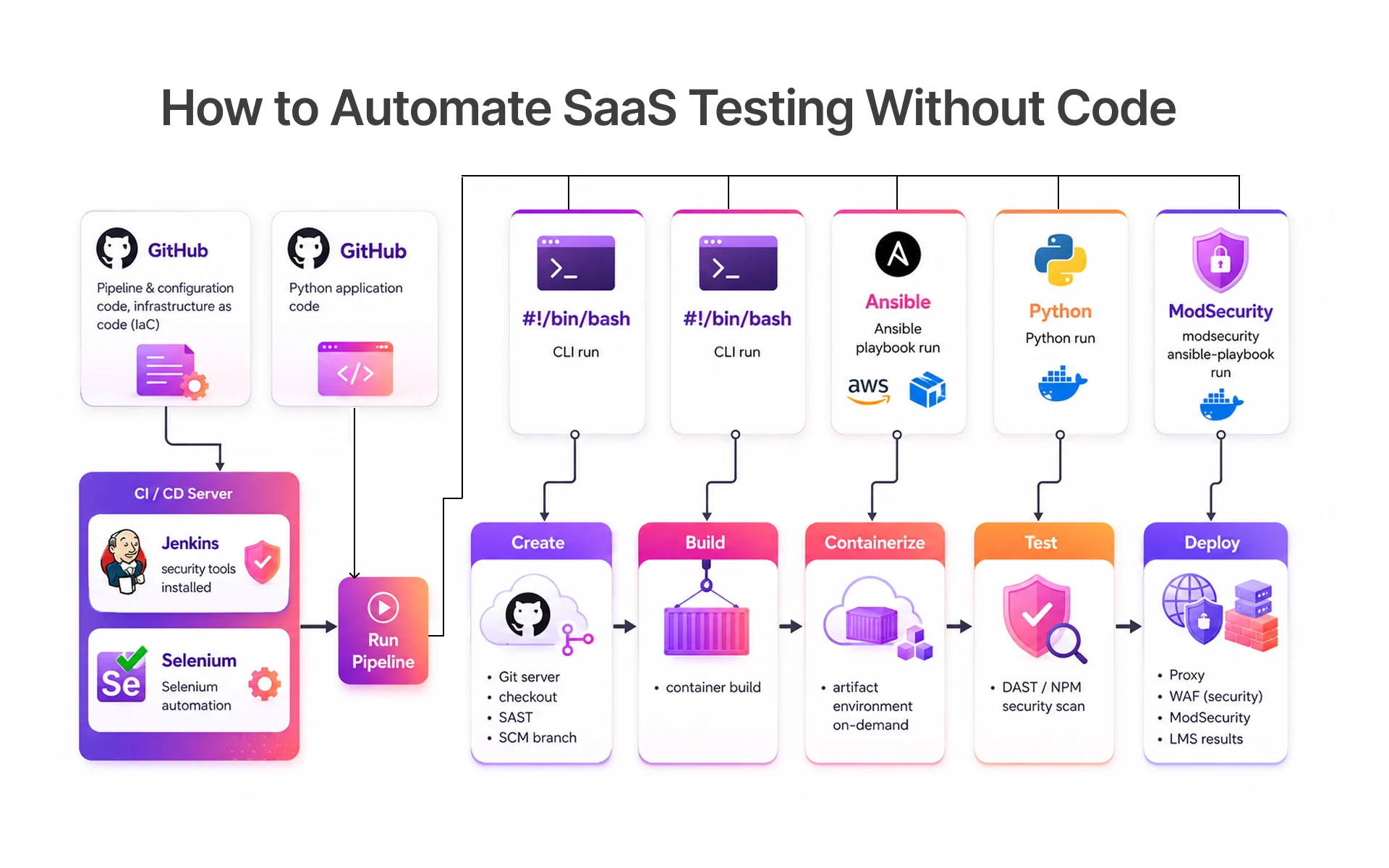
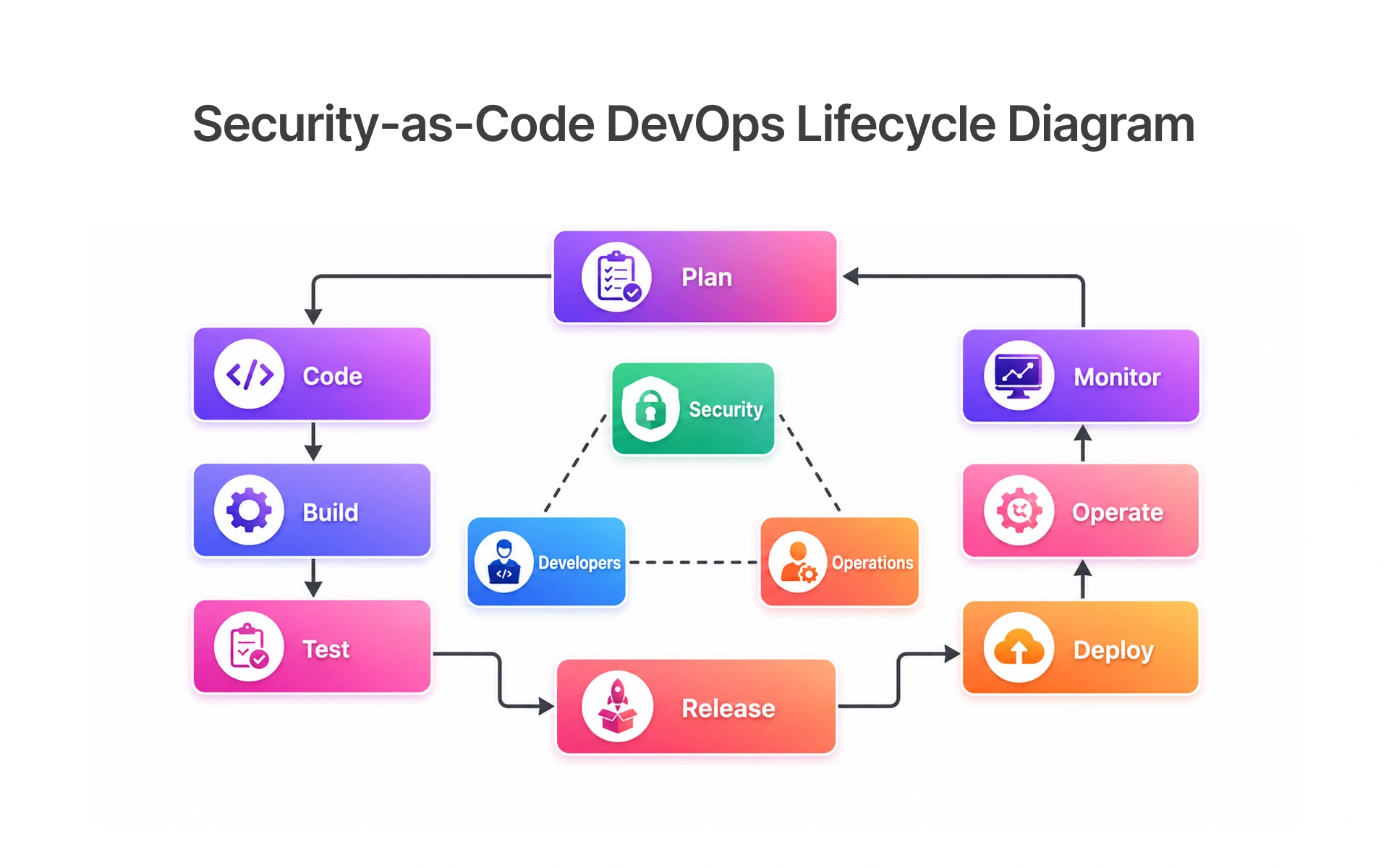
This is the point where Security-as-Code fits into a typical CI/CD pipeline:
This organization renders security controls a non-negotiable gateway and not an optional inspection. All scan findings and policy checks are recorded against a particular commit, and meeting this can be reported across environments. Businesses can strengthen their overall security posture further by combining these digital safeguards with retail security systems that protect physical locations against real-world threats.
What this model removes is the time difference between the introduction of a vulnerability and its discovery. In a conventional workflow, that gap is in weeks. It is time-stated in minutes in a DevSecOps pipeline that is Security-as-Code-driven.
Core Components of Security-as-Code: And What Each One Actually Does in Practice
IaC as the Security Foundation: Locking Down Configs Before Deployment.
Infrastructure-as-Code allows teams to describe cloud resources (servers, networks, storage) as versioned configuration files instead of configuring consoles manually.
The importance of it to security: As a security testing, IaC templates are the first deployable artifact testable in the deployment lifecycle. Those templates can be checked against security configuration policies before any resource is provisioned, not afterwards.
What this would mean in practice:
- The template itself is written with encryption, access control, and network exposure rules.
- Security validation is performed before provisioning - not after deployment.
- All environments are constructed using the same proven base.
- Badly configured templates do not pass validation and never get to staging or production.
Policy-as-Code: Implementing Policies that Move with your Infrastructure.
Writing security rules as code instead of documenting them in spreadsheets or runbooks is the practice of policy-as-Code. These rules are kept in version control and automatically checked at all levels of the CI/CD pipeline - starting with a first commit to a final deployment.
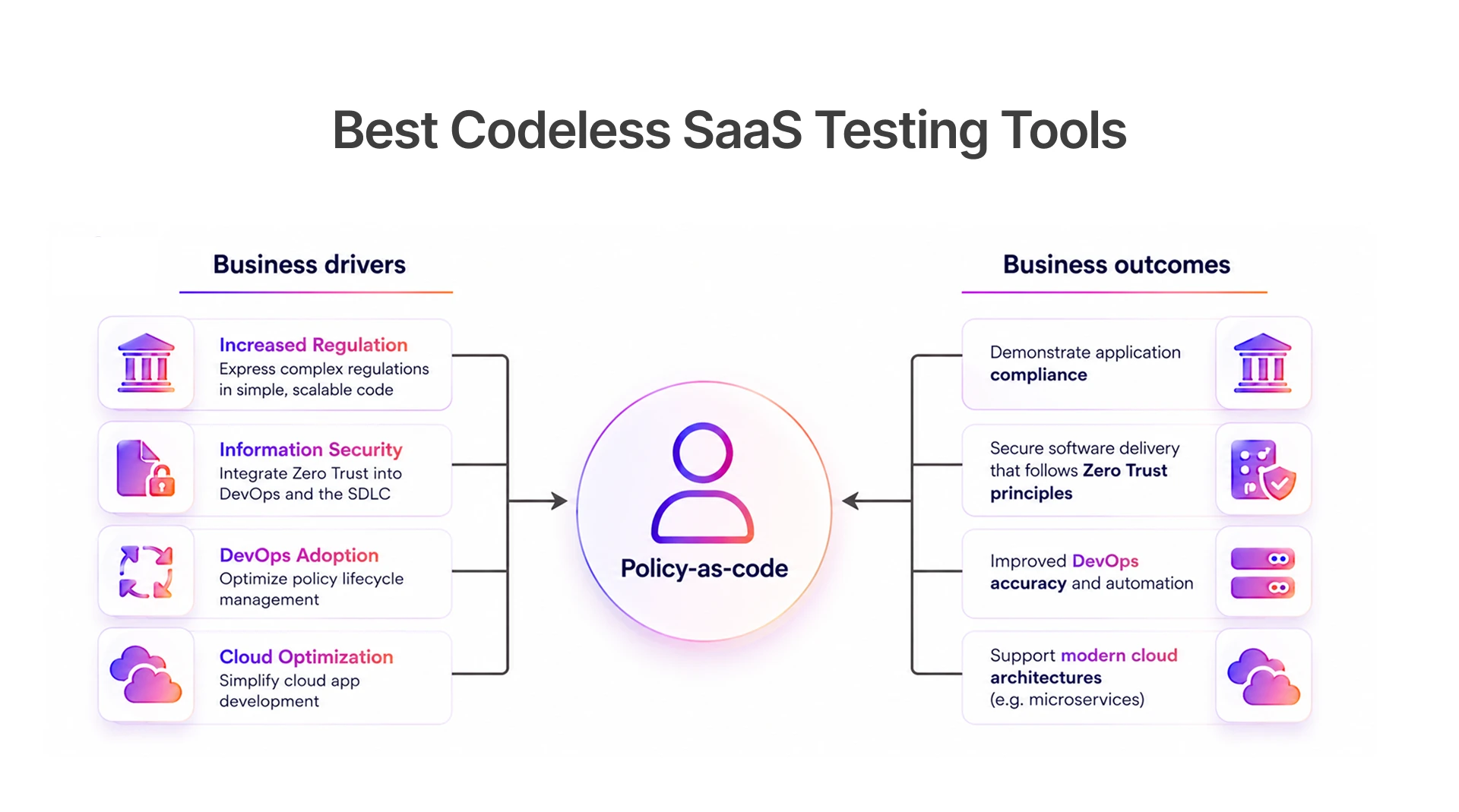
In practice, security policies travel with the infrastructure the same ruleset applies whether a team deploys to AWS, Azure, or an on-prem Kubernetes cluster, eliminating the manual effort of enforcing compliance separately across each environment.
Left Shifting Security Testing: Catching Vulnerabilities in the Pipeline, not Production.
Shifting left means running security tests earlier in the pipeline at code commit and pull request rather than at staging or post-deployment. Security scans in a classic workflow occur after the application has been built or staged, and vulnerabilities are costly to fix. By directly embedding automated security testing into the CI/CD pipeline, issues are identified and addressed during the development process itself.
Traditional vs Shifted Left:
IAM and Secrets Management: Controlling Who Gets What, and When
With an automated cloud system, access control cannot be based on fixed credentials or access permissions assigned manually. The identity-based access control and secrets management define what, under what conditions, and how long can be accessed by who and in what environment(s) - implemented programmatically across all services and environments.
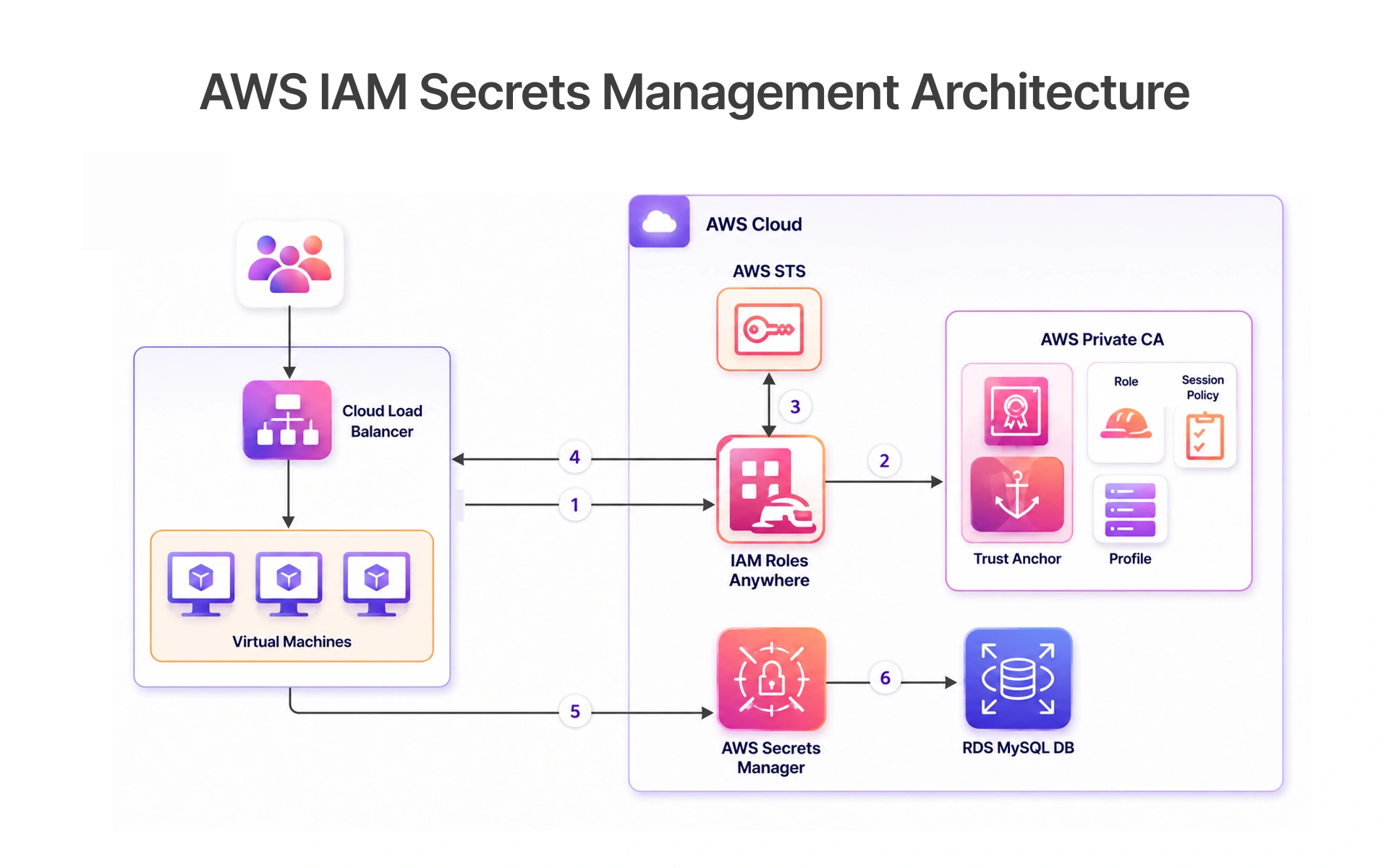
The flow, as shown in the picture, operates on two important layers:
Access Control Layer - IAM Roles Anywhere:
- Instead of using fixed credentials, virtual machines use IAM Roles Anywhere to authenticate.
- The IAM authenticates against Trust Anchors, Roles, and Session Policies that are defined in AWS Private CA.
- AWS STS uses short-lived, temporary credentials - removing long-lived access keys altogether.
- All access requests are scoped, time-bound, and fully auditable.
AWS Secrets Manager Secrets Management Layer:
- Application workloads access secrets on-the-fly directly out of AWS Secrets Manager.
- Secrets are never encoded in a program, never placed in environment variables, never written out in logs.
- The database credentials (e.g., RDS MySQL access) are injected safely where they are required.
Continuous Validation: Why a One-Time Scan Is Never Enough
At the point of deployment, one security scan only reveals where the environment was during that time of scan- not what the environment will be when the configuration change, new container is deployed, or a new threat is added by way of an update in a third-party library, creating a new vulnerability.
Cloud-native and ephemeral workloads. An abundance of changes occur many times per day across a Kubernetes cluster, CI/CD, and cloud-native applications. Static assessments cannot keep pace with this volume of change; validation must be continuous for:
- Security Posture Management (SPM) pinpoints config drift against defined security policies before they become an exploit
- Threat Detection monitors runtime containers, workloads, and API security boundaries for anomalous behavior
- Compliance Monitoring demonstrates current, not historical, compliance
- Vulnerability Scanning continuous scan of infrastructure, application code, and third-party libraries outside of the build stage, as shown
It is constant validation that makes security a deployment gate into a continuous and automated property of the system.
A Step-by-Step Guide to Implementing Security-as-Code in Cloud Systems
Step 1 Harden Your IaC Templates Before They Hit Any Environment
The templates that define any infrastructure need to be checked against established security configuration policies before any infrastructure is brought to a cloud environment.
All downstream environments inherit whatever security posture is provided in the template level - making this the most effective enforcement point throughout the entire implementation.
Step 2 Wire Automated Security Gates into Your CI/CD Pipeline
The hardened IaC templates can only work when the pipeline automatically implements them. Security gates make sure that all changes to codes and every update to the infrastructure are checked against the pre-defined security policies before proceeding with them.
.webp)
Wiring security gates into the CI/CD pipeline means:
- Incorporation of automated security checks at each phase- code, build, test, and deploy.
- Implementing a policy-as-code validation on each pull request before merging.
- The defaulting of the pipeline by default on the failure to pass a gate - warnings are not binding.
- Checking container security and third-party libraries during the build phase.
- Assign each gate result to its specific commit for full audit traceability.
A deployment pipeline has optional security, a CI/CD pipeline that does not have automated security gates.
Step 3 Build a Layered Security Testing Workflow (SAST, DAST, and Beyond)
There is no single testing method that can take care of all the vulnerability classes. A workflow of layered security testing integrates a variety of techniques throughout the SDLC - each is used to address a different attack surface at a different stage.
.webp)
As seen in the image, the cost of remediation will increase significantly the later the vulnerability has been identified. The aim is to identify a problem as soon as possible- at Access Need and Design stages- before a problem can compound.
The way the layers interact:
- SAST - Scans code seeking vulnerabilities during Design and Build and Development phases, prior to the application being run.
- Advanced DAST - Simulates real-world attacks of the Testing stage, all the way through Delivery, verifying runtime behavior against OWASP vulnerabilities.
- Traditional DAST - Applied during Testing and Production phases to simulate larger attacks.
- RASP Monitoring - procures self-protecting, real-time detection of the threat at the Delivery, Production, and Maintenance stages.
Each layer feeds the results back into the CI/CD pipeline - forming a continuous, automated loop of security testing across the entire software development lifecycle.
Step 4 Run Cross-Cloud Integration Tests to Catch Environment-Specific Gaps
Control measures that are passable in a given cloud environment do not necessarily pass through another. Each of AWS, Azure, and GCP has dissimilar default settings, permission structures, and networking actions - a misconfiguration that is identified in one environment may go unnoticed in another.
The 4Cs of cloud-native security create a systematic structure of what must be tested in each environment - making sure that no layer is presumed secure without testing.
All integration test results are recorded against their specific commit, feeding findings back into the CI/CD pipeline as automated security checks not post-deployment observations.
Security that can only be effective in a single environment is not security, but a single point of failure.
Step 5 Close the Loop with Feedback-Driven Security Monitoring
Security-as-Code is not over when it comes to deployment. All scan results, policy violations, and runtime anomalies detected across cloud-native workloads must feed back into the CI/CD pipeline - prompting remediation, policy updates, and re-testing on-going.
The operation of the feedback loop:
- Detect: Continuous monitoring is used to track policy drift, runtime anomalies, and compliance gaps across the cloud-native applications, containers, and Kubernetes clusters.
- Respond: Security orchestration, automation, and response paths automate the process of transitioning into remediation processes, eliminating manual triage.
- Update: Versioned, peer-reviewed, and committed back into version control are updated security configuration policies.
- Re-Test: Updated IaC templates and policies re-enter the CI/CD pipeline - verified by SAST, DAST, and vulnerability scanning before re-deployment.
- Repeat: Each cycle enhances security posture in all cloud environments, making the system ever-more resilient.
Without a feedback loop, security posture will deteriorate unnoticed between audit cycles - and policy drift will not be detected until it becomes an incident.
Tools That Actually Power Security-as-Code Workflows (With Real Use Cases)
Security-as-Code can only be as effective as the tools that implement it. The three most critical functional areas, IaC Security Scanning, Policy-as-Code Enforcement, and Application Security Testing, address the widest possible range of attack surfaces throughout the DevSecOps pipeline.
Common Challenges Teams Face When Adopting Security-as-Code
A switch to Security-as-Code is not necessarily a tooling decision, but rather an organizational and architectural change. These are the problems that most teams have faced and what actually works to fix them.
- Inconsistent Policy Enforcement Across Environments: Security policies enforced in AWS may often be missed in Azure or on-prem Kubernetes clusters. In the absence of policy-as-code being used consistently, compliance loopholes are found at each cloud boundary.
- Toolchain Fragmentation: The vast majority of teams adopt Security-as-Code in stages - adding SAST here, a secrets manager there. In the absence of a unified DevSecOps pipeline, security checks are executed in isolation, and there is no single view of security posture across cloud-native workloads.
- Hardcoded Secrets in IaC Templates: Without secret scanning at the stage of committing the code, credentials in Terraform or CloudFormation templates reach version control without any notice.
- Resistance to Shifting Security Left: Development teams used to late-stage reviews are resistant to the integration of SAST, DAST, and software composition analysis into day-to-day processes.
- Scaling in Multi-Cloud Environments: With Many Teams, each team may have its own cloud environments with no standard policy base.
How Frugal Testing Integrates into a Security-as-Code Architecture
In Frugal Testing's DevSecOps engagements, integrating automated security gates into CI/CD pipelines has consistently identified critical IaC misconfigurations including over-privileged IAM roles and exposed S3 bucket policies before any infrastructure reaches staging. Teams that added policy-as-code validation at the pull request stage reduced post-deployment security findings by measurable margins within the first two sprint cycles.
- IaC Security Validation: Finding and fixing misconfigurations in Terraform or CloudFormation templates before provisioning.
- Automated Security Testing Service: Reducing manual security reviews while increasing security testing for all stages of the CI/CD pipeline.
- API Testing Services: Confirm API security boundaries before they go out to the production environment.
- Mapping ongoing testing to regulatory compliance requirements across multi-cloud environments
Conclusion: Making Security a Built-In Part of Cloud Automation
The total number of security tools running on the application doesn’t matter nearly as much as whether or not all of the critical security controls are continuously tested across the entire SDLC. Issues with inconsistent policy enforcement, a fragmented toolchain, hardcoded secrets, and multi-cloud scaling all contribute to teams seeing Security-as-Code as a one-time activity as opposed to an everyday practice.
Security-as-Code does not eliminate misconfigurations it makes them structurally detectable before they reach production, so a misconfigured state triggers a failed gate rather than a silent vulnerability.
People Also Ask (FAQs)
Q1.How do we enforce consistent security policies across AWS, Azure, and on-prem Kubernetes?
Ans: Consistent security policy enforcement across AWS, Azure, and Kubernetes requires a unified policy-as-code layer tools like Open Policy Agent apply the same version-controlled ruleset across every environment automatically, eliminating environment-specific compliance gaps.
Q2.How can Security-as-Code auto-generate SOC 2 audit evidence?
Ans: Manual compliance evidence collection is error-prone and time-consuming. Security-as-Code logs every policy check, scan result, and access control decision against a specific pipeline commit generating continuous, traceable audit evidence that satisfies SOC 2 requirements without manual assembly before audits.
Q3.Which pipeline stage catches and blocks IaC misconfigurations before production?
Ans: IaC misconfigurations are caught at the code commit and pull request stages security scanning tools validate Terraform and CloudFormation templates before any cloud resource is provisioned, blocking non-compliant infrastructure from reaching any environment.
Q4.How do we detect infrastructure drift from the approved policy state post-deploy?
Ans: Infrastructure modified outside the pipeline breaks the approved security baseline silently. Continuous compliance monitoring tools compare live infrastructure configurations against version-controlled policy definitions in real time flagging drift automatically before it becomes an exploitable vulnerability.
Q5.How do we securely inject secrets into containers without exposing them in logs?
Ans: Secrets can be securely injected into containers at runtime using tools like Vault or AWS Secrets Manager ensuring credentials are never stored in code, environment variables, or pipeline logs.


.webp)