


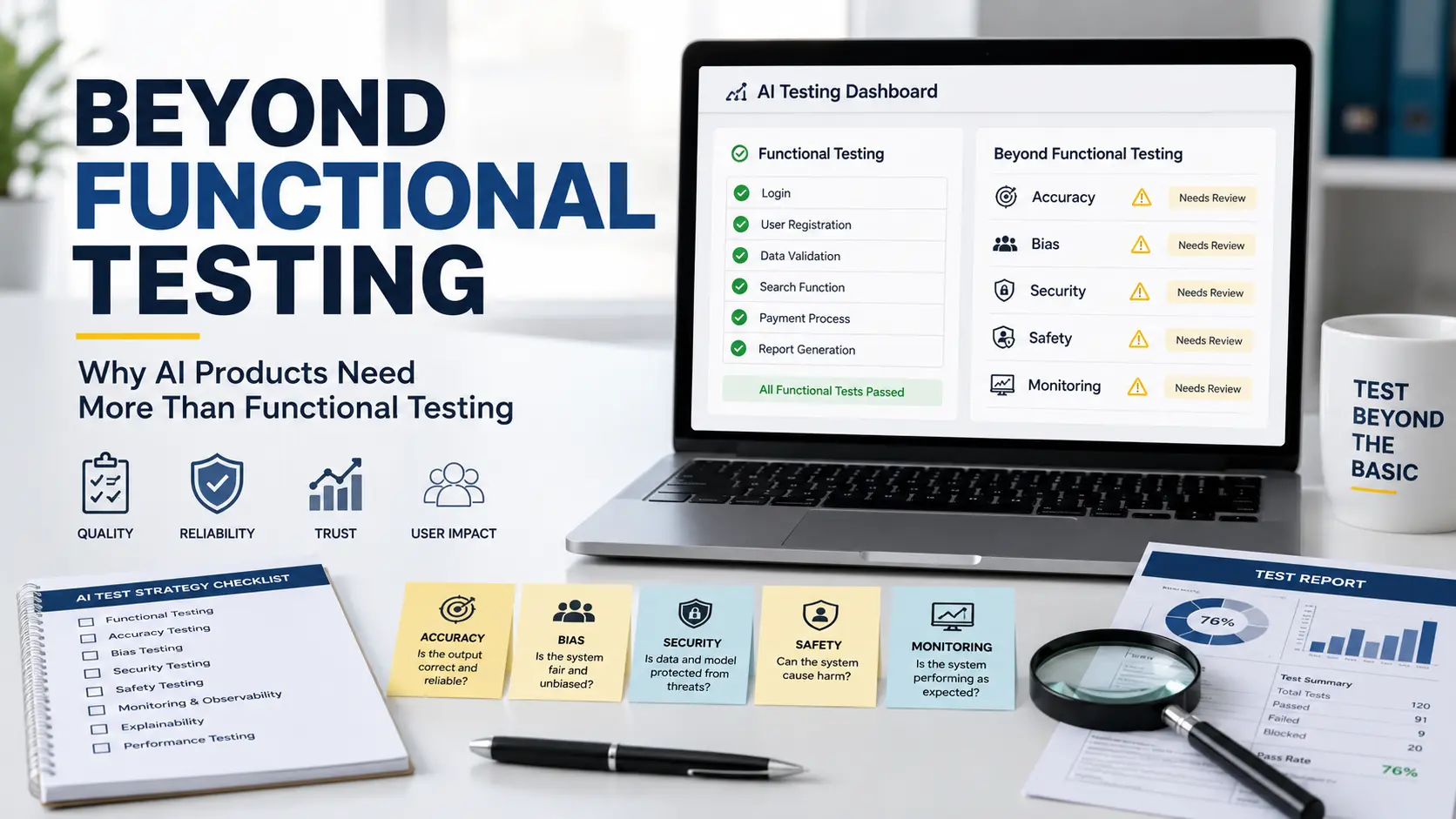
Artificial intelligence is changing how people use software by making digital products more adaptive and intelligent. It powers personalized experiences and supports increasingly complex decision-making across industries. As AI becomes more common, users expect systems to be accurate, reliable, and trustworthy.
Unlike traditional software, AI can generate unpredictable outputs in real-world situations. This makes evaluating product quality more challenging than simply verifying functional features. Organizations that ignore these challenges risk weaker user trust, compliance concerns, and costly performance failures.
In this article, we’ll explore why AI products require testing approaches that go beyond functionality to ensure dependable, ethical, and consistent real-world performance.
Functional Testing Alone Cannot Capture AI Behavior
Traditional feature verification ensures expected functions work correctly, but cannot accurately measure how AI systems respond to unpredictable inputs and changing conditions. AI systems may produce different outputs for similar inputs because they learn from data rather than fixed rules. Comprehensive testing helps identify inconsistencies, bias, and reliability issues before deployment.
Real-world AI performance can create concerns that functional testing alone may not reveal. The Organisation for Economic Co-operation and Development (OECD) found that AI-related data collection increased workplace pressure for many employees. It affected 62% of finance workers and 56% of manufacturing workers.
Many also reported privacy concerns and feared biased decisions, highlighting the need for broader AI evaluation.
Real-World Incidents Show Why AI Safety Matters
Recent legal cases have intensified concerns about the safety and accountability of AI-powered applications. One of the most widely discussed examples is the Character.AI lawsuit. In October 2024, NBC News reported that Megan Garcia sued Character.AI and Google after her 14-year-old son, Sewell Setzer III, died by suicide.
The Character AI lawsuit alleges that his interactions with a Character.AI chatbot contributed to his deteriorating mental health. It also claims that the platform failed to provide adequate safeguards for vulnerable users. The case has brought greater attention to AI safety and protecting vulnerable users.
TorHoerman Law notes that families argue that Character.AI blurred critical lines. The platform presented itself as a supportive presence for distressed individuals. Consequently, this obscured the distinction between casual chat and mental health intervention.
Development teams should test AI models under challenging real-world conditions while verifying content moderation and safety safeguards before deployment. Learning from such incidents strengthens testing practices and promotes more responsible AI systems.
Expand Testing to Include Risk and Safety Evaluations
AI products increasingly shape user experiences, making comprehensive risk and safety evaluations essential throughout testing and deployment. AI systems performing well normally may still generate harmful or biased outputs under unexpected real-world conditions or prompts.
Testing adversarial inputs, edge cases, privacy risks, and content safety identifies vulnerabilities before they affect real-world users. This proactive approach not only strengthens product reliability but also protects brand reputation, regulatory compliance, and user confidence.
Organizations that make safety testing a core part of quality assurance build more dependable AI systems. This approach promotes consistent performance while building stronger user trust and long-term confidence in AI systems.
Measure User Trust Alongside Technical Performance
Technical accuracy alone cannot determine whether an AI product delivers a positive user experience. Organizations should also measure user trust, satisfaction, and confidence during testing. Evaluating these factors helps identify usability concerns, strengthens adoption, and supports the development of more reliable and responsible AI systems.
User trust can decline even when AI systems perform their intended functions correctly. PwC's survey found that nearly one in three respondents reported low trust in online platforms. Outside the technology, media, and telecom sector, only one in eight reported similar distrust.
As AI adoption expands, measuring user trust alongside technical performance ensures confidence, sustained adoption, and long-term success. Trust also matters beyond the performance of an AI product itself. As buyers increasingly use generative AI platforms to research solutions and compare providers, companies must understand how these systems interpret their credibility, expertise, and market relevance. AI Search Demand Generation is the practice of strengthening the signals that help AI platforms confidently surface and recommend a brand. Companies such as Arobis AI help businesses assess these signals and improve how they are represented throughout AI-assisted buying journeys.
Make Continuous Monitoring Part of the QA Process
AI quality assurance should not end at deployment because model behavior can shift as data, users, and conditions change. Continuous monitoring helps teams detect performance drift, unsafe outputs, and emerging risks before they affect users. Integrating continuous monitoring into quality assurance helps maintain AI reliability, accountability, and consistent performance as systems evolve.
Continuous monitoring helps keep AI systems reliable as models, data, and user behavior evolve over time. Cybersecurity and GRC specialist Mark Harris notes that ongoing assurance detects performance drift, bias, and unexpected behavior. It detects issues early before they create operational, regulatory, or reputational risks for organizations.
Integrating continuous monitoring into QA strengthens long-term AI safety, reliability, and governance.
Build Cross-Functional AI Testing Into Every Release
AI testing is strongest when product, engineering, compliance, and user experience teams review each release together. Cross-functional input helps uncover blind spots that technical checks may miss, from safety risks to user confusion.
Making this collaboration part of every release creates better accountability, faster fixes, and more trustworthy AI products. Effective AI testing depends on strong collaboration across teams, not isolated technical reviews.
IBM's survey found 68% of CEOs consider integrated data architecture vital for collaboration. Additionally, 72% view proprietary data as essential for generative AI. Bringing diverse teams into every AI release helps identify hidden risks earlier and supports safer, more reliable outcomes.
Key AI Testing and Trust Statistics
Building AI That Users Can Trust
As AI becomes more influential in everyday decisions, the standard for quality must extend beyond functional performance. Products that are accurate but unsafe, biased, or unreliable can quickly lose user confidence. Organizations that embrace comprehensive testing are better equipped to identify hidden risks before they affect real people.
Combining technical validation with safety, trust, and continuous monitoring creates stronger AI systems. It helps teams uncover hidden risks early and improve reliability over time. Responsible testing is ultimately about building AI products that users can confidently rely on.
People Also Ask (FAQs)
Q1. What is the hardest AI behavior to reproduce during testing?
Ans: Inconsistent AI responses under similar conditions remain the most difficult behavior to reproduce. AI outputs can vary because of probabilistic generation, changing context, or model updates. Testing with diverse scenarios and repeated evaluations helps identify these inconsistencies more effectively.
Q2. How can QA teams test AI features that produce different outputs for the same prompt?
Ans: QA teams should evaluate response quality against defined acceptance criteria instead of expecting identical outputs. Testing multiple prompt variations and edge cases reveals consistency, safety, and reliability. Combining automated evaluations with human review strengthens AI validation and improves overall testing reliability.
Q3. How can AI safety issues be prioritized alongside functional bugs?
Ans: AI safety issues should be assessed based on their potential impact on users and business risks. High-severity concerns such as harmful content, bias, or privacy failures deserve immediate attention. Risk-based prioritization ensures AI functionality and user safety receive equal attention throughout development.

.webp)

.webp)