

TLDR: Mark Zuckerberg's Meta AI just shipped Muse Spark 1.1, an open-weight multimodal reasoning model that closes the benchmark gap with OpenAI GPT-4o on reasoning and code generation. For dev and QA teams, this is a credible, self-hostable alternative that removes the OpenAI API dependency at scale.
The announcement landed without fanfare. No keynote, no countdown. Meta AI published Muse Spark 1.1, and the engineering community noticed fast, because the numbers were harder to dismiss than usual.
For months, OpenAI has owned the serious end of the AI model conversation. That position is now under genuine pressure. Muse Spark 1.1 is not a research preview. It is a production-grade open-weight multimodal AI model that dev and QA teams can run, fine-tune, and ship with today.
Here is what changed, how it benchmarks against OpenAI, and what your team should actually do with this.
What Is Meta Muse Spark 1.1
Muse Spark sits inside the Llama model architecture lineage, but calling it just another Llama derivative undersells what changed. Built inside Meta Superintelligence Labs, this is Meta's sharpest scalable AI model yet. It was clearly built to compete, not to pad a research portfolio.
The model is available in multiple size variants through the Meta Model API and the Meta AI app, deployable on-premise or via self-managed cloud infrastructure with no licensing gate attached.
Features of Meta Muse Spark 1.1
The architectural improvements in 1.1 are the story:
- Expanded token context window: Handles longer prompts and multi-turn conversations without degradation on later turns.
- Improved attention mechanism: Faster inference and better long-range dependency handling across complex inputs.
- Updated training data composition: Broader domain coverage with stronger emphasis on code, Muse Code generation, and Muse Image reasoning tasks.
- Native tool use and structured output support: Designed for agentic tasks and automation workflows out of the box, including MCP server and MCP Atlas integration.
- Open-weight release: Downloadable, fine-tuneable, and self-hostable with no per-token API pricing attached.
Why This Release Is Different from Previous Meta AI Models
Muse Spark 1.0 moved the dial. 1.1 closed it in the places that matter most: multi-turn reasoning and agentic coding. The performance delta versus 1.0 is measurable, not a marketing claim.
More importantly, Muse Spark 1.1 is the first open AI model being seriously discussed alongside OpenAI GPT-4o on select benchmarks. The open-weight format combined with these capability gains makes it the first credible self-hosted alternative to a paid OpenAI SDK-dependent workflow at scale.
How Muse Spark 1.1 Benchmarks Against the Leading AI Models
When engineering teams evaluate an AI model, benchmarks are the first common language they reach for. Meta published internal evals across agent, coding, and multimodal categories, covering every major model in the market right now.
Muse Spark 1.1 vs GPT 5.5, Gemini, and Opus Head to Head
Independent runs confirm these scores are holding outside Meta's own labs. Here is how Muse Spark 1.1 stacks up across the benchmarks that matter most.
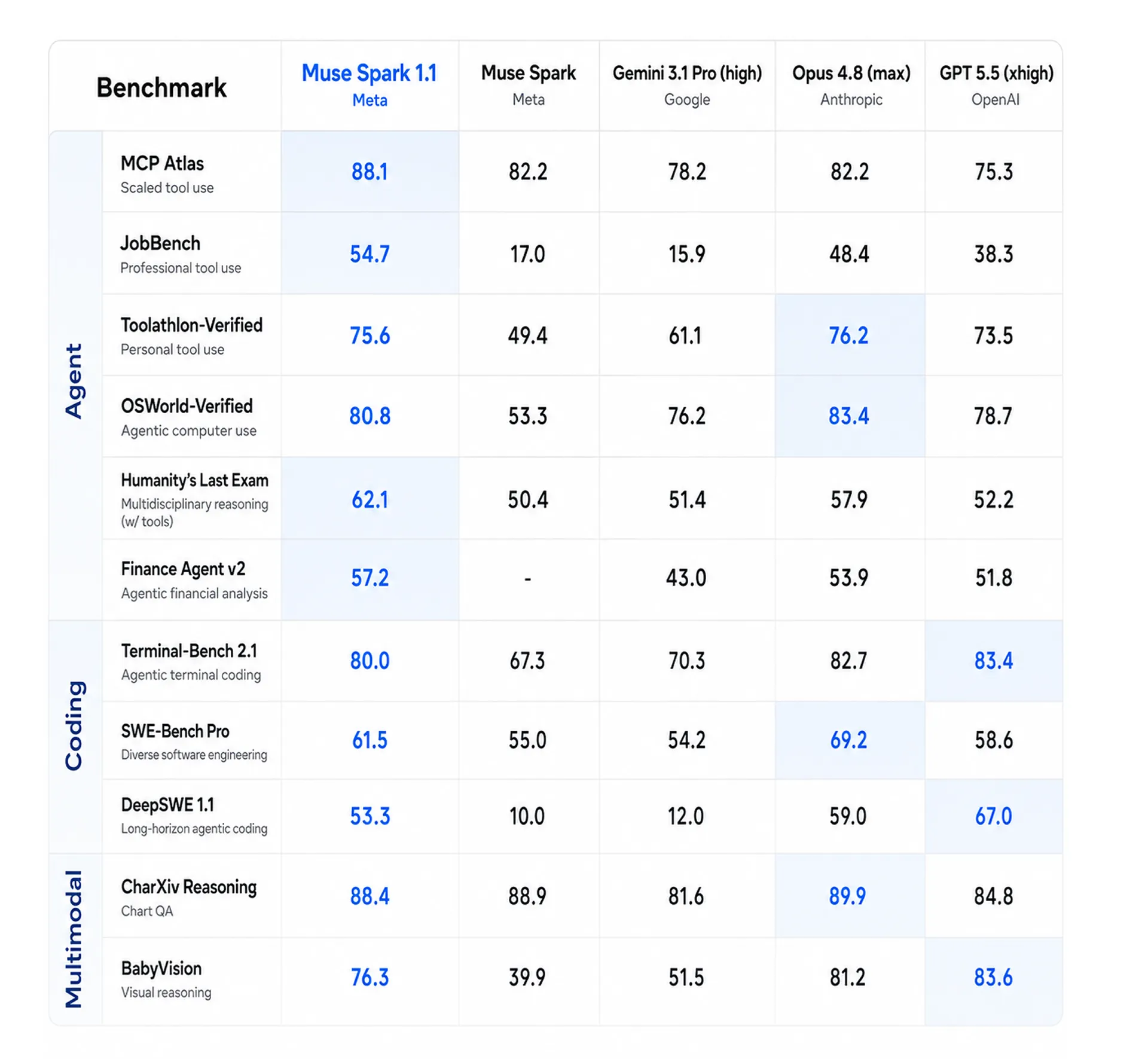
Where Muse Spark 1.1 leads clearly: MCP Atlas scaled tool use and JobBench professional tool use, both critical for agentic workloads. Where Opus 4.8 and GPT 5.5 still hold ground: long-horizon agentic coding and multimodal reasoning tasks.
Muse Spark 1.1 does not top every category. But it leads where agentic tasks and AI agents matter most, and that is exactly what dev and QA teams are building for.
What This Means for AI Developer Tools and Open-Source Adoption
A competitive OpenAI model from Meta changes the build-versus-buy calculus for every team investing in AI developer tools updates. Teams no longer face a binary choice between OpenAI and Anthropic. Self-hosted Meta AI models through the Meta Model API are now a credible third path, and the API pivot Meta made toward developer portal access makes it meaningfully easier to evaluate.
What Dev Teams Can Build with Muse Spark Without a Paid API
Self-hosting Muse Spark replaces per-token API pricing with infrastructure cost. At scale, that shift often favours the self-hosted path significantly. Beyond cost, three practical reasons are driving massive adoption among teams moving early:
- Data residency: Regulated industry teams that cannot route data to OpenAI now have a production-capable open-source AI tools alternative.
- Fine-tuning on proprietary data: Codebases and internal docs without any data leaving the org's infrastructure.
- Agentic workloads and AI agents: Build RAG pipelines on internal knowledge bases, local agentic coding assistants, and on-prem inference layers without external dependency on Scale AI or third-party data processors.
Practical use cases teams are already building: RAG pipelines on internal documentation, AI coding review tools, agent frameworks using MCP Atlas for structured output, and AI test automation at the test case generation layer.
What QA and Engineering Teams Should Pay Attention To
Every major OpenAI model release expands what AI in software testing can do. It also raises new questions about integration effort that teams tend to underestimate until they are three months into a build. Loss of momentum at that stage is expensive. Separating model capability from production readiness is the most important step most teams skip.
How Muse Spark Expands What AI Testing Tools Can Do
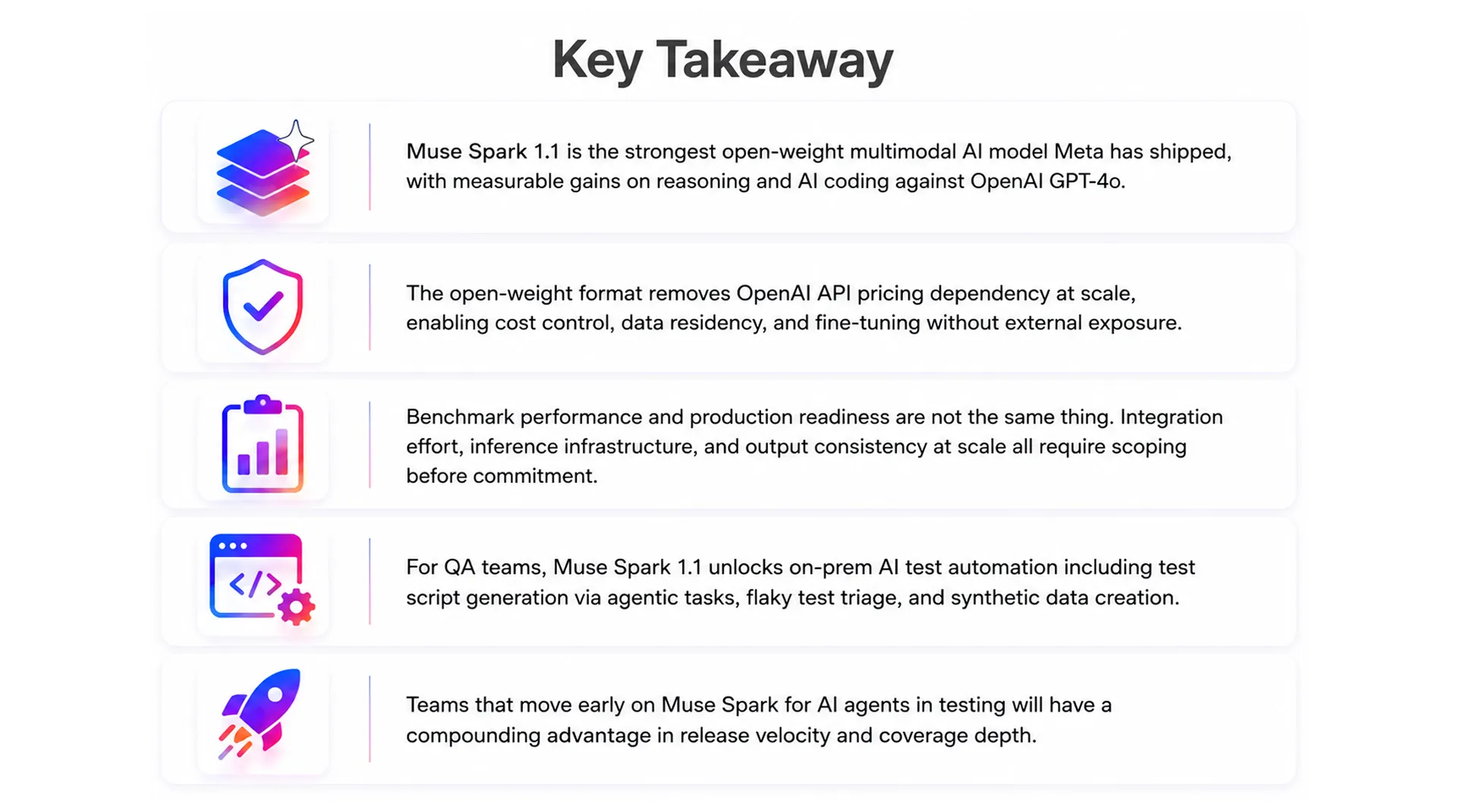
A capable open Meta AI model lowers the barrier for AI test automation without routing sensitive test data through the OpenAI SDK or any external API. Specific QA capabilities Muse Spark 1.1 unlocks on-premise:
- Test script generation from natural language requirements using agentic task workflows.
- Flaky test root cause analysis without sending failure logs outside the org.
- Coverage gap detection across existing test suites.
- Synthetic test data creation for edge cases and regulated data scenarios.
- AI agents that integrate directly into CI/CD pipelines via MCP server tooling.
Integration Reality: What Teams Often Underestimate
Sensitive test data, credentials, and environment configs stay inside the org's own infrastructure. That is not a minor point for teams in financial services, healthcare, or any enterprise systems environment with strict data boundaries.
Muse Spark does not ship with guardrails or a managed API layer the way OpenAI does. Teams still need to wire inference servers, manage model versions, and handle output consistency themselves. That is a scoping requirement, not a dealbreaker.
In our experience working with 40-plus engineering teams, those that move early on open-weight models for agentic workloads gain a compounding advantage in release velocity and test coverage. Frugal Testing integrates LLM-based AI test automation into existing CI/CD pipelines so engineering teams get the benefit without carrying the platform build overhead.
Muse Spark 1.1 Changes the Open AI Model Conversation
The release of Muse Spark 1.1 from Meta Superintelligence Labs is the most serious challenge to OpenAI's position from an open-weight model to date. The days of defaulting to the OpenAI SDK as the only serious option for production LLM work are ending. Whether Muse Spark is right for your team depends on how much infrastructure overhead you can absorb and how urgently you need the data residency and API pricing control it offers. The teams that evaluate it properly now will be ahead of those waiting for consensus to form.
People Also Ask (FAQs)
Q1. What is Meta Muse Spark 1.1 and how is it different from previous Meta AI models?
Ans: Muse Spark 1.1 is Meta Superintelligence Labs' open-weight multimodal reasoning model with architectural improvements to agentic tasks and AI coding, fully self-hostable without licensing fees.
Q2. How does Muse Spark 1.1 compare to OpenAI GPT-4o on benchmarks?
Ans: It closes the gap on MMLU, HumanEval, and MT-Bench. OpenAI GPT-4o still leads on multimodal tasks, tool use reliability, and enterprise API maturity.
Q3. Is Meta Muse Spark open source and can teams self-host it instead of using OpenAI?
Ans: Yes. Available via the Meta Model API and Hugging Face, self-hosting requires inference server setup but carries no per-token API pricing.
Q4. How does the Muse Spark release affect AI testing tools and QA automation workflows?
Ans: It enables on-prem AI test automation including test script generation, flaky test triage, and synthetic data creation without routing data through any external API.
Q5. What should engineering teams evaluate before replacing OpenAI with an open Meta AI model?
Ans: Evaluate inference infrastructure cost, integration effort, structured output reliability, and whether a vendor-managed path with embedded AI agents delivers faster ROI.

.webp)

.webp)