

Codeless automation testing is transforming how QA teams build, maintain, and scale test automation. Traditional script-based testing is slow, expensive, and difficult to maintain.
Codeless automation testing is transforming how QA teams build, maintain, and scale test automation. It reduces QA effort by 40–70%, speeds up test creation by 3–5x, and minimizes maintenance through AI-powered self-healing. It also enables non-technical users to create tests, making it ideal for fast-moving teams. In this guide, we explore how it works, its ROI, and how to implement it successfully.
In this guide, we break down how codeless automation works, its ROI, real-world benefits, and how to implement it successfully.
Why Most QA Strategies Break in Modern Software Delivery Pipelines
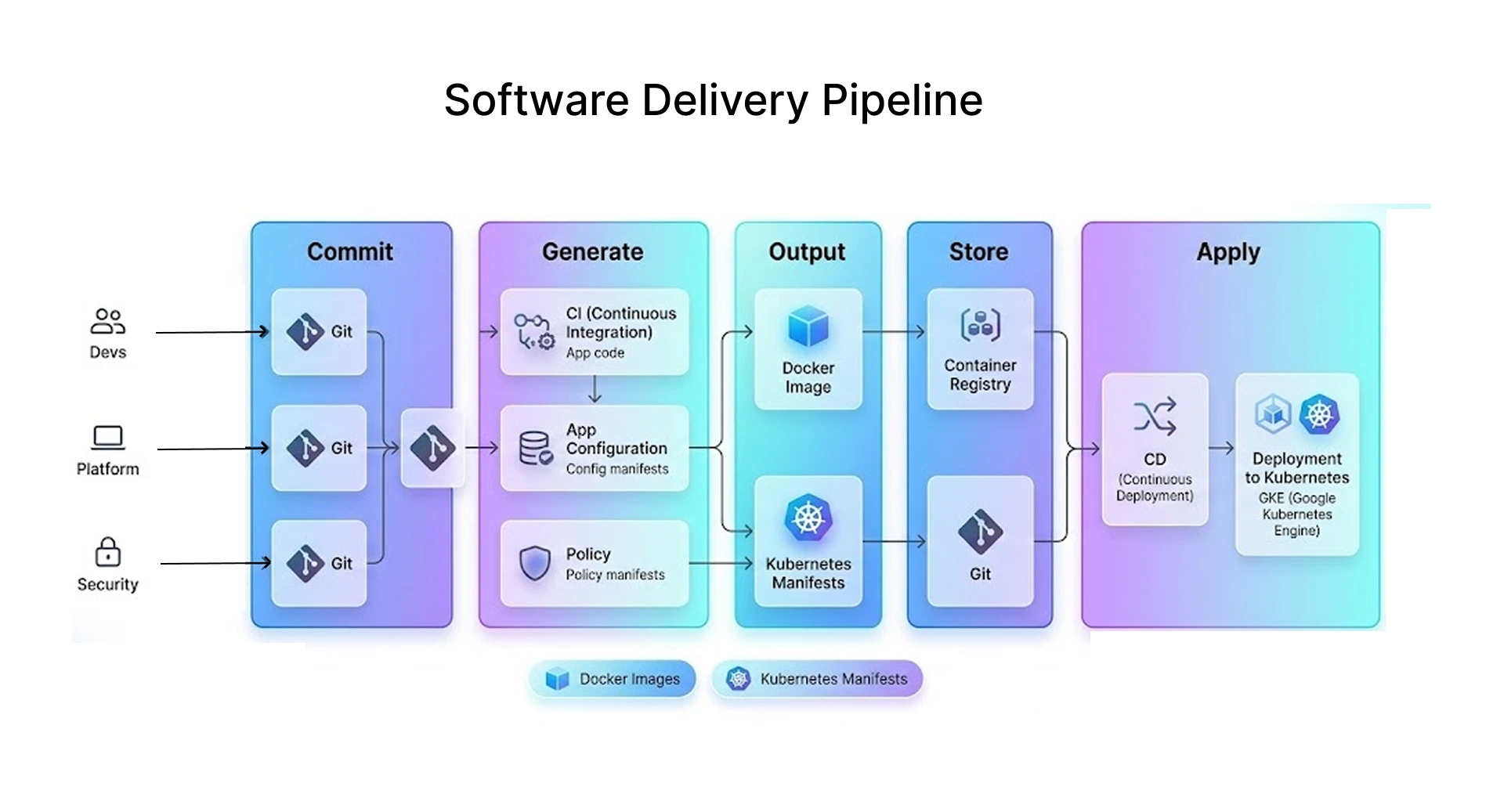
These days, the way code gets shipped is wildly different from how it was two or three years ago. CI/CD pipelines, distributed teams, time zones, etc.- these aren’t the exception anymore; they're the rule. But a lot of the QA strategies we’re using are still built for the world where we shipped code once a month and where one developer was responsible for the whole test suite. That mismatch isn't just inefficient-it’s actively dangerous for product quality.
The result is predictable. Testing is the bottleneck-everybody else is waiting on us. Bugs are getting into production not because the vendor is careless, but because the testing level simply can't keep up. Teams burn out maintaining fragile automation frameworks that break every time a UI element shifts by two pixels or a button ID gets renamed.
Why Script-Based Automation Fails at Scale
Script-based automation was a huge leap forward when it first came along. Selenium, JUnit, TestNG - these tools gave developers real power. But scaling them across an organization revealed uncomfortable truths that the vendors were reluctant to acknowledge.
Limitations of Codeless Automation Testing
Codeless automation has its benefits but also has its drawbacks. Teams should consider the following negatives prior to implementing a codeless solution:
- Not Suitable for highly complicated or unique workflows.
- Not as flexible as is possible with a code-enabled Framework.
- There could be risks associated with vendor lock-in.
- Might require a hybrid implementation for handling unique edge cases.
By acknowledging these limitations, you will be able to build trust, enhance your credibility, and improve decision-making.
Where Traditional QA Models Lose Time and Efficiency
The longer our releases are pushed back, the greater chance our competitors have to get further ahead of us and gain a larger share of the industry than we do. If you count all of the costs from these delays, between dozens of features, hundreds of iterations, and an entire engineering team that isn’t engaged in more profitable activity, the costs quickly add up and are high-not just in terms of productivity lost, but to the morale of the team working on those features; it is very clear to see that we have more than just lost confidence in the team-in fact, we have lost all momentum that the team had been building up from one release to the next.
Codeless Automation Testing as a Scalable QA Strategy
Codeless, or 'no code', automation testing represents a fundamental paradigm shift in the role of testing within the software development life cycle of the future. We are not only trying to figure out ways to automate testing faster anymore; we are trying to determine how we can build an entire layer of testing that can scale without breaking or falling apart on the way up, and that can be contributed to by any member of the team who has expertise in the area.
Definition and Architecture of Codeless Automation Platforms
The Execution Engine allows for tests to be run in multiple browser environments, on different devices, and under various environmental conditions at the same time.
AI/ML Layer - Provides intelligent locator recovery, intelligent recommendations, and anomaly detection.
Integration Layer - Connects with other platforms directly through Jenkins, GitHub Actions, and Azure DevOps.
Enterprise-class codeless platforms can provide businesses with abilities that other market available record/playback products do not provide. The recorder is the entry point to a codeless testing framework; however, all of the value lies in what happens in lower layers of the architecture.
Core Capabilities of Enterprise-Grade Codeless Tools
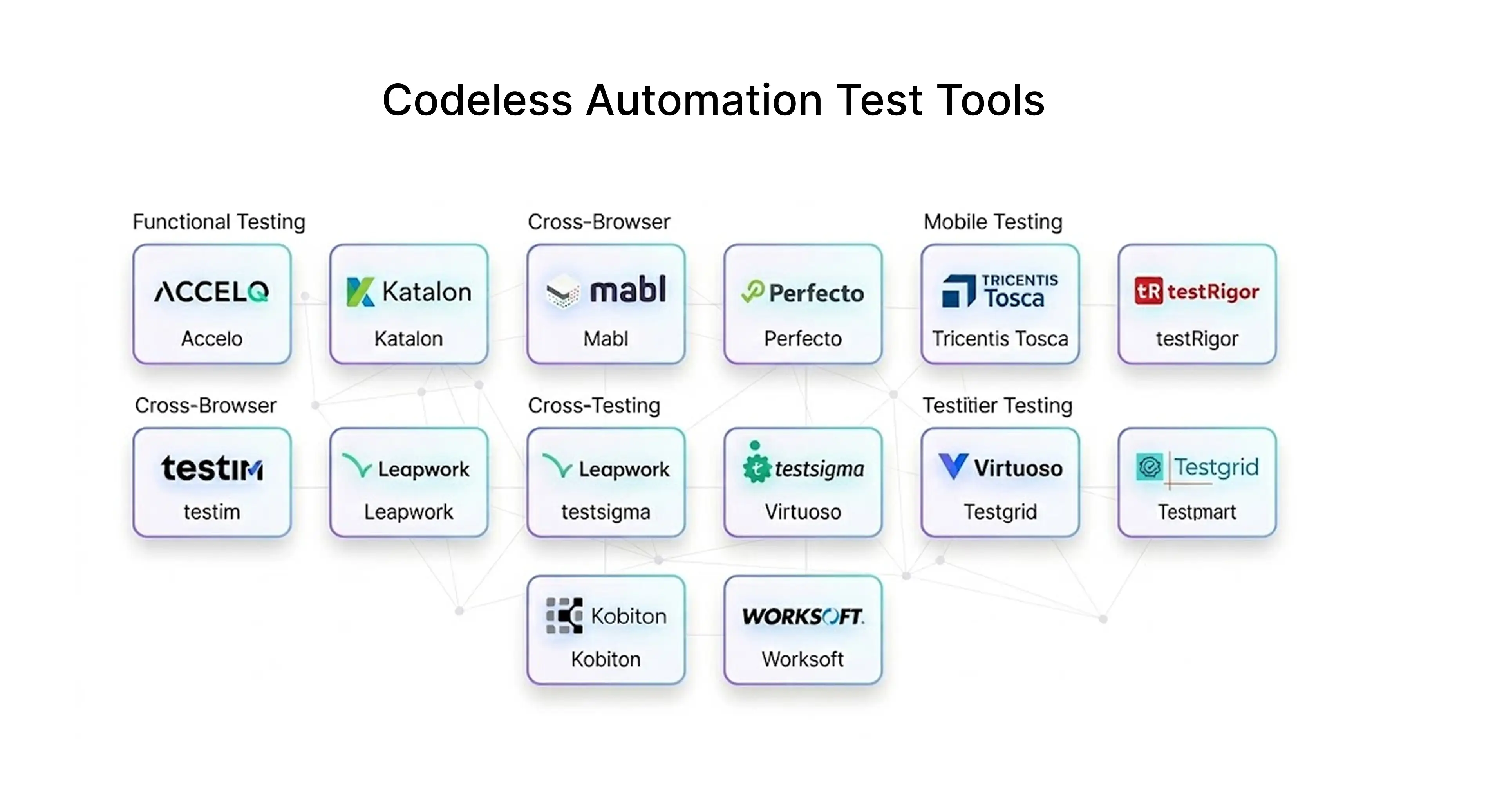
Tools Comparison for Codeless Automation
Implementation Framework for Codeless Automation
Many companies fail to implement codeless automation due to their fragmented tooling between UI, API, and Mobile, which creates gaps in their integrations and inconsistent reporting. Look for a platform that combines all three of these toolsets into one place.
After you've chosen the right platform, you will take two non-negotiable steps:
- Before you get near the tool, make sure that your QA objectives are in alignment with your organization's business KPIs. Those organizations that fail to do this will find themselves measuring the wrong things and losing the support of their leadership team quickly.
- Treat the codeless automation initiative as a transformation and not merely a tool swap-out; those organizations that merely view codeless automation as another piece of technology will invariably have lower performance metrics than those that embed codeless automation into their overall delivery strategy.

Aligning QA Automation with Business KPIs
As organizations change their QA metrics to align directly with the enterprise’s business goals, customers will experience greater satisfaction and increase the rate of revenue per product purchase than they would otherwise experience with defect escape rate as their only metric.
The most important QA metrics from the business perspective are:
- Defect escape rate – customer satisfaction and support costs
- Release frequency – revenue velocity and competitiveness
- Test coverage – production risks and compliance costs
- Mean time to detect (MTTD) – developer productivity
Tool Selection Criteria for Enterprise Adoption
Actual operation of the product requires demonstration through a full test of operation, including using the product in a real environment, not a demo environment. The look of the platform in a clean area doesn't mean it will work well when tested against both existing legacy code and the full front-end technology stack of the company. Most vendors will perform a structured proof of concept, and if the vendor will not do so then you should be concerned.
What ROI Can You Actually Expect from Codeless Automation?
The trend and direction of ROI results are true for all industry sizes and types of companies; the actual results are consistent and result in the same outcome, but vary with different total numbers of employees tested, complexity of applications, and current status of the company's QA process.
How Much QA Cost Can You Reduce Across the Lifecycle?
Codeless automation for this mid-sized company with 20 QA engineers will give operational capacity of 8-12 engineer equivalents. Capacity will be dedicated to exploratory, security, and performance testing, which cannot be automated. Return on investment does not only include cost savings, but businesses also need to use costly employee resources on high-value activities.
How Does It Improve Release Velocity and Time-to-Market?
The quicker you can release products to your customers, the faster your organization's revenue generation and customer feedback development processes become. Organizations that follow a rapid cadence for releasing their products have an advantage; SaaS companies that can release major improvements to their product weekly have a distinct competitive advantage over those that release large-scale improvements to their product only once per month.
Does It Reduce Defect Leakage in Production?
The leadership team typically does not see that their actual ROI is much better than they realize, based on a study done. The study shows that development defects that get detected by testing cost 6 times as much to fix as those that are found during production. The actual cost of fixing a defect found in the post-release phase is 100 times the cost of fixing a development defect that was identified during testing. The production testing process does not include the costs of finding defects, so they incur greater costs due to the fact that their testing budget does not allocate for these costs, which leads to inaccurately estimating the costs of testing losses.
Codeless automation can reduce the leakage of defects through the following:
- Team members who generate tests will provide greater test coverage by providing test coverage through others, so that all developers can provide a greater number of tests that cover more scenarios without having additional personnel
- Every commit of code is tested through continuous integration testing during all phases of the software development life cycle.
- AI technology can identify untested paths through its ability to identify and locate instances of testing deficiencies.
Where AI Actually Adds Value in Codeless Testing
AI in software testing is a phrase that gets used a lot - and misused almost as often. Here's where it genuinely changes outcomes in measurable, reproducible ways.
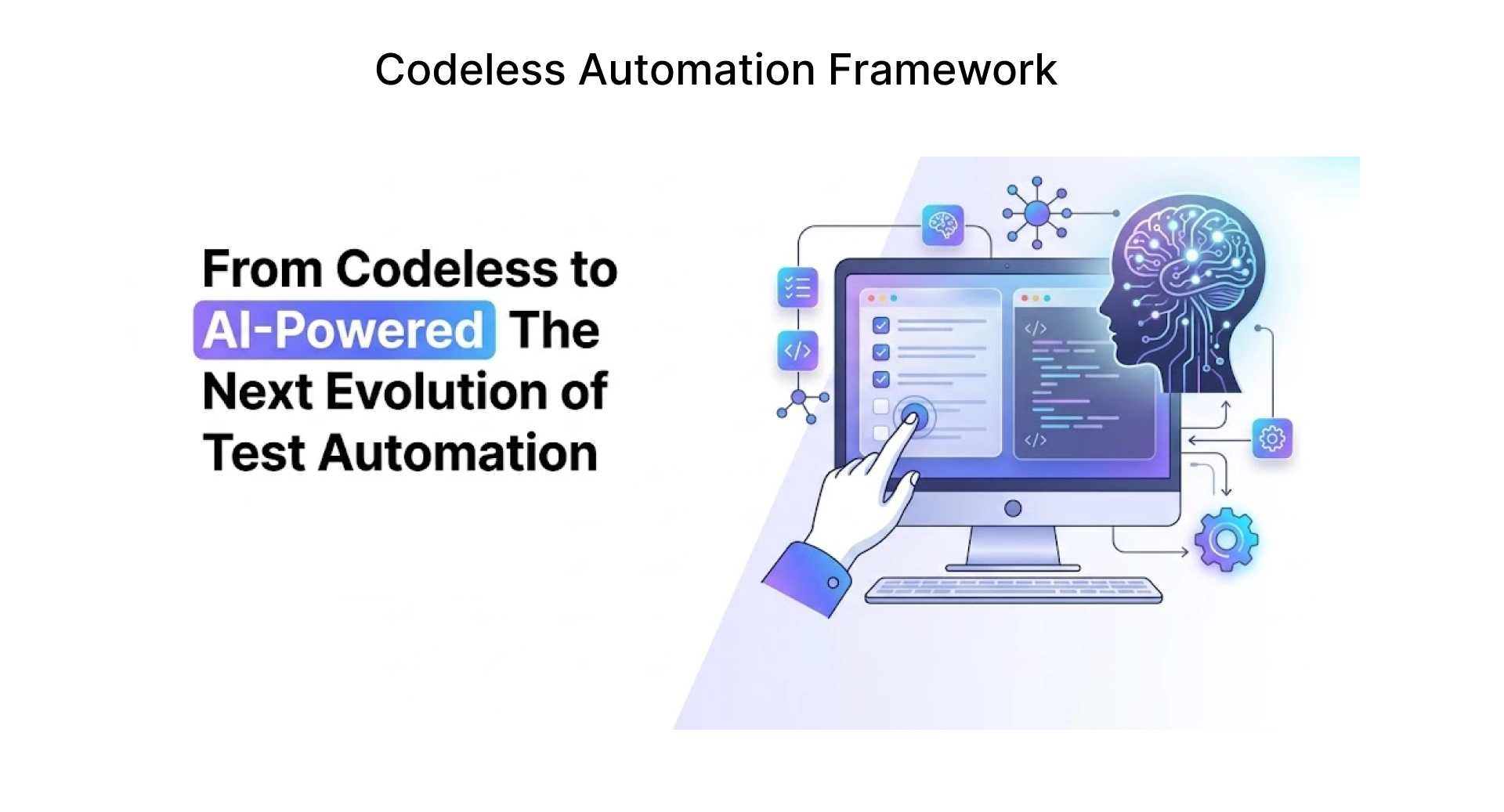
How AI Improves Test Case Generation and Maintenance
AI provides the greatest benefit when it comes to generating and maintaining tests (i.e., the costs associated with maintaining the test throughout the lifecycle of the application). The key benefit of AI is self-healing (if the UI changes, for example), which means that the AI can detect if a change has occurred, such as an ID or class being modified or moved, and heal the test automatically, without the need for human help. The platform will give you multiple back-up locators, so you do not have to hardcode a single locator, because if the developer modifies the CSS class, the recorded test will fail.
javascript
// Traditional locator - breaks on any DOM change:
By.xpath("//div[@id='submit-btn-v2']")

// AI self-healing approach:
{
  "primary": "id=submit-btn-v2",
  "fallbacks": ["text=Submit", "aria-label=Submit Form", "css=.form-submit"],
  "confidence_threshold": 0.85
}
// If primary fails, AI selects the best fallback automatically
The AI will then try to use the second locator if the first has failed, and document that it did so before continuing with the test. This specific feature will lower the cost associated with test maintenance for test frameworks, as it is one area of expense in an application framework.
Scaling Codeless Automation in CI/CD and Distributed Systems
Automated tests should run automatically on all test environments every time a developer modifies the code base. This takes place without any human interaction (i.e., all tests are run in CI/CD whenever a new version of the code is submitted). Each time a developer submits a new build, a complete set of regression tests will be performed on that build, a nd if any of those tests fail, developers will receive immediate notifications about the failures.
yaml
name: QA Automation Pipeline
on:
  push:
    branches: [main, develop]
  pull_request:
    branches: [main]
jobs:
  codeless-tests:
    runs-on: ubuntu-latest
    steps:
      - name: Trigger Codeless Test Suite
        uses: codeless-platform/run-tests@v2
        with:
          suite: regression
          environment: staging
          parallel: true
          notify-on-failure: slack
In short, when any developer submits a new pull request, the automated system will automatically execute a complete regression test of that code, resulting in instant feedback, which eliminates the need for a traditional QA phase and continually provides feedback throughout the development process.
Common Challenges in Adopting Codeless Automation (and How to Solve Them)
Performance Measurement and Continuous Optimization
Key Metrics to Track QA Efficiency and ROI
As a result of that automation process, engineering leaders can use data from multiple numerical displays to communicate to their management team how much funding they require, because that data turns into a self-sustaining business that creates its own revenue rather than simply relying on past funding sources to continue their operation.
Continuous Improvement in Codeless QA Strategy
A team that considers its codeless automation system as an "ongoing" system will develop superior testing methodologies because it expands its testing capabilities and refines the ways in which it uses its AI systems based on real-time analysis of defect patterns. It is just another platform that does not behave like a project that will finish at a predetermined time.
The following cadence schedule defines some of the practical ways in which to improve:
- Weekly - review the few ( low confidence ) faulty tests and either fix them or remove them.
- At the end of each sprint, add all new automation coverage to any new feature that has been released.
- The team creates an audit report once per month to help determine any gaps and evaluate potential risks related to new releases in the next month or two.
- The team will review our tool setup to check for existing gaps in employee skills on a quarterly basis.
Conclusion: Business Impact and ROI Realization
The execution time of tests in codeless automation requires users to choose from two different approaches in order to perform the tests they have selected. Companies that are currently utilizing codeless automation testing to its fullest potential use this form of technology as part of their digital transformation efforts rather than simply as a basic QA tool, and have established the system from the outset to monitor their company's key performance indicators through the use of this technology.
Codeless automation testing is not just a tool-it’s a strategic enabler for digital transformation. Organizations that adopt it effectively see faster releases, lower costs, and improved product quality.
At Frugal Testing, we’ve seen QA teams cut maintenance effort by up to 70%, increase automation coverage 2–3x within three months, and reduce test execution time from days to hours-ultimately lowering QA costs, enabling scalable automation, and accelerating release cycles. Get in touch to schedule a free consultation.
People Also Ask (FAQs)
Q1. Can codeless automation handle complex applications?
Ans: Most enterprise-level automation platforms support the use of Shadow DOMs and iframes. However, there are still issues with canvas-based automated testing. To accommodate/test for all your application's UI, you will want to consider a blended approach: Use codeless automation for approximately 80% of the application, and use coded automation only for canvas interactions. Always test on your actual stack - do not test on the vendor's demo environment!
Q2. What is self-healing in codeless automation testing?
Ans: When a codeless automation test is executed, the platform stores many Locator IDs for each element during the record phase. If/when the primary ID fails, the AI will use the scores of the other locators, compare them to each other, and select the best match as a replacement for the primary locator ID. However, for self-healing automation to fail, the element that was replaced by the new locator ID will have high confidence that it was repaired without actually repairing it. It will simply report as a successful test. Therefore, you will need to conduct an audit of the self-healing automation tests weekly to catch these early.
Q3. What is a realistic estimate for maintenance hours saved due to codeless automation - not vendor claims?
Ans: According to vendor claims, codeless automation will yield a 70% reduction in maintenance, while most organizations that have older technology or frequent UI changes are finding that they will see a 40% to 50% reduction in maintenance hours in the first year. A major 'hidden' cost associated with moving from manual test cases to codeless automation without redesigning the module will be the carryover of fragility from the legacy system to the new system.
Q4. What is the best way to present codeless automation ROI to a CFO?
Ans: Use three hard numbers: hours saved based on SDET maintenance time multiplied by their blended rate; production defect cost avoidance; and potential revenue produced by faster product deliveries. Do not talk velocity; create a one-page spreadsheet using your actual data.
Q5. What major changes will happen to my organization beyond changing to a new tool?
Ans: Ownership of testing must be transferred from the quality assurance silo to a shared team responsibility. The role of SDETs will change from being only test writers to being coverage strategists. Most teams discover during implementation that they do not have adequate test data management; no codeless solution will provide that for you.

.webp)

.webp)