

Why API Tests Pass Locally but Break in Production
You run your test suite. Green across the board. Push to prod. Something breaks within the hour.
I've seen this happen to teams with 80% code coverage. Teams with dedicated QA. Teams running Postman collections against staging every single PR. The tests weren't wrong they were just validating the wrong version of reality. Staging isn't production. Your mock isn't the real third-party API. That gap is where incidents live.
Most pre-production API test failures are caused by environment drift (staging config that doesn’t match production), over-mocking third-party services, shared mutable test data, and missing error-path coverage, not bad code. The fix is a layered test strategy that validates contracts, integration behavior, and load before every deployment.
What actually helps is being able to run your API under real load, against real service behavior, before the deploy goes out. That's what frugal testing makes practical: instead of skipping load tests because standing up a proper test environment takes longer than the sprint, you run production-scale scenarios directly in CI.
This piece covers the failure patterns and what the fix looks like at each layer assertions, contracts, pipeline structure, pre-release gates, and what to do when production breaks anyway.
Root Causes Behind Pre-Production API Test Failures
Honestly, most pre-production failures aren't caused by bad code. They come from tests validating a slightly different world than the one your users are hitting.
API Test Environment drifts taging vs production config gaps
API test environment drift occurs when staging and production diverge in configuration, different database pool sizes, API credentials, failure flags, or rate limits. The test passed in staging but failed in production because the two environments are no longer equivalent.
Staging drifts from production quietly. Different pool sizes, different credentials, and feature flags someone toggled months ago. The classic version: a payment processor API key in staging has relaxed rate limits. Load tests pass. Your batch job hits the production key's real 100 req/min ceiling within 20 minutes of launch.
Poor test data management and shared mutable state
Shared test databases are a mess that teams tolerate until they can't. When test B modifies a record that test A was counting on, you get failures that vanish on retry, which is worse than consistent failures because people start hitting re-run instead of investigating. Idempotent seed scripts and per-test data factories fix this.
Brittle assertions and over-mocking (testing the mock, not the service)
Over-mocking looks like good isolation. But you're testing whether your mock agrees with you. I know a team that spent three weeks chasing a production incident caused by a date format disagreementmock returned YYYY-MM-DD, and the live API had switched to DD-MM-YYYY. Tests have been passing happily for eight months. Nobody caught it until a date range query started returning garbage in prod.
Missing edge cases, error paths, and timeout scenarios
Happy-path tests give false confidence. What does your API do when upstream returns a 429? When does the response take 8 seconds? When does a required field come back null? These aren't exoticthey happen. They're just not in the initial test plan because nobody was thinking about them when the tickets were written.
Lack of observability tests that pass silently but fail noisily
Checking HTTP 200 but not validating the response body schema isn't much protection. You end up with a passing test suite that would wave through completely wrong data, as long as the status code looked right.
How to Design an API Test Strategy That Survives Production
An API test strategy is a layered plan covering unit, contract, integration, end-to-end, and load testing, each layer running at an appropriate CI/CD pipeline stage. The strategy assigns test depth based on business risk rather than code coverage targets.
A test strategy that actually holds up in production isn't built around coverage percentages it's built around risk. Specifically, which endpoints failing would hurt the most, and how likely is each one to fail?
Define scope across all API Testing layers
These layers aren't interchangeable. A unit test on a data transformation catches a completely different class of problem than a contract test between microservices. Teams that collapse everything into 'integration tests' end up with gaps that only surface when two services are talking live in production.
Prioritise API Test Coverage by Business Risk, Not Code Paths
An auth endpoint going down affects every user. A broken admin export affects five people on a Tuesday. Build your test investment to match that asymmetryhigh likelihood plus high impact gets the deepest coverage.
Create a team-wide API testing checklist
Left to their own devices, engineers test what they're comfortable with. A shared checklist raises the floor. At a minimum, for every endpoint:
• Status code validation200 and the non-200 paths
• Response schema validation
• Required header checks
• Latency assertions (p95 threshold)
• Error message format validation
• Auth and permission boundary tests
API Testing Shift-left: involve QA from the API design phase
When QA engineers are in the room during API design looking at the spec draft, questioning error codes, flagging ambiguous contracts they're preventing a whole category of rework. Most teams don't do this. The ones that do spend noticeably less time debugging integration failures.
API Contract Testing: Lock Down the Interface Before Integration
Contract testing gets skipped not because teams haven't heard of Pact it's been around for years but because the setup cost looks high and integration tests feel close enough. Then a field rename breaks a consumer silently, and nobody finds out until staging is on fire.
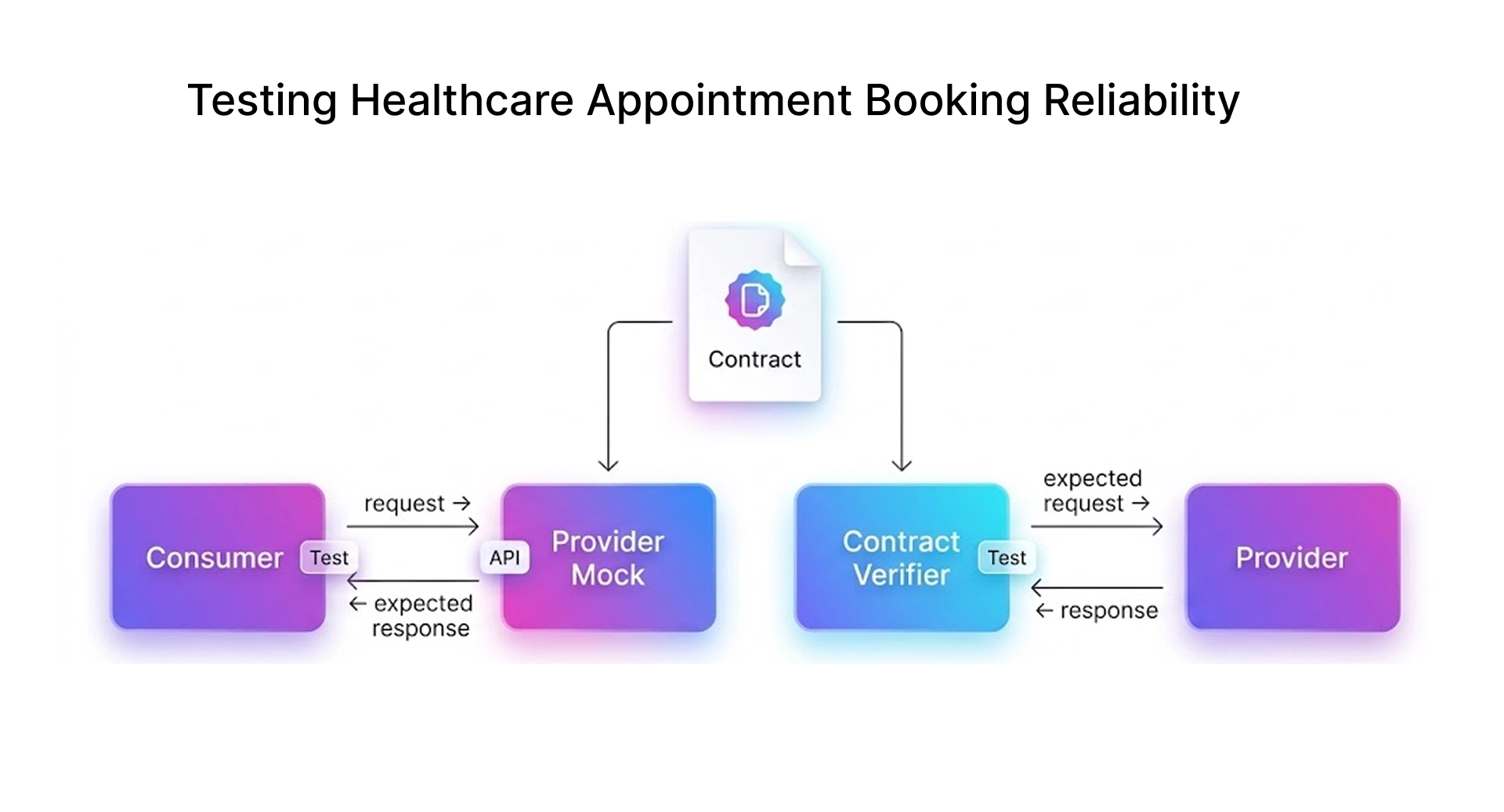
The premise: instead of testing two services together, you test each independently against a recorded description of what the other expects. The consumer writes the expectation. The provider verifies against it. The breaking change was caught before the services ever met.
Consumer-driven contracts with Pact
The consumer writes what it expects request shape and response fields. Pact records that as a contract and publishes it to a broker. The provider pulls and verifies independently. If a field gets renamed or a required property disappears, verification fails on the PR, not in production.
JavaScript (Pact)Frugal Testing: production consumer-driven contract configuration
// Frugal Testing -- production Pact configuration
 // API Contract Testing Guide
 await provider. addInteraction({
   state: 'user 42 exists',
   Upon receiving: 'a request for user 42',
   withRequest: { method: 'GET', path: '/users/42' },
   willRespondWith: {
 	status: 200,
 	headers: { 'Content-Type': 'application/json' },
 	body: {
   	id: 42,
   	email: Matchers.like('user@example.com'),
   	created_at: Matchers.iso8601DateTime(),
 	},
   },
 });
API Schema validation as a lighter starting point
Not every team is ready for a full Pact setup. JSON schema validation is lower overhead and still catches the most common breaking change a field disappearing or changing type. Hook it into your suite to validate every response on every run.
Python Frugal Testing: API response schema validation pattern
# Frugal Testing  API Response Schema Validation
 # API Schema Validation Guide
  import jsonschema, requests  user_schema = {
   'type': 'object',
   'required': ['id', 'email', 'created_at'],
   'properties': {
 	'id': {'type': 'integer'},
 	'email': {'type': 'string', 'format': 'email'},
 	'created_at': {'type': 'string', 'format': 'date-time'}
   }
 }

 response = requests. get ('https://api.example.com/users/42')
 jsonschema. validate(response.json(), user_schema)  # raises if invalid
Run contract tests before integration tests
Sequencing matters. Contract tests don't need real services they're fast and cheap to run. If the contract is already broken, your integration suite is going to fail too, just slowly and expensively. Run contracts first. Gate on them. Save the integration tests for code that actually passes the interface check.
Integrating API Tests Across Every Stage of Your CI/CD Pipeline
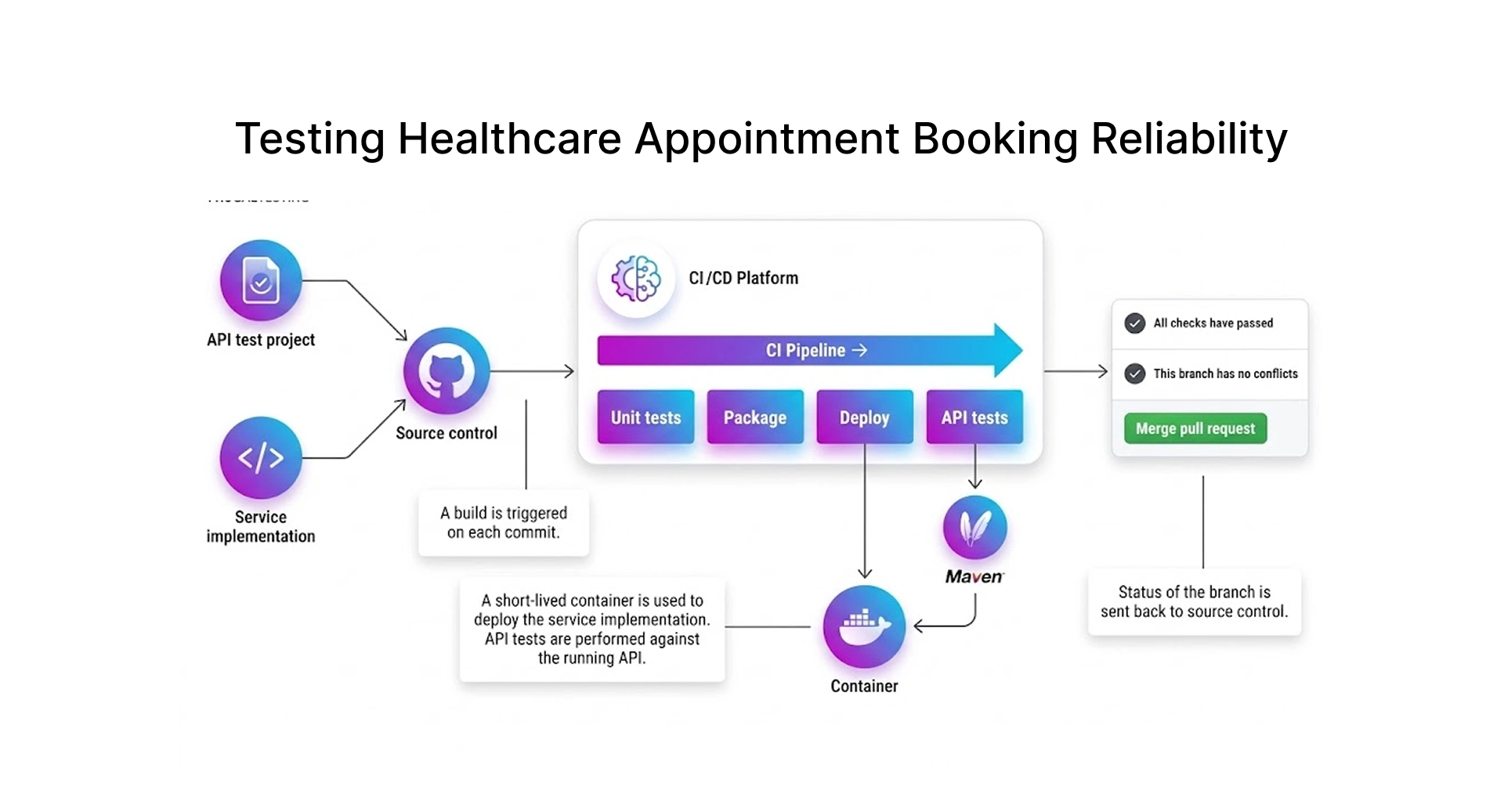
The most common CI/CD mistake I see is the single-gate pipeline: run everything; if it passes, deploy. Teams end up with two bad outcomes: a 40-minute pipeline that developers learn to route around or use a fast pipeline that drops the expensive tests to stay fast. Either way, the tests that actually matter aren't running.
PR stage: contract tests and schema validation
Catching a breaking change before a branch merges is the cheapest option. Contract tests and schema validation are fast enough for every PR this is the right place for them.
Build stage: API Test Environment Setup with ephemeral service instances
At build time, spin up throwaway instances (throwaway service instances spun up for the test run and torn down after) of your dependenciesDocker Compose for most teams or a Kubernetes namespace if you need something more complex. Run integration tests and tear them down. No shared staging environment, no test pollution.
YAML (GitHub Actions) Frugal Testing: CI pipeline with ephemeral dependencies
# Frugal TestingCI Pipeline with Ephemeral Test Dependencies
 # CI/CD API Testing Pipeline Guide
 Services:
   Postgres:
 	image: postgres:15
 	env:
   	POSTGRES_DB: testdb
   	POSTGRES_PASSWORD: test

 steps:
   - name: Run integration tests
 	run: npm run test: integration
 	env:
   	DATABASE_URL: postgresql://postgres:test@localhost/testdb
Staging stage: E2E, API load testing, and security scans
By staging, the code has cleared contract and integration gate sso this is where you run the slow stuff. Full E2E journeys, load tests, security scans. These take time, which is fine they're protecting the deployment decision.
A fintech client we worked with, a week from launch, needed to confirm their checkout API could handle 2,000 concurrent users. No load infrastructure, no time to build any. They configured a ramp-up scenario in Frugal Testing in about 15 minutes. The test flagged DB connection pool exhaustion at 800 concurrent usersp95 spiking from 180 ms to nearly 5 seconds. Missing ORM pool max setting. One-line fix, reran, confirmed under 300ms at 2,000 users. If that test hadn't run, they'd have found it during actual peak traffic.
Gates block; they do not warn
"Deploy anyway and monitor it" isn't a gate it's an absence of one dressed up in process language. If your pipeline can proceed past a test failure, the test isn't protecting anything. Hard blocks only. And parallelize where you can, so the 45-minute staging suite doesn't become the reason people start pushing directly to the main.
Choosing the Right API Test Automation Framework Tools
Framework choice matters less than maintenance discipline the right tool is the one your team will actually keep up to date. That said, there are real differences worth knowing.
Postman Newman CI Integration for Collection-Based Regression Testing
Shell (Newman CLI) Frugal Testing: CI-native Postman collection runner
# Frugal Testing  Newman CI Collection Runner
 # Newman CI Integration Guide
 newman run api-tests.postman_collection.json \
   --environment staging.postman_environment.json \
   --reporters cli,junit \
   --reporter-junit-export results.xml
Newman lets you run existing Postman collections in CI without rebuilding anything. The JUnit reporter drops results directly into GitHub Actions, GitLab CI, or Jenkins. Good for teams with solid collections who want to stop manually running them before releases.
API mocking vs. stubbing vs. live environments
Rough rule of thumb: mock third-party stuff at the unit level, use real services (or contract-verified stubs) for integration tests, and don't mock anything in your staging environment. The whole point of staging is to find out what happens with real service behavior.
Pre-Production Checklist: API Testing Gates Before Every Release
Every release should clear this checklist before touching production including the 'small' ones. The incidents that feel most avoidable in retrospect are almost always traced to a change that seemed too minor to warrant the full process.
Real-world failure example 1: auth token mismatch between staging and prod
A SaaS team rolled out a new OAuth flow. Staging had token expiry enforcement turned off. Production tokens expired after 15 minutes. Users were getting logged out mid-session within hours of launch. The fix was trivial; the investigation took most of the day. A single checklist item would have caught it.
Real-world failure example 2: rate-limiting not enforced in test environment
Rate limiting was disabled in staging for easier testing. Production enforced 100 req/min per API key. A batch job went live, hit the ceiling in seconds, and threw 429s that the application had no handler for. Job failed silently, records weren't processed, and support tickets followed.
Debugging API Failures That Only Appear in Production
Sometimes production breaks despite all of the above. No test strategy catches everything. What matters is how fast you can reproduce the failure and make sure it doesn't happen the same way twice.
Traffic mirroring for reproducing production-only API failures
Traffic mirroring copying live production requests to a parallel environment in real time, without affecting usersis the most reliable way to reproduce failures that only appear with specific request shapes or load patterns you've never generated in a test. AWS VPC Traffic Mirroring, Envoy, and NGINX all support it. You get the exact requests that triggered the incident replayed in a safe environment.
Nginx config Frugal Testing: production traffic mirroring to staging
# Frugal TestingProduction Traffic Mirroring to staging
 # Production Traffic Mirroring Guide
 location /api/ {
 	mirror /mirror/;
 	proxy_pass http://production-upstream;
 }
 location /mirror/ {
 	internal;
 	proxy_pass http://staging-upstream;
 }
Distributed tracing to isolate the failing API call
When a request fans out across five microservices, 'the API returned a 500' isn't a diagnosis. Distributed tracingJaeger, Zipkin, and Datadog APMgives you the full call chain with latency at every hop. The failure is almost always at a service boundary where a contract assumption broke, a query that degrades under concurrency, or a third-party integration that changed without notice.
Common Staging vs Production API Differences That Tests Miss
Build a post-mortem to test the backfill loop
Every production incident should produce at least one new test before the issue closes. A post-mortem template with a 'test gap identified' field plus a team norm that the fix PR ships with the new test closes the loop. Do this consistently, and your test suite becomes institutional memory.
A B2B SaaS team running nightly baselines through Frugal Testing caught a dependency upgrade that had silently added ~40 ms per API callresponses were correct, just slower, so no functional test flagged it. On Monday morning, the Frugal Testing report showed p95 up from 210 ms to 290 ms on their core endpoint. Correlated with the deploy log, they rolled back the dependency the same morning. Without the nightly run, this would have accumulated user complaints over days before anyone investigated
Conclusion: From Fragile Tests to a Production-Ready API Strategy
Production failures are almost never a single missed test. They come from the accumulated distance between what your test environment validates and what production is actually doingdifferent config, different load, different service behavior. Closing that distance is what this guide is about.
The approach that works is layered and continuous:
1. Design agree on contracts before writing code; define test scope by business risk
2. Contract lock down interface agreements with Pact before integration testing begins
3. CI/CD layer tests: contracts on PR, integration at build, E2E, and load at staging
4. Pre-release run a structured checklist with production-equivalent configuration
5. Debugwhen production fails, replay it, trace it, and backfill the missing test
Teams with QA involved in API design and layered CI pipelines catch regressions through monitoring, reproduce failures from mirrored traffic, and file the test alongside the fix every time. That consistency is what makes the gap between the test environment and production shrink sprint over sprint.
The goal is a test suite that reflects what production is actually doing and gets a little closer to that reality with every deploy.
Ready to close the gap between your tests and production? Frugal Testing gives teams production-scale API load testing, CI/CD integration, and continuous monitoring without managing hardwareit's used by fintech and B2B SaaS engineering teams shipping microservices at high release velocity who need pre-production confidence on every deploy.
People Also Ask (FAQs)
Q1.Why do API tests pass in staging but fail in production?
Ans: API tests pass in staging but fail in production because of environment drifts taging config, credentials, or third-party service behavior that does not match production. Over-mocking is the second most common cause. Fix: environment parity checks, consumer-driven contract tests, and a pre-release checklist.
Q2.What is the difference between API contract testing and integration testing?
Ans: API contract testing verifies each service independently against a recorded interface agreement, is fast, needs no real services, and catches breaking changes at the PR stage. Integration testing runs both services together end-to-end slower and environment-dependent. Run contract tests first; gate on them before integration tests.
Q3.How should API tests be structured in a CI/CD pipeline?
Ans: In layers. PR: Contract tests and schema validation block the merge. Build: integration tests against throwaway service instances. Staging: E2E, load tests, security scans against a production-equivalent environment. Post-deploy: smoke tests and synthetic monitoring. Each layer gates the next.
Q4.What are the most common signs of a flaky API test?
Ans: Fails sometimes, passes on retry, no code changes in between. Underneath it's usually shared mutable test data, a dependency on an external service with real SLAs, or an async timing issue. Shared databases are the most common root cause isolating test data is usually the first thing worth fixing.
Q5.What is shift-left API testing, and why does it reduce production failures?
Ans: API testing shift left means involving QA during API design, before code is written, so contract expectations are defined upfront. This catches interface mismatches at the design stage rather than during integration testing or in production, significantly reducing the cost of fixing them.

.webp)