

.webp)
Two weeks from release, and the backlog of untested edge cases is still growing. Sound familiar? It is then that engineering managers typically begin wondering if outsourced software testing could make up for the deficit, since the QA department obviously cannot do it alone. Outsourcing test design, test execution, and test reporting lets a company's internal team ensure software quality without a full-time QA department.
This guide will cover outsourcing testing services from top to bottom. It will not be a marketing guide, but rather a guide describing the technical side of things: Models and services available, the cost of software test outsourcing, and how to choose a testing partner that will actually suit you, and not the one that will just talk you out of your money. At the end of this guide, you will know whether it is worth considering outsourced testing services for your release cycle.
What Is Outsourced Software Testing?
Outsourced software testing means handing some or all of your QA activity, including test design, execution, and reporting, to an external provider while your team keeps ownership of product decisions. Simple enough on paper. In practice, two dimensions constantly get tangled: Geography (onshore, nearshore, or offshore delivery) and the ownership model (who decides what gets tested). Conflate the two, and you end up with the wrong contract. Done well, software QA outsourcing protects software quality and stretches an IT outsourcing budget. Get outsourcing software testing services wrong, though, and it just relocates the same problems somewhere less visible.
Common QA Outsourcing Models (Project-Based, Dedicated Team, Managed Services)
Three models cover most of the market, and the differences come down to who owns strategy versus who executes it.
- Project-based work fits a single, well-scoped job.
- Dedicated team engagements split ownership differently: The vendor supplies steady capacity for ongoing release cycles, but the client still steers priorities week to week.
- Managed services hand the vendor full strategic ownership, the right call for teams with no in-house QA leadership at all.
Benefits of QA Outsourcing
Most content on this topic leads with cost savings. Fair enough, but that's rarely the real driver behind QA outsourcing services. Teams outsource QA mainly to move faster, close a test automation outsourcing skill gap, and add capacity that flexes with release deadlines.
- Faster release cycles: A vetted outsourcing partner can start within days of a signed scope, while an in-house QA hire typically takes three to four months to onboard.
- On-demand automation expertise: Outsourcing gives immediate access to teams experienced with Selenium, Cypress, and other automation frameworks, without a lengthy in-house training curve.
- Lower cost of late-stage defects: A bug caught in a sprint review costs an afternoon of rework; the same bug caught in production costs an incident report, a patch release, and a support escalation.
- Flexible capacity: Coverage can scale up ahead of a major release and scale down once things stabilise, without carrying a permanent bench through the quiet months.
- Reduced hiring risk: Outsourcing spreads the risk across an established team instead of betting everything on one new hire who may or may not work out.
- Broader specialised coverage: Partners often bring performance testing, security testing, and compatibility testing expertise that a generalist in-house team may not have.
- More predictable costs: Outsourced engagements are typically scoped and priced upfront, which makes budgeting easier than an open-ended hiring and training cycle.
- Fewer missed release deadlines: With QA capacity no longer the bottleneck, release deadlines become easier to hit consistently.
.webp)
Types of QA Outsourcing Services to Choose From
Outsourcing isn't all-or-nothing. Teams routinely hand off one category of application testing outsourcing while keeping the rest in-house, and that's precisely where most guides to QA and testing services get too vague to be useful.
Manual and Exploratory Testing Services
A tester exploring a new checkout flow catches what scripts miss, every time. Confusing copy. Awkward interactions. A layout break a scripted test would sail straight past. Manual testing and exploratory checks remain essential for usability testing and edge cases no automated script anticipates, particularly around new feature validation, where the user flow itself is what's being judged. Automation is fast, but manual QA still catches what nobody thought to test for.
QA Automation Services for CI/CD Pipelines
Automation isn't about running tests after code ships. It's about wiring execution directly into the pipeline so failures block a merge, not a release.
- Outsourced automation testing teams typically integrate with Jenkins, GitHub Actions, or GitLab CI.
- Regression suites then run automatically on every pull request, catching breakage before a human reviewer ever sees it, which closes the gap between tests existing and tests actually running.
Specialized Testing (Performance, Security, Ecommerce QA)
Some testing needs domain depth a generalist QA team rarely has sitting in-house.
- Performance testing and stress testing validate how a system holds up under real and extreme traffic, using tools like JMeter.
- Security testing probes for vulnerabilities and simulates the kind of online attacks a production system might genuinely face, often the first step toward a broader security solution.
- Ecommerce QA testing outsourcing covers checkout flows, payment reconciliation, and inventory sync, since a single bug in any of those areas hits revenue directly. Most outsourced QA testing partners fold these in as add-ons to a core functional testing engagement.
How to Evaluate a Software QA Testing Company
"Good communication" and "proven track record" show up on every QA services company page ever written, and they tell you nothing. The market for software QA testing services is crowded enough that specificity is the only real filter: Named case studies, real toolchain compatibility, current certifications rather than merely claimed.
What to Look for in a QA Outsourcing Partner
A handful of concrete signals separate a solid qa testing services company from a risky one.
- Case studies in your industry vertical, with named QA specialists attached, not vague logos.
- Existing support for your CI/CD toolchain and test environment, so there's no migration project before work even starts.
- SOC 2 Type II or ISO 27001 certification wherever your data handling actually requires it. Ask for the certificate itself, not the reassurance.
Questions to Ask Before Signing a QA Services Contract
A short list of pointed questions predicts delivery quality better than any pitch deck.
- How is defect severity triaged, and who has authority to block a release?
- What happens when a tester finds a bug outside the agreed scope?
- Can they produce a sample defect report and a sample test plan before signing?
- Does the Service Level Agreement name response time and defect turnaround explicitly?
Outsourced QA vs. Building an In-House Team
This isn't an argument for always making a QA outsourcing decision. It's a framework for deciding when to. The right call depends less on cost and more on how volatile your release cadence is, and how much institutional knowledge genuinely lives inside your internal QA teams versus how much just looks that way on an org chart.
Cost Comparison: Outsourcing vs. Hiring
Tools QA Experts Rely On for Outsourced Testing
An outsourced engagement runs on its tooling as much as its people, something most qa software testing services pitches skip over. QA experts pull from a consistent toolkit across QA processes and software QA services delivery, supporting a genuine quality assurance strategy and agile test strategy.
- Selenium anchors test automation tool stacks, driving regression testing and compatibility testing.
- Cypress speeds up end-to-end testing inside CI/CD pipelines without hurting user experience.
- Playwright unifies automated testing tools across browsers in a single API, a common pick for QA automation testing services.
- Appium extends automation QA to native mobile apps for compatibility testing on real devices.
- JMeter anchors performance testing tools and feeds a team's performance test strategy.
- Postman is the default for API testing and building shared test documentation.
- TestMu AI (LambdaTest) offers an AI-powered testing copilot that generates and runs test cases from plain-language prompts.
- TestRail centralises test cases, test plans, and bug tracking.
- BrowserStack covers compatibility testing and localization testing without a physical device lab.
- Testsigma brings AI-powered testing and AI-powered tools that self-heal scripts as an application changes.
Software outsourcing works best when a partner picks the right tool for the job.
How Frugal Testing Helps You Outsource Software Testing Without the Overhead
Scoped tightly. Reported honestly. Handed back fully documented at close instead of held hostage to keep a retainer alive. That's the standard we run outsourced QA services against. Our team, a genuine quality assurance software testing company at heart, works embedded alongside yours rather than as a black box handing back a pass or fail report at sprint's end.
We support the toolchains you already use, whether that's Selenium, Cypress, Playwright, or a custom CI/CD setup, so there's no migration project first. Every engagement covers software testing and QA services end-to-end, including a documented test strategy and a Service Level Agreement, with full knowledge transfer at close.
What Our QA Outsourcing Engagement Looks Like
Here's roughly how it unfolds with our QA software testing company:
- Week 1: Scoping call to map current test coverage, tooling, and gaps against your release calendar.
- Week 2: Test strategy document delivered, covering scope, test plans, and the test environment we'll work in.
- Week 3: Onboarding into your pipeline and bug tracking system, with credentials and access confirmed.
- Week 4 onward: Parallel execution alongside your team, with regular reporting and no black-box handoffs. At close, you own the test suite and documentation.
Who This Is For
Teams without in-house QA leadership. Teams whose release frequency has outpaced internal QA teams' capacity. Anyone ahead of a compliance deadline, an enterprise software audit, or a failed QA hire.
Conclusion
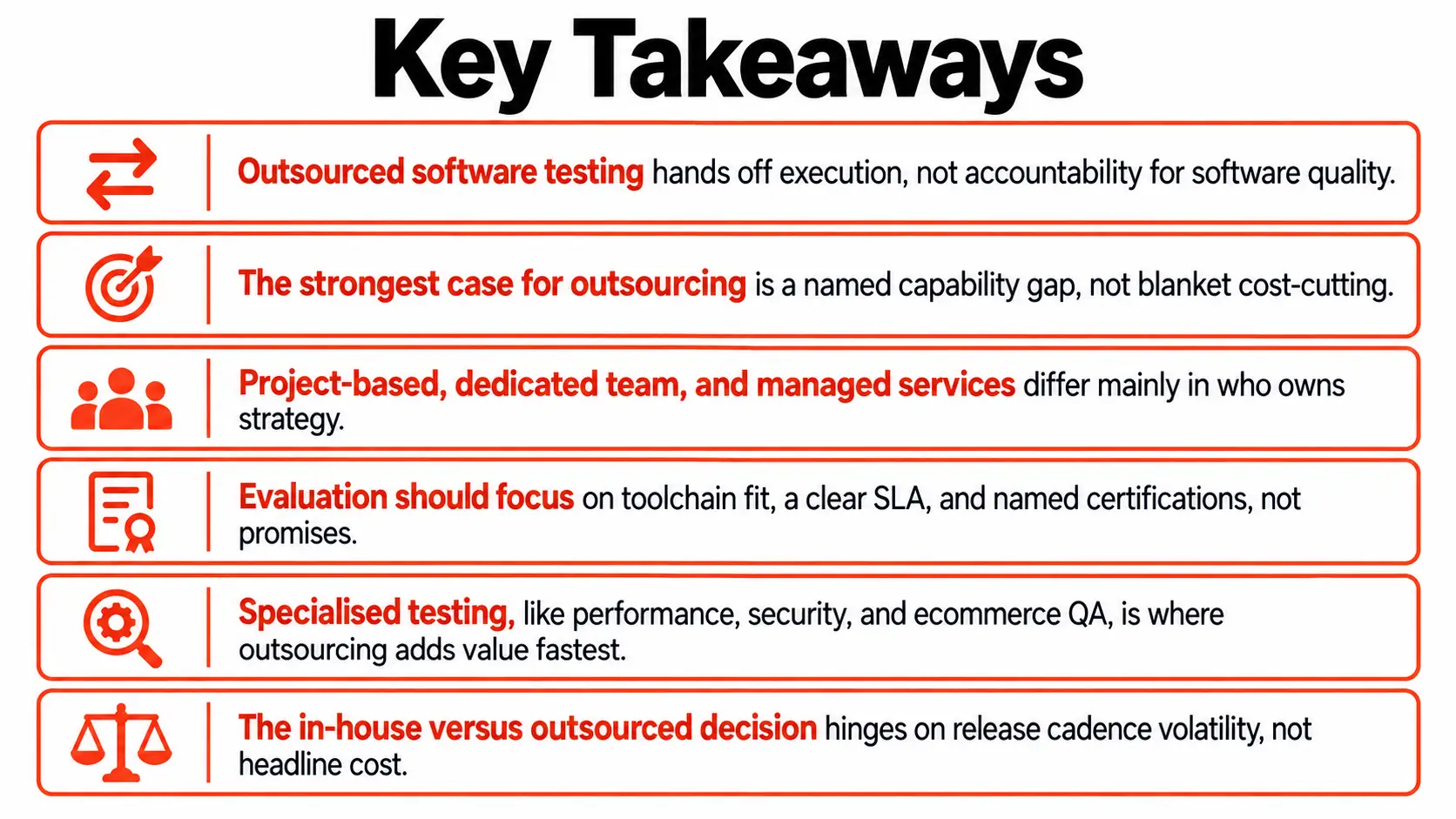
Outsourcing software testing works when it closes a gap your team has actually named: Automation depth, release-cycle capacity, specialised coverage like security or performance testing. It fails when it's used to paper over a problem nobody's admitted to yet.
If your release cadence has quietly outpaced your QA capacity, start with a scoping conversation, not a signed contract. The choice between a dedicated team, a managed service, or staying in-house tends to sort itself out once someone's actually looked under the hood.
People Also Ask (FAQs)
Q1. Is quality assurance outsourcing a good fit for early-stage startups?
Ans: Yes, particularly for teams without a QA hire yet. A project-based or managed services engagement gives founders test coverage without the overhead of building an internal QA function too early.
Q2. How long does a typical QA outsourcing engagement run before renewal?
Ans: Most engagements start with a three- to six month term, reviewed against agreed metrics like defect leakage and coverage before either side commits to a longer renewal or scope change.
Q3. What happens if an outsourced QA partner isn't performing well?
Ans: A well-drafted contract includes an exit clause and a notice period, letting you transition out cleanly. This is exactly why reviewing the SLA carefully before signing matters so much.
Q4. Does outsourced software testing fit an agile, sprint-based workflow?
Ans: Usually, yes. Most outsourced QA teams work inside two-week sprints alongside your developers, joining standups and grooming sessions rather than testing in a separate, disconnected cycle after the fact.
Q5. Can one QA outsourcing partner support multiple products at once?
Ans: Often, yes, especially with a dedicated team model, though separate products usually need their own test strategies and reporting lines to stop coverage gaps from slipping between the two.