

Both Quality Assurance (QA) and Quality Control (QC) play vital roles in ensuring that products are manufactured to a customer’s satisfaction; they address these goals through different means. This guide will describe what distinguishes these two functions as they relate specifically to software, with examples from a practical implementation perspective, as well as how to leverage both functions effectively for teams based within the United States working under various regulatory frameworks, including FDA, HIPAA and ISO.
Understanding Quality Assurance (QA)
Quality assurance concerns itself with building quality throughout its lifecycle by focusing on processes, as opposed to being reactive and looking back. Quality Assurance defines all ways of defining Processes, Standards, and Systems (like Standard Operating Procedures, Quality Management Systems, and ISO 9001 compliance)throughout product development, helping to minimise defects within a finished product.
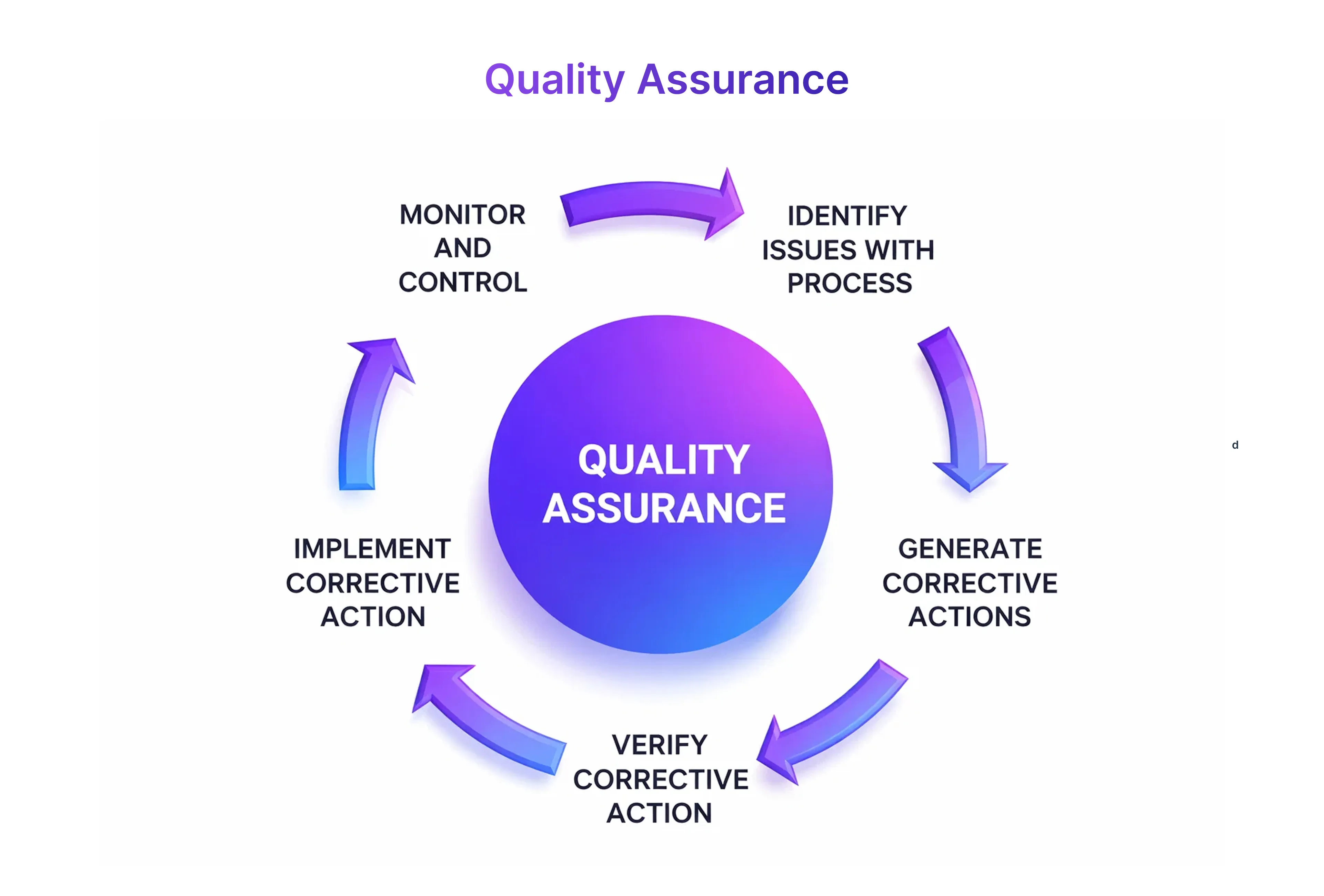
Objectives and Scope of Quality Assurance
- Define and implement a quality assurance risk management process through design, implementation and enforcement of project processes (for example - Software Testing Life Cycle, version control, code review process).
- Ensure that projects are compliant with all regulatory requirements and relevant industry standards (including ISO 13485 for medical devices, FDA 21 CFR Part 820, HIPAA for Patient Data).
- Create an environment where predictability and repeatability of releases are achievable and reliable through the use of standardised processes across all teams.
- The scope of this project encompasses process audits, training, test strategy development, creation of the CI/CD pipeline policy and vendor assessments or third-party quality audits.
Key Activities Involved in QA
- Design of the Software Testing Life Cycle Process, Gate Criteria for Release, Acceptance Criterion
- Audits and Compliance Process (Internal to Company and Suppliers)
- Measurement and Metrics Design (Capability of the Process, Defect Escape Rates).
- Conducting Training, Creating Documentation, Creating Standard Operating Procedures (SOPs), and Continuous Improvement (Kaizen, PDCA).
- Strategy for Tool and Automation (CI Policies, Test Automation Framework).
Examples of QA in Software Development
- Formulating a strategy to test that stipulates unit testing, integration testing, and user acceptance testing for each capability/feature.
- Implementing merge blocking continuous integration review processes for all new code through both static analysis and security scans.
- Establishing and maintaining an electronic quality management system (eQMS) or quality management system (QMS) to provide documentation of the steps associated with releasing regulated products.
- Performing process capability improvements (Six Sigma) and conducting root cause analyses to reduce the trends of defects in processes, products, etc.
Understanding Quality Control (QC)
Quality Control is focused on the product and reacts to findings from the inspection of a deliverable. QC inspects, validates, and tests deliverables for identified defects; therefore, it can confirm that the deliverables meet specification requirements prior to releasing them. Quality Control activities occur within the framework of Quality Assurance; however, Quality Control focuses on validating the actual product.
Objectives and Scope of Quality Control
- Identify and eliminate any faults in constructed material (code), released (to production), or delivered (to customers) for testing.
- Confirm product output meets predefined acceptance criteria.
- Supply decision-making information (release hold, rollback, hotfix).
- Scope consists of executing test cases, managing defects, reporting test results, and conducting acceptance testing.
Key Activities Involved in QC
- Functional, regression, performance, and security testing were all performed manually and automated through test execution.
- Defect logging was performed with severity levels assessed and analyzing defect trends.
- Verification of release criteria and validation of the work environment through smoke testing and sanity testing.
- Coordination of UAT (User Acceptance Testing) and part sampling inspections for larger releases.
Examples of QC in Software Development
- Regression testing using Selenium/JUnit in Continuous Integration (CI) to identify and capture regression issues.
- Load/Performance testing to ensure load performance after a large load has gone live.
- Manual, exploratory testing (UX) for complex user experiences.
- Verifying all necessary configuration, database migrations and environment parity pre-deployment.
Key Differences Between QA and QC
Focus and Objectives
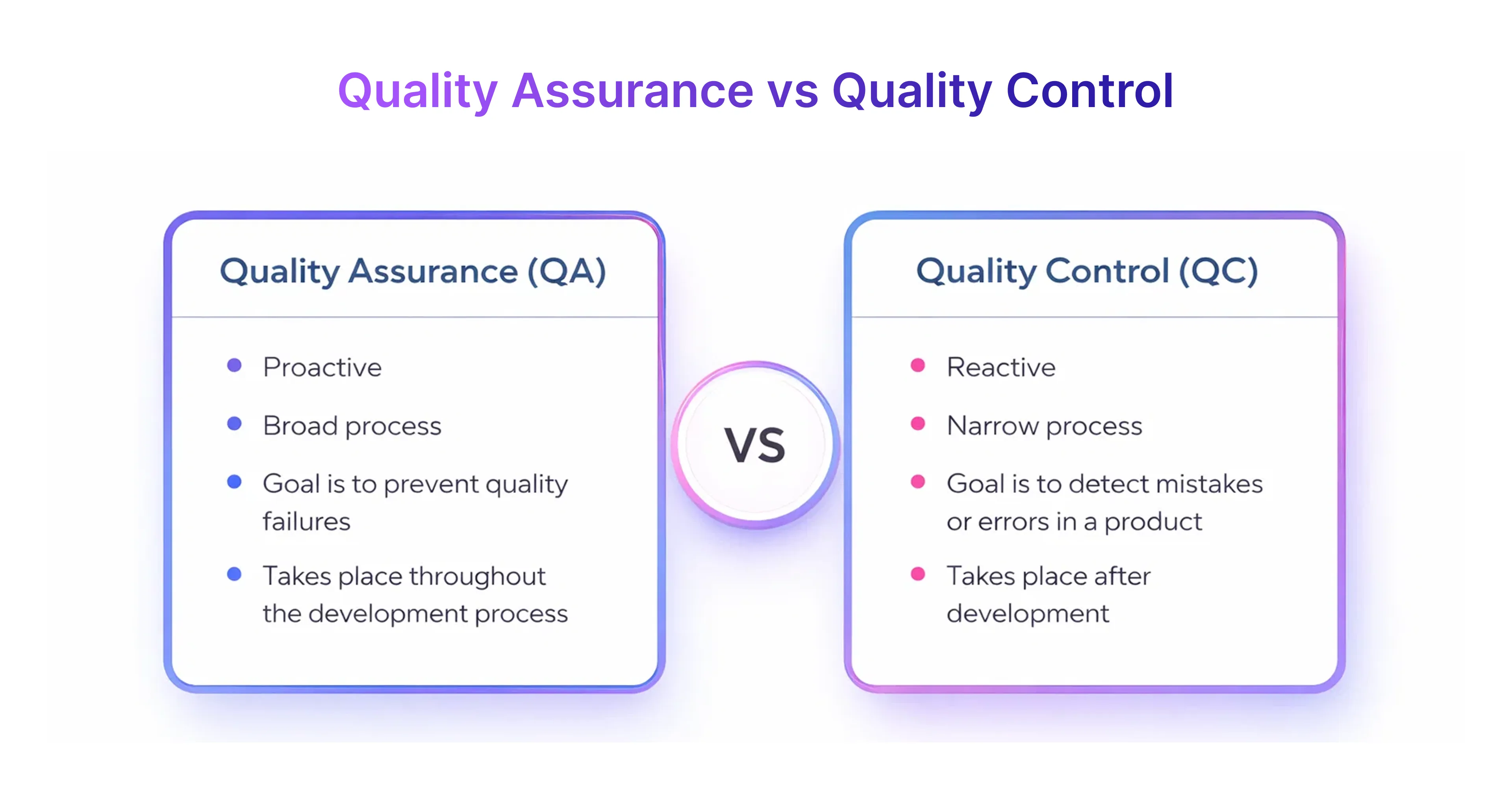
Quality Assurance (QA) improves and sets up methods/ways of producing software. The end goal for QA is to prevent defects from occurring by ensuring that the methods of producing a software product(s), i.e., Development Method(s), Testing Methods(s), Documentation Method(s) and Release Method(s) follow an established set of standards and best practises. QA focuses on understanding a company's overall quality management system in addition to how tasks are being completed throughout the life cycle of a software product.
On the flip side, Quality Control (QC) validates the end result of the software product. The end goal of QC is to detect defects by finding bugs, functional design gaps, or performance issues within the software, before it is delivered to end users. QC also ensures that the software product meets the business and technical requirements, and those imposed by any applicable regulations.
Process vs. Product
QA is process-oriented. It defines how software should be developed and tested by establishing SOPs, test strategies, version control rules, review processes, and compliance checkpoints. QA activities influence how teams work and how consistently quality standards are applied.
The difference between quality assurance and quality control, the difference between quality control and quality assurance, and the difference between QA and QC all come down to how quality is achieved in a product or service. Quality assurance and quality control work together, but they serve different purposes. Quality assurance focuses on improving and standardizing processes to prevent defects before they occur, while quality control focuses on identifying and fixing defects in the final product through testing and inspection. This QA QC difference is especially important in software development, where quality assurance defines how work should be done across the lifecycle, and quality control verifies whether the delivered software meets defined requirements and customer expectations.
Metrics and Measurements
QA metrics measure the effectiveness of processes and systems. Common QA measures include process compliance rate, audit findings closure rate, process capability, documentation accuracy, and defect prevention trends. These metrics help organisations improve workflows and reduce long-term risk.
QC metrics measure product quality and testing effectiveness. These include defect density, escaped defects, test case pass rate, regression failure rate, and mean time to detect defects. QC data helps teams decide release readiness and prioritise fixes.
Proactive vs Reactive Approach
QA follows a proactive approach by identifying risks early and addressing them through better planning, standards, and controls. By improving processes upfront, QA reduces the likelihood of defects entering the system.
QC follows a reactive approach by identifying defects after development activities are complete. While reactive, QC is essential for catching issues that process controls cannot prevent. Together, QA and QC minimize both defect injection and defect escape, leading to higher software quality and customer satisfaction.
Comparison Table - Quick reference
Practical Implementation of QA and QC in Software Testing
Different Types of Software Testing
- Unit (developer-owned, automated) testing prevents regressions from occurring at a low level.
- Integration Testing - Validates module/service-to-module/service interactions
- System Testing - Validates end-to-end operation per specifications.
- User Acceptance Testing (UAT) - Validates with actual users or representatives of the business.
- Non-Functional Testing - Validate performance, Security, Reliability, Compliance.
- Exploratory/Manual Testing - Validate human scenarios that the automation may miss.
Integrating QA and QC for Maximum Effectiveness
- Define “shift-left” policies: require unit tests and static analysis before code review.
- Incorporate CI/CD gates that utilise the rules (required verification) associated with Quality Assurance and automated verification associated with Quality Control.
- Utilise a single source of truth for an organisation’s acceptance criteria (e.g., user stories, test cases).
- Conduct a lightweight post-incident audit and retrospective using a Corrective Action and Preventive Action process, such as the Five Whys Analysis Method.
- Align incentives for QA, who will be responsible for the organisation’s process maturity, and QC, who will be responsible for the organisation’s metrics for quality of release; both report to Product/Engineering Leadership.
Integration Checklist (short)
- Document acceptance criteria in each ticket.
- Enforce pre-merge static checks and unit test coverage thresholds.
- Schedule periodic process audits and test-suite health checks.
- Maintain a defect backlog triage cadence and root cause tracking.
Tools to Enhance QA and QC Processes
Tool table - common categories and examples
Why QA and QC Both Matter
The Interdependence of QA and QC
Quality Assurance (QA) establishes the environment necessary for Quality Control (QC) to function properly. Without Quality Assurance, a Quality Control program will only identify and track repeated failures. Conversely, Quality Assurance has no way of knowing if the quality management system (QMS) is working if the Quality Control program does not exist. Both functions serve to continually reduce the total cost of quality.
Impact on Customer Satisfaction
- Detecting and preventing defects more rapidly has a direct impact on customer confidence and retention.
- The consistency in the quality of software releases is lower than the number of incidents, regulatory risks, and reputational damages.
- In the US, companies that meet FDA/HIPAA/ISO requirements reduce potential financial penalties as well as delays due to issues with market access.
Long-term Benefits for Organizations
- Lower technical debt and reduced remediation costs.
- Predictable release cadence and higher developer productivity.
- Better metrics to guide investment in automation, process improvements (Lean, Six Sigma).
Industry-Specific Applications of QA and QC
QA and QC in Software Development
- Emphasise unit/integration automation and CI gates.
- Use code reviews and branch policies as QA controls; use automated suites as QC verification.
- Monitor defect trends for continuous improvement.
QA and QC in SaaS and Cloud-Based Applications
- Add environment and configuration checks into QC (infrastructure-as-code validation).
- Require runbook validation and chaos testing for resiliency.
- Implement strong telemetry and rollback strategies to shorten MTTD/MTTR.
QA and QC in Healthcare
- Apply QMS and documentation rigour (ISO 13485:2016, FDA 21 CFR 820).
- Use traceability matrices between requirements, tests, and releases.
- Enforce data protection controls (HIPAA) during both QA process design and QC test environments (use anonymised or synthetic data).
- Plan for formal validation artefacts and audit readiness.
Conclusion
QA (process) and QC (product) are complementary: QA reduces the chance of defects entering the product; QC finds what still slips through. For US software teams - especially in regulated industries - align processes, enforce CI/CD gates, automate testing where it delivers ROI, and use both QA and QC metrics to guide continuous improvement. Frugal testing recommends practical, cost-effective combinations of process audits and automated QC to improve delivery speed and release stability without sacrificing compliance
People Also Ask (FAQs)
Q1: When does separating QA and QC roles improve delivery speed and release stability?
Ans: Separating roles helps when scale creates conflicting priorities - for example, when process owners (QA) need to drive long-term improvements while testers (QC) must ship releases quickly. Separation makes sense when teams exceed a single cross-functional group's capacity, and regulatory requirements demand formal role segregation.
Q2: What are the most common QA vs QC mistakes that lead to production failures?
Ans: Common mistakes include weak acceptance criteria, missing pre-merge checks, over-reliance on manual tests, poor environment parity, and failing to act on root-cause data. These lead to repeated escapes and unpredictable releases.
Q3: Which metrics best reflect the business impact of QA and QC efforts?
Ans: Use a mix: escaped defects/production incidents (QC), time to detect/resolve (MTTD/MTTR), release rollback frequency, and process compliance or audit closure rates (QA). Tie these to business KPIs like customer-reported incidents and revenue-impacting outages.
Q4: What QA and QC risks are most common in outsourced or offshore software development?
Ans: Risks include inconsistent process adherence, communication gaps on acceptance criteria, fewer opportunities for informal knowledge transfer, and environment mismatches. Mitigations: clear SOPs, automated CI gates, regular audits, and shared test artefacts.
Q5: How do QA and QC responsibilities shift as teams move from Agile to DevOps pipelines?
Ans: In DevOps, QA responsibilities shift toward embedding quality practices in pipelines (policy as code, automated checks), while QC becomes more automated and continuous (shift-left testing, production monitoring). Both move toward shared ownership with developers and SREs.


.webp)