


MCP (Model Context Protocol) is an open standard that enables AI models to communicate with test environments, application state, and data sources in real time.
Engineers spend hours debugging test failures that have nothing to do with application quality. CI/CD pipelines get bypassed to hit release deadlines. Coverage shrinks because maintaining broken tests takes longer than writing new ones.
MCP (Model Context Protocol) addresses the architectural gaps that produce these failures. This guide covers what MCP is, how it restructures test generation and execution, and what engineering teams can do differently when dealing with flaky tests, broken pipelines, and coverage gaps.
What Is MCP? The Protocol Reshaping How AI Integrates with Test Automation
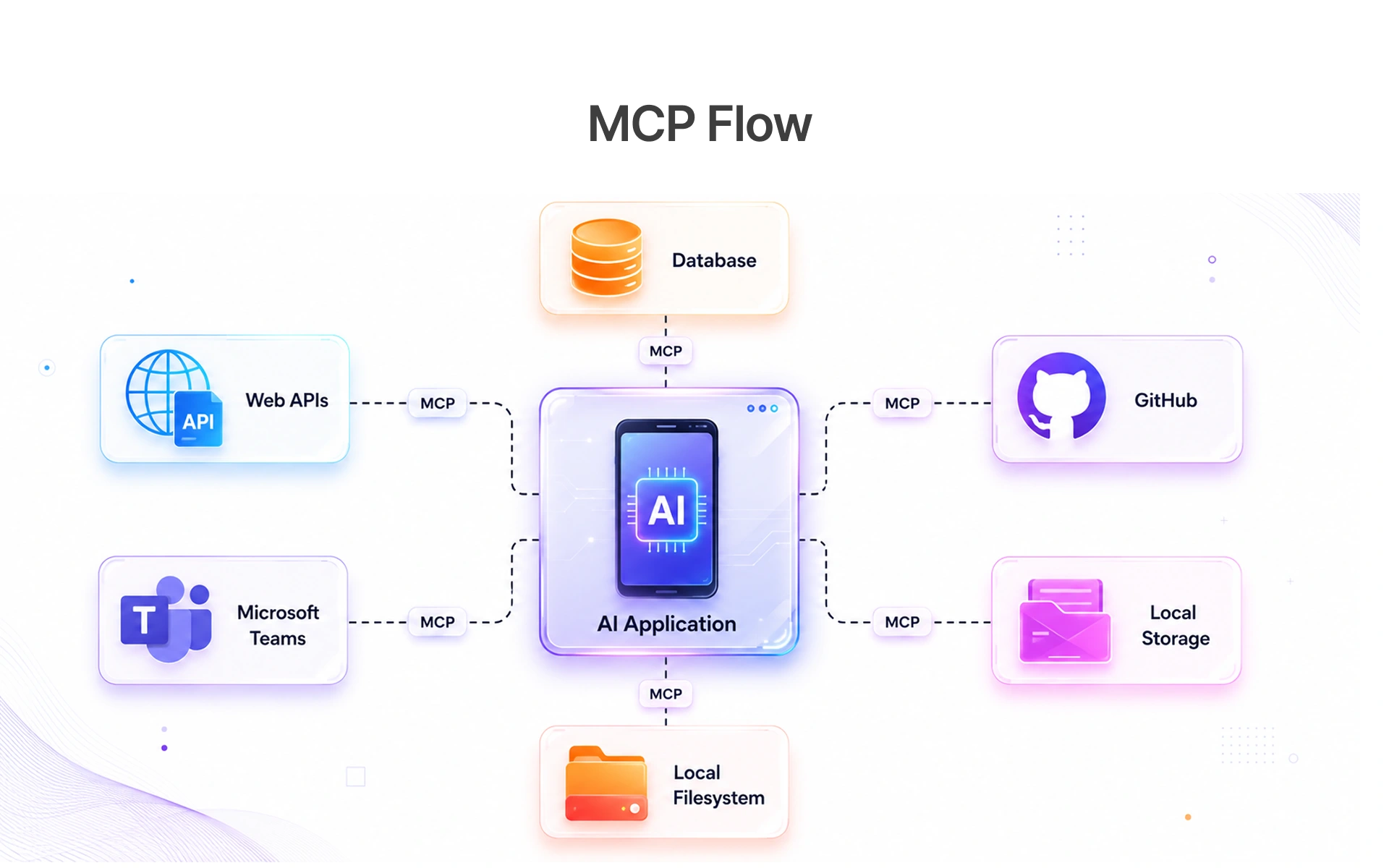
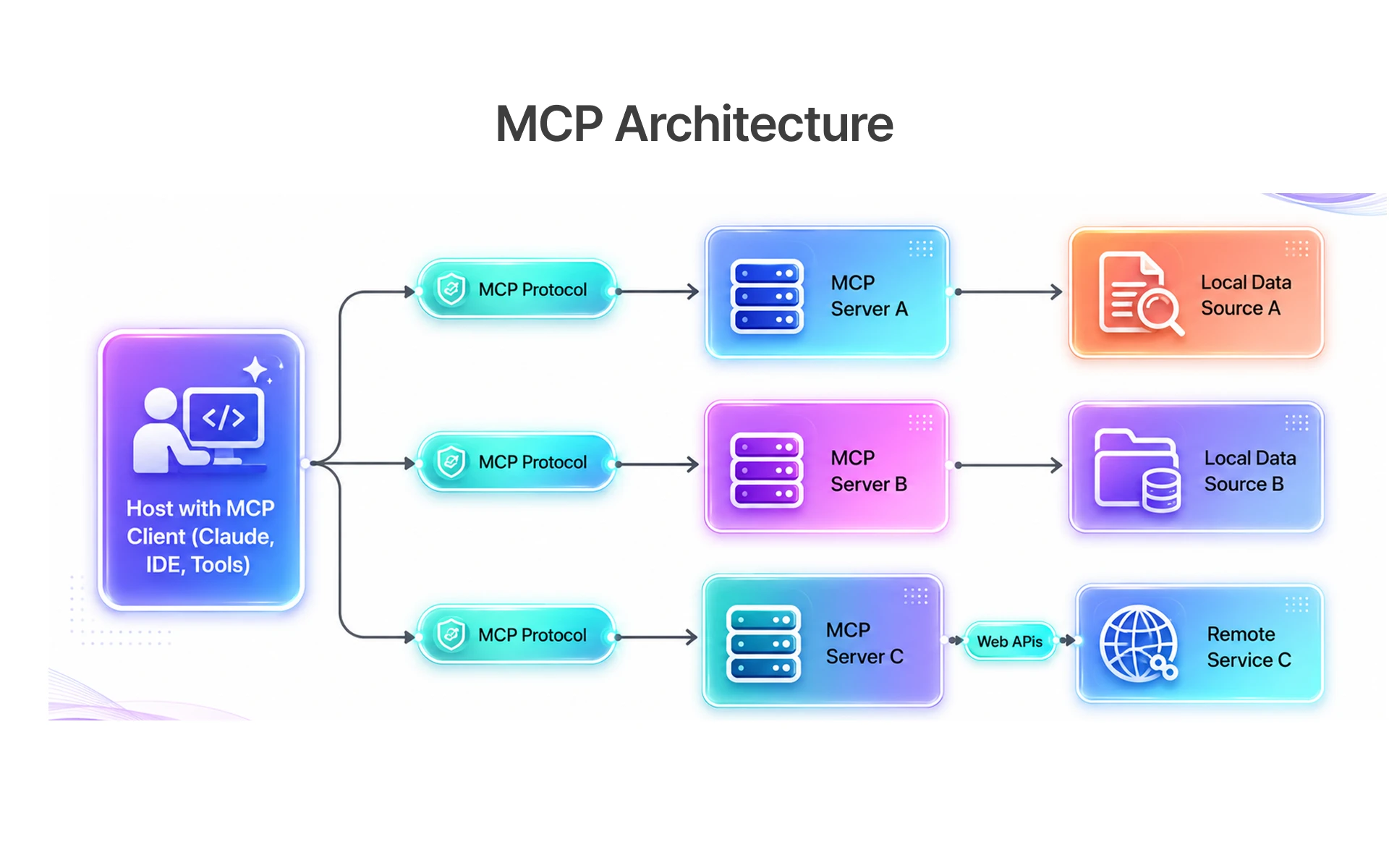
MCP, short for Model Context Protocol, is an open protocol that allows AI models to connect with external systems, tools, applications, and live data sources in a standardized way. Instead of operating only on static prompts, an AI model using MCP can retrieve real-time context from the environment it is working in. The AI model running test logic queries live context before each test execution, pulling current DOM state, environment variables, and test data at runtime.
This shift reduces the gap between what the test expects and what the application actually delivers.
MCP vs. Traditional Automation Frameworks: A Side-by-Side Architectural Comparison
Why Existing Frameworks Break Under Real-World Test Conditions
Selenium and Cypress handle stable applications reasonably well. The problems appear when applications change frequently.
A SaaS product with bi-weekly deployments will accumulate selector drift, data dependency issues, and environment configuration gaps faster than QA teams can patch them. By the time a test failure is investigated, diagnosed, and fixed, the next sprint is already in progress.
MCP addresses this by allowing the test layer to retrieve current context rather than assume it. The protocol does not eliminate test failures, but it reduces the category of failure caused by outdated assumptions.
Why QA Teams Are Moving to MCP-Powered Testing
The shift is not driven by enthusiasm for new tooling. It is driven by the cost of existing problems.
Flaky tests that fail 30% of the time are useless as quality gates. CI/CD pipelines that skip test stages to hit release deadlines accumulate technical debt. Coverage gaps that allow production defects through are not recoverable with more manual QA effort alone.
MCP gives AI models direct access to the application state during testing. That changes what is possible.
The Architectural Shift MCP Introduces and Why It Changes Everything
Conventional test frameworks separate test logic from application context. Test scripts run against assumptions baked in at write time. If the application changes after script creation, the script fails.
MCP creates a bidirectional communication channel between the AI testing model and the application environment. The model can query current element states, retrieve session-specific test data, and check environment readiness before executing a test step.
The practical result: tests that previously required manual update after every sprint can run reliably across deployment cycles without script rewrites.
From Prompt to Production-Ready Test Script: How AI Generation Actually Works
With MCP-enabled test generation, a QA engineer describes the test scenario in natural language. The AI model retrieves the current application structure through MCP, identifies the relevant DOM elements, and generates a test script that maps to the live element state.
The output is not a generic template. It reflects the actual element IDs, ARIA attributes, and interaction patterns present at generation time. When the application changes, the model can regenerate or update the script by querying MCP again.
This reduces the write-once-break-often cycle that makes large test suites expensive to maintain.
Fixing Flaky Tests: How MCP Targets the Root Cause, Not the Symptom
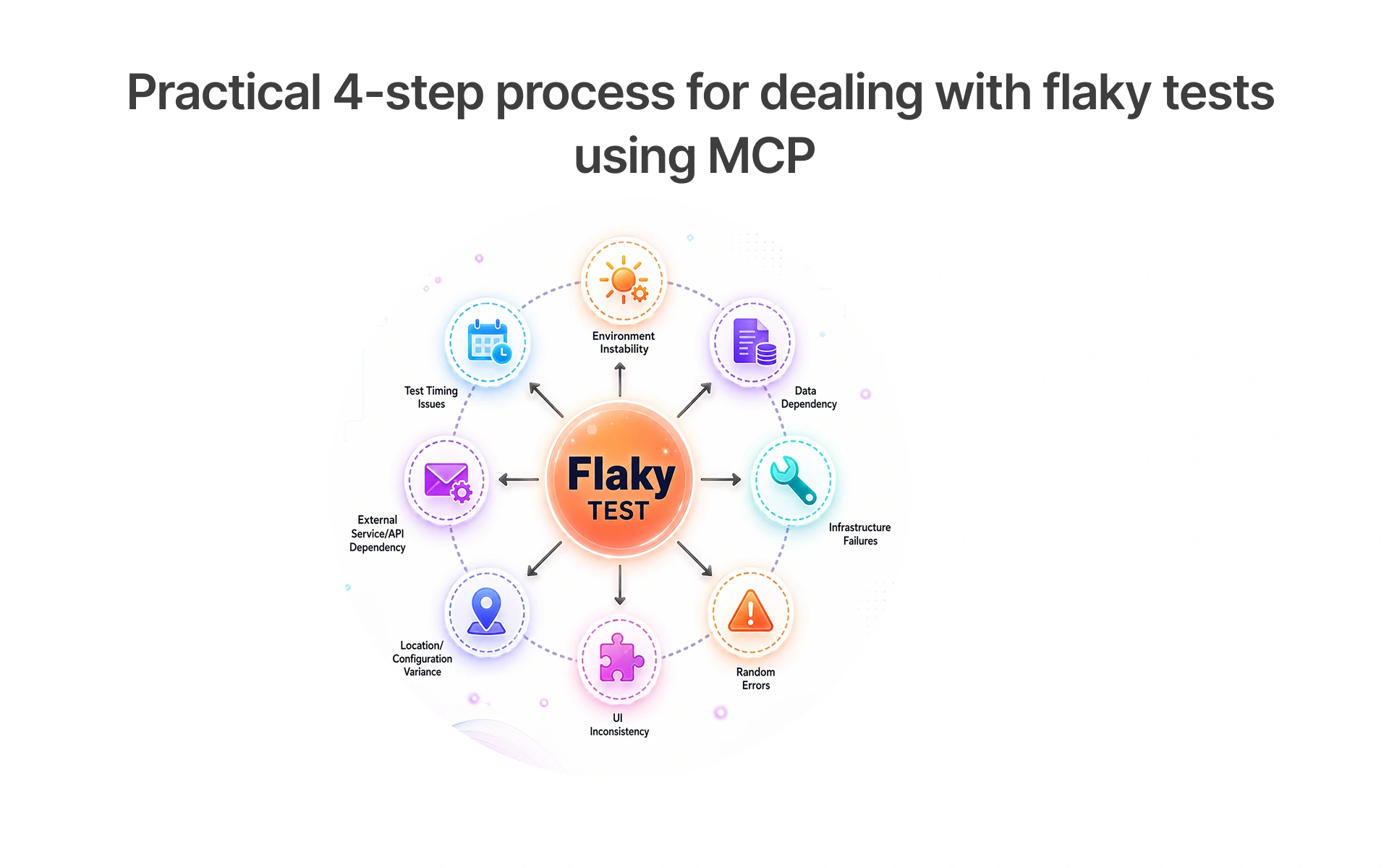
Flaky tests are not random. Most flakiness comes from a specific set of causes: timing dependencies, unstable locators, test data conflicts, and environment inconsistencies.
Retry logic and sleep statements mask these causes without fixing them. Teams that rely heavily on retry wrappers usually see flakiness rates creep back up within two to three sprints as the application evolves further.
What Makes UI Tests Inherently Unstable and Where MCP Intervenes
UI tests fail because they depend on state that changes. A button's XPath changes after a redesign. An API response takes longer than the timeout threshold. A test database row gets modified by a parallel test run.
MCP intervenes at the context retrieval layer. Before a test step executes, the model checks current element state through the MCP connection. If the locator has shifted, the model identifies the updated selector rather than failing on the stale one.
For timing-related flakiness, MCP provides real-time readiness signals from the application state rather than relying on fixed wait times.
How MCP's Self-Healing Approach Differs from Conventional Retry Logic
MCP’s self-healing approach operates differently. Before retrying, the model analyzes the execution context, inspects the live DOM through MCP, and determines why the step failed. If a locator has changed due to a frontend update, the model identifies the closest matching element using attributes, hierarchy, and contextual relationships, then updates the locator dynamically before continuing execution.
If the target element genuinely no longer exists, the test does not keep retrying until timeout. Instead, MCP surfaces a meaningful diagnostic explaining the failure condition and the detected UI change. This makes root-cause analysis significantly faster for QA and development teams.
The difference becomes especially important in long-term test maintenance. Conventional retry logic can create false confidence by masking unstable tests and allowing flaky executions to pass intermittently. MCP self-healing focuses on preserving test accuracy by adapting only when the application behavior still matches the intended workflow. The result is more reliable automation, reduced maintenance overhead, and clearer visibility into real application issues.
Self-Healing Test Automation: Less Maintenance Without Sacrificing Coverage
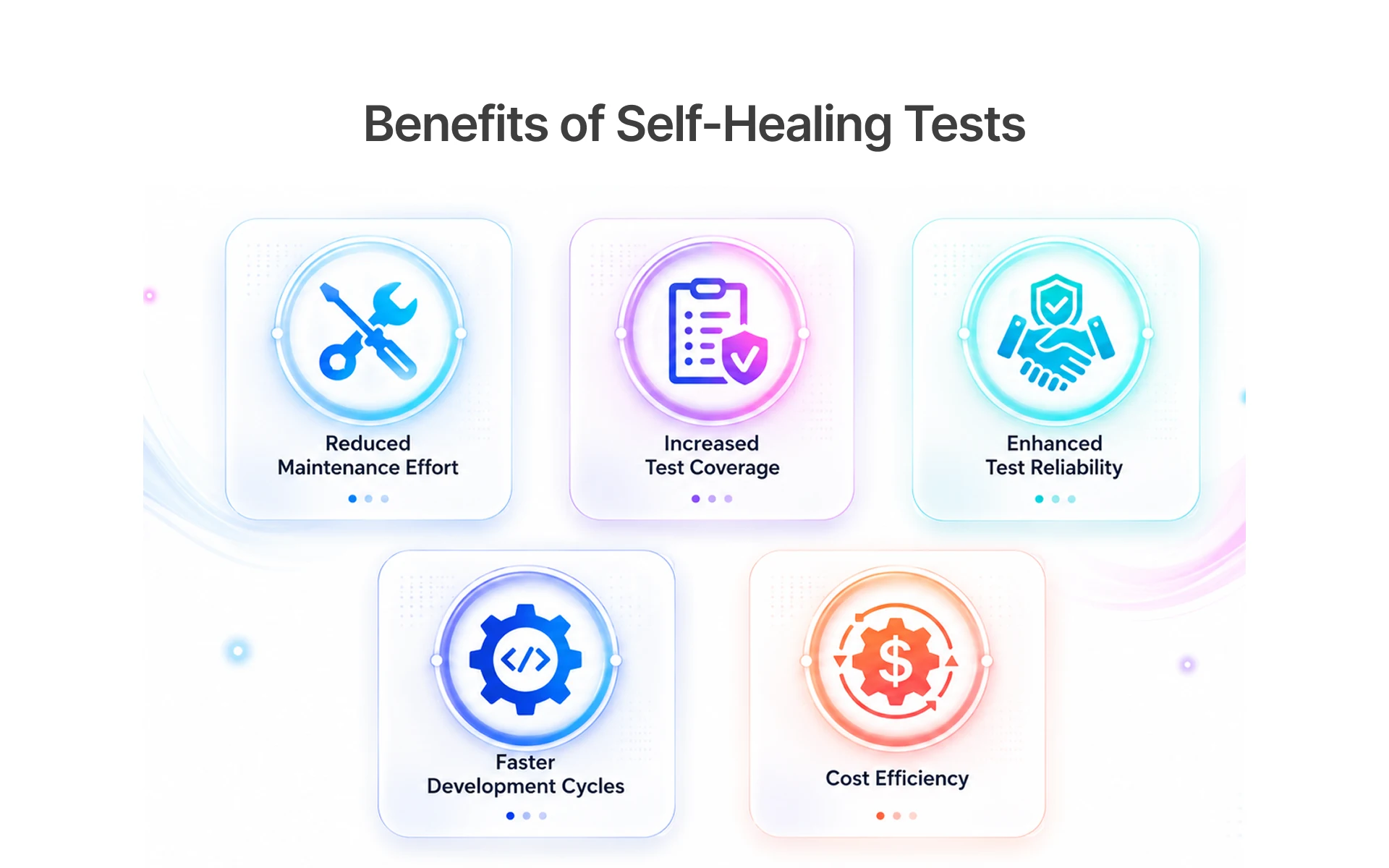
Self-healing is one of the more substantive benefits MCP-powered frameworks offer. For teams managing suites of several hundred or more tests, the maintenance burden of keeping locators current after every UI change is significant.
Consider a team running 400 test cases before each release. At 2 to 3 minutes per manual locator review and update, that is 12 to 20 person-hours per release cycle. Across monthly releases, that amounts to 144 to 240 hours annually on selector maintenance alone. That figure does not include investigation time when a selector fails silently or the downstream regression failures triggered by a single stale locator.
How Self-Healing Locators Detect DOM Changes Before Tests Break
Self-healing locators in MCP-powered setups work by maintaining a multi-attribute element signature. Rather than relying on a single XPath or CSS selector, the system tracks element ID, ARIA role, text content, relative position, and class attributes simultaneously.
When the DOM changes, the healing engine compares the stored signature against the current DOM state through MCP. If a sufficient number of attributes still match, the element is identified and the locator is updated. If the match confidence falls below the threshold, the test flags for human review rather than silently passing.
AI-Driven Test Repair: How Broken Tests Get Fixed Without Manual Intervention
When a test fails due to a locator mismatch or structural change, the MCP-enabled model retrieves the current page structure, compares it to the expected test state, and generates a repair patch. The patch updates the relevant selectors and, where applicable, the interaction sequence.
The repaired test runs in the same pipeline without requiring a developer or QA engineer to manually inspect the failure, identify the root cause, and apply a fix. Teams receive a repair log that documents what changed, which tests were affected, and what updates were applied.
In Frugal Testing's MCP adoption engagements, teams running self-healing test automation see locator maintenance effort drop by 60–70% within the first two sprints — selectors that previously required manual review after every UI deployment are updated automatically by the MCP context layer.
MCP CI/CD Testing Integration: Automate Regression Without Rebuilding Your Pipeline
One concern QA teams raise about MCP adoption is pipeline disruption. Most teams have invested in Jenkinsfiles, GitHub Actions workflows, or GitLab CI configurations that took time to build and stabilize. A testing protocol that requires rebuilding that infrastructure is not viable.
MCP integrates at the test execution layer rather than the pipeline orchestration layer. Existing CI/CD tooling stays in place. The MCP connection operates as a runtime context source that test scripts call during execution.
In Frugal Testing's QA automation engagements with SaaS teams, shifting regression execution to every commit, powered by MCP's dynamic context retrieval, reduces defect escape rate by 40 to 60 percent within the first two sprints. Issues that previously surfaced Friday afternoon are caught Tuesday morning before they reach staging.
CI/CD Test Pipeline with MCP: What Changes and What Stays the Same
A standard CI/CD test integration follows this sequence, with each stage triggering a progressively deeper set of tests:
The pipeline structure above follows conventional CI/CD stages. MCP adds context-awareness at each stage without changing the trigger logic or deployment flow.
Running 500 Tests Per Commit: How Parallel Execution and Smart Queuing Make It Possible
Large test suites slow CI/CD pipelines A 500-test regression suite running sequentially can take 45 to 90 minutes. making it impractical to execute on every commit.
MCP-powered execution addresses this through two mechanisms. First, smart queuing prioritizes tests based on the files changed in the commit. A frontend component change triggers UI tests first. A backend service change triggers API and integration tests first. Unrelated tests queue for later parallel execution.
Second, MCP provides real-time resource availability data, allowing the execution engine to distribute tests across available workers without over-provisioning or idle time. Teams running 500 tests per commit on standard CI infrastructure typically see full suite completion within 12 to 18 minutes.
Dynamic Test Data Generation: Why Static Fixtures Break in Modern Pipelines
Static fixture files are the silent cause of many CI/CD failures. A JSON fixture written three months ago references a user account that no longer exists, a product ID that was archived, or an order state that the application no longer supports.
When a test fails on a static fixture mismatch, the failure message often points to an assertion error rather than the underlying data problem. QA engineers spend time investigating test logic when the actual issue is a stale data dependency.
MCP solves this by enabling dynamic test data retrieval at runtime. Rather than reading from a fixture file, the test connects to the MCP data source and pulls current, valid records that match the test requirements.
Key benefits of MCP-driven dynamic test data:
• Test data reflects actual application state at execution time, not fixture creation time.
• Environment-specific data is retrieved from the correct source without manual environment switching.
• Parallel test runs receive independent data sets, eliminating write conflicts between concurrent tests.
• Data cleanup after test execution is handled through MCP teardown hooks rather than manual database scripts.
• API dependency failures are surfaced immediately rather than masked by fallback static data.
Teams that replace static fixtures with MCP-driven data retrieval typically see a measurable reduction in data-related flakiness within the first release cycle. The shift also reduces the time QA engineers spend on test data setup before each sprint.
MCP Isn't a Tool, It's a Testing Strategy Shift
Adopting MCP changes how tests are written, how they retrieve data, how they recover from failures, and how they integrate with the broader delivery pipeline it is an architectural change, not a feature addition.
Teams that evaluate MCP purely as a flaky test fix will see partial value. Teams that adopt it as a framework for AI-driven test generation, self-healing test automation, and continuous testing pipeline integration see compounding returns across the quality lifecycle.
The practical adoption path for most teams starts with a single test suite, usually regression or smoke tests, running through MCP in a staging environment. After validating the integration and observing self-healing behavior in practice, teams expand coverage incrementally.
Automated regression testing services built on MCP reduce the manual overhead of test maintenance without reducing coverage. End-to-end automation testing services that incorporate MCP produce test suites that stay current with the application rather than falling behind it.
Conclusion: Build a Test Suite That Keeps Pace With the Product
Slow releases and production defects are engineering problems with engineering solutions. CI/CD pipeline integration, functional test suites, and a clear DevOps QA strategy reduce defect escape rates and shorten release cycles without requiring QA teams to work longer hours.
MCP brings together self-healing test automation, dynamic test data management, and AI test generation into a single architectural layer. Teams that adopt this approach stop patching test failures reactively and start running test suites that reflect the application as it exists, not as it existed when the scripts were written.
Frugal Testing works with engineering teams to design and implement MCP-powered automation frameworks, enterprise QA services, and continuous testing pipelines suited to real release schedules. Whether the goal is reducing flaky tests, stabilizing CI/CD, or expanding coverage without adding headcount, the starting point is understanding the current test architecture.
People Also Ask (FAQs)
Q1. Does MCP work with existing Selenium test suites, or does it require a full rewrite?
Ans: MCP works with existing Selenium test suites without requiring a full rewrite the most practical approach is to add MCP as a context provider for selector resolution and test data fetch, keeping existing test logic intact.
Q2. Is MCP suitable for mobile app testing, or is it limited to web automation?
Ans: MCP is not limited to web automation. The protocol works with any environment that exposes an API or context endpoint. Mobile automation frameworks such as Appium can be extended with MCP context retrieval for element identification and test data management.
Q3. How does MCP handle authentication and secure test environments?
Ans: MCP connections support token-based authentication and role-scoped context access. Test environments can define which context sources are accessible to which test roles, preventing test runs from accessing production data or performing destructive operations outside designated environments.
Q4. Can small QA teams with no AI experience adopt MCP without a steep learning curve?
Ans: Small teams with limited AI experience can adopt MCP incrementally. The initial setup requires configuring the MCP server and connecting it to the test execution environment, which is a one-time infrastructure task. After setup, QA engineers interact with MCP through standard test scripting patterns.
Q5. Is MCP suitable for fast-moving SaaS product teams?
Ans: MCP is particularly well suited to SaaS teams with frequent deployment cycles. The self-healing capabilities reduce the test maintenance cost that accumulates with frequent UI changes. Dynamic test data retrieval ensures that test environments stay synchronized with product changes.

.webp)

.webp)