


Outsourcing blockchain testing helps product teams improve security, reduce launch risks, and accelerate delivery without maintaining a dedicated in-house QA function. External QA specialists handle smart contract audits, wallet and API testing, penetration testing, and performance validation to identify vulnerabilities early in the development cycle.
This approach enables organizations to strengthen test coverage, detect critical defects before deployment, and scale QA efforts based on project requirements while maintaining faster release cycles.
Blockchain technology has transformed digital systems through decentralized applications (dApps), DeFi platforms, and smart contracts. While these systems enable automation, transparency, and efficiency, they also introduce significant risks if not tested thoroughly.
Errors in smart contract logic or API integrations can lead to financial losses, transaction failures, downtime, or unrecoverable system issues. Because of this, blockchain testing requires specialized skills and structured validation methods that go beyond traditional QA approaches.
For many organizations, building this capability in-house is challenging due to skill gaps, tooling requirements, and resource constraints. As a result, outsourcing blockchain QA services has become a practical approach to ensure deeper security coverage and faster release readiness.
What You Will Learn in This Blog
- Blockchain testing in modern Web3 development and its role in decentralized applications
- Why dedicated blockchain testing methods are essential for security-focused systems
- Common challenges in testing blockchain applications with internal teams alone
- Why businesses choose outsourced QA services and testing support
- How outsourcing improves security through early detection of smart contract vulnerabilities
- How it improves cost efficiency, scalability, and time-to-market
Understanding Blockchain Testing in Modern Product Development
Blockchain products operate within distributed networks, execute irreversible transactions, and rely on smart contracts to automate core business logic. Because of this structure, even minor defects such as logic errors, misconfigured permissions, or untested edge cases can lead to significant and often irreversible impacts on performance and security.
Unlike traditional software systems where issues can be fixed through quick updates, blockchain applications may require contract redeployment or protocol-level changes, making early testing essential.
As a result, organizations must evaluate blockchain systems not only for functional correctness but also for security, reliability, and integration behavior. This includes validating smart contract execution, transaction accuracy, cross-system interactions, and overall system resilience across different network conditions.
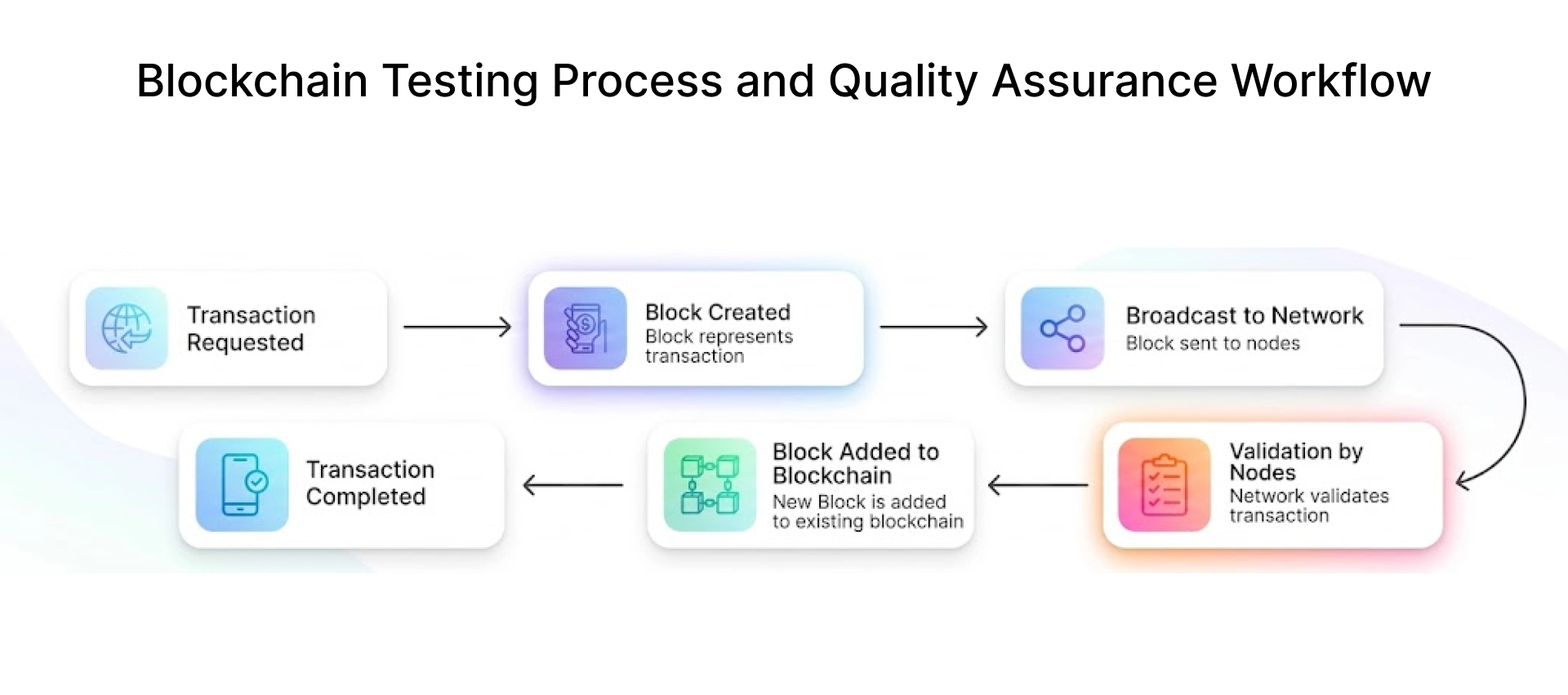
What is Blockchain Testing in Today’s Web3 Development Lifecycle
Blockchain testing refers to verifying that a blockchain-based product functions correctly, securely, and reliably before it goes live. In Web3 development, this includes testing decentralized applications, wallet connections, transactions, API integrations, and smart contracts across blockchain networks.
A major difference between Web3 testing and traditional software testing is that blockchain transactions are irreversible. Once a smart contract executes or a transaction is recorded, it cannot be modified or reversed. Because of this, even small mistakes in business logic or contract execution become permanent and visible on the network, making thorough pre-launch testing essential.
Testing typically happens at different stages of the Web3 development lifecycle. Teams usually validate:
- How smart contracts behave under edge or unexpected conditions
- Whether transactions are accurate, gas-efficient, and properly confirmed
- Wallet login flows and permission/access control mechanisms
- API integrations with exchanges, oracles, and third-party services
- Network performance under multiple users or high load
- Security vulnerabilities that could impact user funds or data
Why Blockchain Applications Need Specialized QA and Security Testing
Blockchain applications require dedicated quality assurance and security testing because they handle digital assets, decentralized systems, and automated smart contracts. Unlike traditional software, even a small defect can lead to serious and often irreversible consequences such as financial loss, security breaches, or failed transactions.
Conventional testing methods are often not enough for blockchain systems. These platforms involve components like wallets, APIs, tokens, and smart contracts, all of which need specialized validation before deployment.
Key Reasons Specialized Testing Is Essential
- Smart contract correctness: Verifying contract logic, permissions, and execution flow before deployment
- Security validation: Detecting vulnerabilities such as reentrancy attacks, incorrect access controls, and API-related risks
- Transaction reliability: Ensuring transactions, confirmations, and related processes work accurately and consistently
- Integration testing: Validating connections with wallets, exchanges, cross-chain bridges, and external services
- Performance testing: Ensuring the blockchain can handle real-world user load and traffic conditions
- Safe updates: Running regression tests after protocol upgrades or new feature releases
Common Challenges Teams Face When Testing Blockchain Applications Internally
Testing blockchain applications using only internal teams can be challenging, especially when those teams are already focused on development deadlines and product delivery. Blockchain systems demand specialized knowledge, dedicated tools, and ongoing validation across multiple layers.
Common Internal Testing Challenges
- Limited domain expertise: Many teams have strong developers but limited hands-on experience in smart contract audits, wallet flows, or decentralized system testing
- Tooling gaps: Internal QA setups may lack advanced testing frameworks, automation tools, or security scanning capabilities
- Complex integrations: Wallets, APIs, exchanges, and third-party services introduce multiple failure points that are harder to test thoroughly in-house
- Time pressure: Testing time often gets reduced near release deadlines, increasing the chances of missed bugs
- Scalability issues: Smaller QA teams may struggle to manage regression testing, performance validation, and new feature testing simultaneously
- Security blind spots: Without dedicated blockchain security specialists, subtle vulnerabilities may go unnoticed until after deployment
Why Outsourcing Is Becoming a Smart Choice for Blockchain Testing
As blockchain applications become more complex, internal QA teams often struggle to balance security validation, complete test coverage, and strict release deadlines. This challenge becomes even more critical in smart contract-based systems, where even small issues can lead to financial or operational damage.
Outsourcing blockchain testing allows companies to work with experienced QA specialists who already understand decentralized architectures, Web3 testing methods, and blockchain security risks.
It also provides flexibility to scale testing efforts based on project complexity and release pressure, without needing to expand internal teams. This ensures structured testing of both functional and security layers while allowing development teams to continue working without interruption.
Access to Blockchain Security Experts Without Long Hiring Cycles
Hiring blockchain security experts is often slow, expensive, and competitive due to limited availability of skilled professionals in the market. Many companies are competing for the same talent, which can delay projects.
Outsourcing solves this by providing quick access to experienced blockchain QA professionals who already understand smart contracts, wallet security, decentralized systems, and Web3 testing.
Key Benefits
- Start testing without waiting for long hiring cycles
- Access professionals with real blockchain project experience
- Reduce recruitment and onboarding effort
- Improve security coverage during critical releases
- Bring in expertise only when needed
Faster Testing Execution with Dedicated QA Resources
In many internal teams, developers handle coding, support, and release pressure at the same time. Because of this, testing often gets delayed until the final stage of development, which increases the risk of last-minute issues and delayed launches.
Dedicated QA resources help remove this bottleneck by working in parallel with developers. While development continues, testers handle validation, regression testing, and bug retesting simultaneously.
For example, in a startup building a token wallet, if three engineers manage both development and testing, progress slows due to constant bug fixing. With external QA support, testing runs in parallel, allowing developers to focus on building features while issues are identified earlier.
How Dedicated QA Improves Speed
- Testing starts alongside development instead of after completion
- Bugs are identified earlier, reducing rework
- Regression testing is completed before every release
- Multiple features can be tested at the same time
- Releases happen faster with fewer blockers
Lower Operational Costs and Flexible Scaling for Product Teams.
Building an internal blockchain QA team involves more than salaries. Companies also spend on recruitment, onboarding, training, infrastructure setup, and testing tools. These costs are even higher in blockchain projects due to the limited availability of skilled QA professionals.
Outsourcing helps reduce these expenses by providing on-demand access to testing resources. Instead of maintaining a full-time QA team regardless of workload, companies can scale testing based on project needs, release cycles, or feature launches.
For example, a DeFi product rollout may only require extra QA support for a short period, such as a few weeks. In such cases, outsourcing is more efficient than hiring permanent staff for temporary demand.
Where Cost and Flexibility Improve
- Reduced recruitment and onboarding costs
- No long-term overhead for temporary testing needs
- Easy scaling during launches and major updates
- Access to tools and expertise without extra investment
- Better budget control through project-based engagement
How Outsourcing Blockchain Testing Strengthens Product Security
Outsourcing significantly improves blockchain security by giving teams access to experienced specialists in smart contract validation, wallet security, API testing, and decentralized system audits. These professionals follow structured testing approaches to evaluate risks across functionality, integrations, and underlying logic before deployment.
In blockchain systems, even small vulnerabilities can lead to financial loss or system failure. Because of this, early and focused testing becomes extremely important. External QA teams help reduce these risks by identifying issues during development instead of after release.
Rather than depending only on internal teams, organizations often bring in external experts specifically to detect vulnerabilities before new features or updates go live.
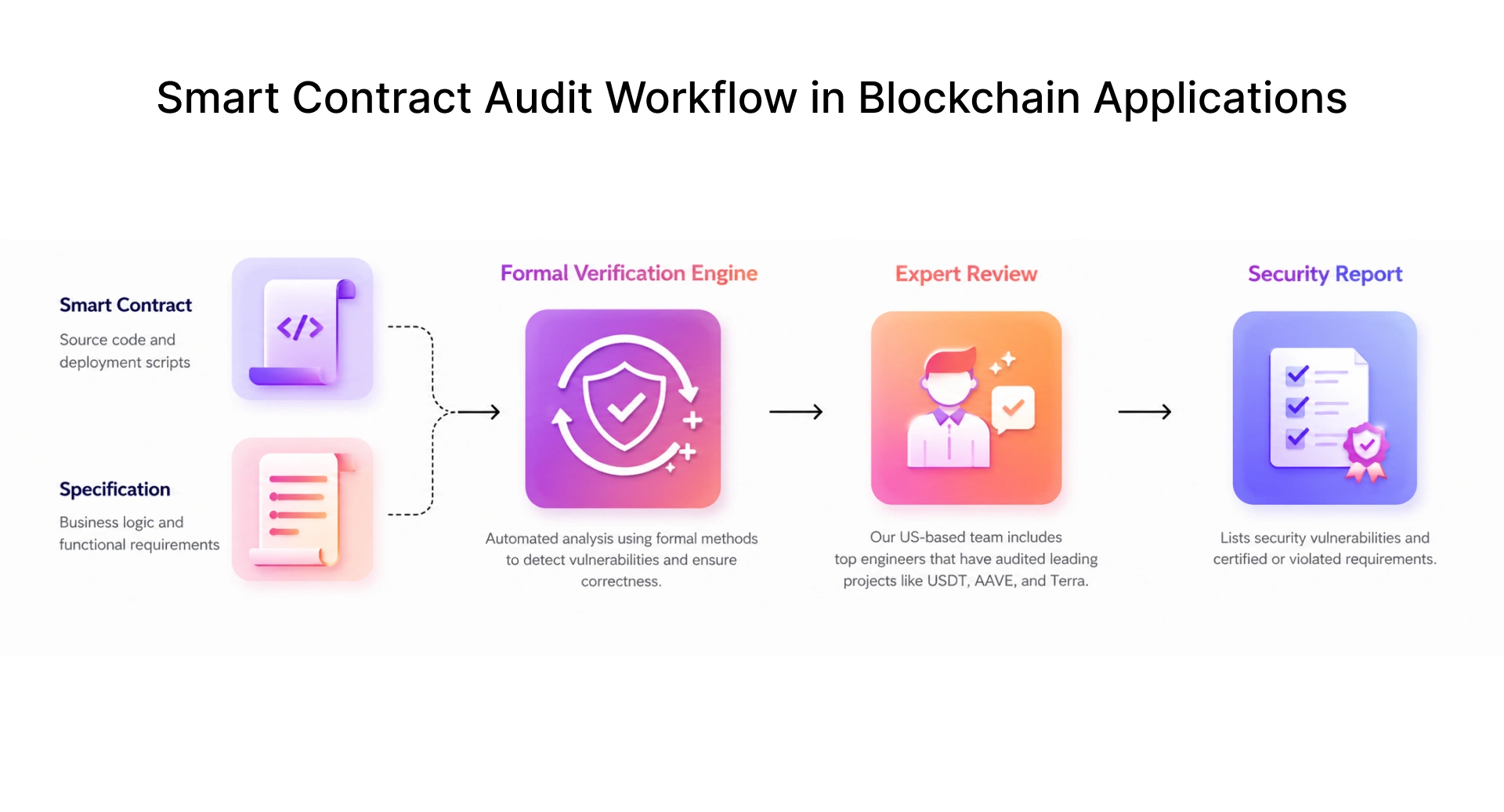
This approach is especially important for systems involving smart contracts, wallet integrations, token flows, or multi-platform ecosystems. In these environments, even small security gaps can lead to serious financial or operational risks.
Security Mapping: How Outsourcing Helps
The table below maps five core security needs in blockchain product development to how outsourced QA teams help address each one in practice.
Detecting Smart Contract Vulnerabilities Before Deployment
Smart contracts handle critical operations like transactions, token transfers, staking mechanisms, and automated workflows. Once deployed, they are extremely difficult to modify and usually require upgrades or redeployment, which can be complex and risky.
Because of this immutability, pre-deployment testing is the most important stage for identifying vulnerabilities. It is the best opportunity to catch logic errors, access control issues, and edge-case failures before the contract goes live.
Across Frugal Testing’s blockchain QA engagements, access control misconfigurations are among the most commonly identified pre-deployment vulnerabilities. They appear in roughly 6 out of 10 smart contract reviews, most often in admin functions, upgrade permissions, or role-based settings that were not properly restricted.
Common Smart Contract Vulnerabilities Found Before Deployment
- Access control issues: Weak permissions may allow unauthorized access to admin functions
- Reentrancy risks: Poorly secured functions can be repeatedly triggered before state updates
- Reward distribution flaws: Incorrect logic can cause overpayments or duplicate rewards
- Calculation errors: Small arithmetic issues can affect balances, fees, or staking returns
- Input validation gaps: Unrestricted inputs may break logic or bypass rules
- Upgrade permission issues: Poor controls may allow unauthorized contract modifications
Identifying Wallet, API, and Authentication Risks Early
Blockchain applications depend not only on smart contracts but also on wallets, APIs, and authentication systems. These components control how users access the platform and authorize transactions. If any of them fail, users may face broken flows or security risks.
Testing these components early is significantly more effective than resolving issues after deployment. It helps reduce integration failures, identify security gaps in advance, and ensures smoother user onboarding across different wallets and platforms.
Common Areas Where Risks Appear
- Wallet compatibility issues: Different wallets behave differently across devices and browsers
- Unsafe approval flows: Users may unknowingly grant excessive token permissions
- API security gaps: Unprotected endpoints may expose sensitive data or allow abuse
- Weak authentication controls: Poor session handling can lead to unauthorized access
- Third-party integration issues: External tools may disrupt core application flows
Performing Penetration Testing and Security Validation Efficiently
A blockchain application can appear fully functional while still containing hidden vulnerabilities. Just because everything works correctly does not mean it is secure. Penetration testing focuses on identifying how attackers could exploit weaknesses in APIs, wallets, permissions, or infrastructure.
Instead of verifying functionality, it actively looks for security gaps that could be exploited in real-world scenarios.
Common Issues Identified by Security Teams
- Public APIs without rate limits leading to abuse or scraping
- Misconfigured admin permissions exposing restricted functions
- Weak session management causing insecure logins
- Unsafe wallet approval flows requesting unnecessary permissions
- Exposed credentials in staging environments
- Poor logging and monitoring of suspicious activity
Lessons from The DAO and Ronin Hacks for Pre-Launch Security
It turns out that many of the blockchain security flaws could have been avoided if proper testing had been done. Weak logic, insufficient access control measures, and other types of vulnerabilities usually result in massive losses for projects. The DAO hack and Ronin Network hack are two of the best-known cases.
The DAO Hack (2016) - A flaw in the DAO smart contract allowed an attacker to repeatedly withdraw funds through a reentrancy exploit.
Impact: Approximately 3.6 million ETH was drained, leading to a major crisis in the Ethereum ecosystem and eventually a blockchain hard fork.
What teams should learn:
Smart contracts must be tested for edge cases, repeated function calls, and withdrawal logic before deployment.
Ronin Network Hack (2022) - Attackers gained control of validator keys and approved unauthorized withdrawals from the Ronin bridge network.
Impact: More than $600 million in ETH and USDC was stolen, making it one of the largest crypto security breaches recorded.
What Blockchain Teams Can Learn from These Failures
- Test your product under attack conditions, not only typical user cases
- Audit all permissions and access measures
- Use independent security testing to uncover potential threats
- Identify vulnerabilities and fix them before going live
How Outsourcing Blockchain Testing Reduces Launch Risk
Launching a blockchain product without thorough validation can create costly setbacks. Critical bugs, wallet failures, slow transaction processing, or security gaps often become most visible when real users start using the platform. At that stage, fixes are slower, more expensive, and can damage user trust.
Outsourcing testing helps reduce these risks by bringing in dedicated specialists before release. External teams can improve test coverage, execute a structured test plan, and identify issues while internal developers remain focused on product delivery.
The following sections explain how outsourcing helps prevent critical defects, improve launch performance, and avoid delays caused by last-minute fixes.
Preventing Critical Bugs and Failures Before Go-Live
The first few hours after launch often shape how users perceive a product. If transactions fail, balances display incorrectly, or wallet connections break, users may leave quickly and hesitate to return. In blockchain products, early failures can spread fast through communities and social channels.
This is why many teams use external testers before release to uncover high-impact issues that internal teams may miss while focusing on development.
What Usually Gets Caught Before Launch
Instead of only checking whether features work, pre-launch testing focuses on whether they work consistently under real usage.
- Transaction requests that fail after wallet approval
- Incorrect token balances after refresh or reconnect
- Reward calculations that break under edge cases
- Features that worked previously but fail after updates
- Permission settings that expose the wrong functions
Across Frugal Testing’s pre-launch blockchain QA engagements, more than half of critical defects identified during final validation had already been present in the codebase for multiple sprints. Earlier continuous testing would have helped detect these issues before release pressure increased.
The cost of fixing these issues after launch is usually far higher than resolving them during testing.
External QA teams bring fresh eyes, broader test scenarios, and dedicated time for release readiness. That often leads to stronger defect detection in the final stages.
Improving Scalability and Performance for Launch Traffic
A blockchain product may perform well in internal environments but face pressure once real users arrive at scale. Launch traffic often brings simultaneous wallet logins, rapid transaction requests, API spikes, and high dashboard activity within a short time.
If performance issues appear during launch, users may experience delays, failed actions, or poor responsiveness problems that can quickly damage trust.
- Common Launch-Time Performance Risks
- Slow transaction processing: High request volume can create queues or delayed confirmations.
- API response lag: Traffic spikes may slow price feeds, dashboards, or account data requests.
- Wallet session failures: Large numbers of concurrent users can interrupt connection flows.
- Frontend slowdowns: Heavy traffic may affect page speed and user navigation.
How Outsourced Testing Helps
External QA teams can simulate real traffic using automated testing scenarios, load checks, and stress validation before release. This helps teams identify system limits early and improve readiness.
For example, a token launch expecting 10,000 users in the first hour may run smoothly with a few hundred internal test users, but fail under real demand if capacity planning is incomplete.
Reducing Delays Caused by Last-Minute Fixes
Many product launches are delayed not because development is incomplete, but because important issues are discovered too late. When bugs appear during final review, teams often need urgent fixes, retesting, and release approvals all within a short window.
In blockchain products, last-minute issues can be even more disruptive. A wallet approval bug, incorrect transaction logic, or API failure may require additional validation before release.
Common Reasons Final Fixes Delay Launches
- Late bug discovery: Critical defects found near release day create immediate pressure.
- Retesting cycles: Every fix needs fresh checks to confirm nothing else is affected.
- Cross-team dependency: Developers, QA, DevOps, and product teams must align quickly.
- Release risk concerns: Teams may postpone launch rather than ship unresolved issues.
When external QA teams are involved earlier, testing runs continuously instead of being compressed into the final phase. This helps surface issues sooner, giving internal teams more time to resolve them properly.
For example, if a token claim feature fails only under peak load conditions, finding it two weeks before launch is manageable. Finding it the night before launch can delay the entire release.
Comparing In-House vs Outsourced Blockchain Testing: Cost, Speed, and Expertise
Choosing between in-house and outsourced blockchain testing is rarely a simple quality decision. It usually comes down to three business factors: cost, speed, and access to expertise.
An internal team may offer closer day-to-day alignment with product goals, but building strong blockchain QA capabilities often requires hiring specialists, purchasing tools, and creating mature testing processes over time.
Outsourced partners, on the other hand, can provide ready-to-use expertise in Smart Contract Testing, security audit workflows, API testing, and broader release validation without the long setup cycle.
The following sections compare internal teams and external partners across cost, tooling, speed, and long-term return on investment.
Cost Comparison Between Internal Teams and External QA Partners
Testing costs go beyond salaries. For blockchain products, businesses also spend on hiring time, tools, training, management effort, and release delays. Comparing the full cost model gives a clearer picture.
Access to Security Tools, Smart Contract Audits, and Testing Frameworks
Building a reliable blockchain product requires more than internal QA bandwidth. Teams often need specialized tools, independent contract reviews, and scalable automation frameworks to validate releases properly.
Outsourced testing partners can provide all three without the time and cost of building them internally.
1. Access to Security Tools
External teams often work with proven solutions such as Burp Suite, OWASP ZAP, Slither, Mythril, Snyk, and other security testing tools used for vulnerability detection, penetration checks, and dependency risk analysis.
2. Access to Smart Contract Audits
A smart contract audit goes beyond functional testing. It reviews contract logic, permission controls, exploit paths, gas efficiency, and upgrade risks.
Many teams seek external auditors or firms such as CertiK audit providers and other blockchain audit companies before launch because independent review adds credibility and fresh scrutiny.
3. Access to Testing Frameworks
Outsourced QA teams often bring ready-to-use testing frameworks such as Hardhat, Foundry, Truffle, Playwright, Cypress, CI/CD automation pipelines. This speeds up regression cycles, release validation, and continuous testing.
Faster Time-to-Market with Scalable Testing Resources
Speed matters in blockchain markets. Delayed launches can mean missed user demand, slower partnerships, and lost first-mover advantage. However, rushing release cycles without proper validation often creates even bigger setbacks after launch.
This is where outsourced testing becomes valuable. Instead of waiting to hire and train internal specialists, companies can quickly add experienced QA resources when timelines tighten.
How Scalable Testing Resources Accelerate Delivery
- Parallel test execution: Multiple testers can validate wallets, APIs, user flows, and regression cycles at the same time.
- Faster ramp-up: External teams usually begin faster than building an internal hiring pipeline.
- Flexible resource allocation: Testing capacity can increase during launch phases and reduce after release.
- Continuous release support: Additional bandwidth helps teams maintain delivery momentum during updates and new feature rollouts.
For example, if a product plans to launch on Binance Smart Chain or another fast-moving ecosystem, delaying release by even a few weeks can reduce market momentum. Scalable testing support helps teams stay on schedule without compromising quality.
Step-by-Step Guide to Successfully Outsourcing Blockchain Testing
Outsourcing blockchain testing delivers consistent results when the engagement is structured correctly from the start. The difference in outcomes is usually determined by how thoroughly scope, security expectations, and integration processes are defined before onboarding an external team. Misalignment in these areas often leads to gaps in testing coverage or delays in execution.
Successful engagements typically share a few key factors: clearly defined scope from day one, selection of a partner with proven blockchain testing experience rather than generic QA capability, and well-documented security and compliance requirements established before kickoff.
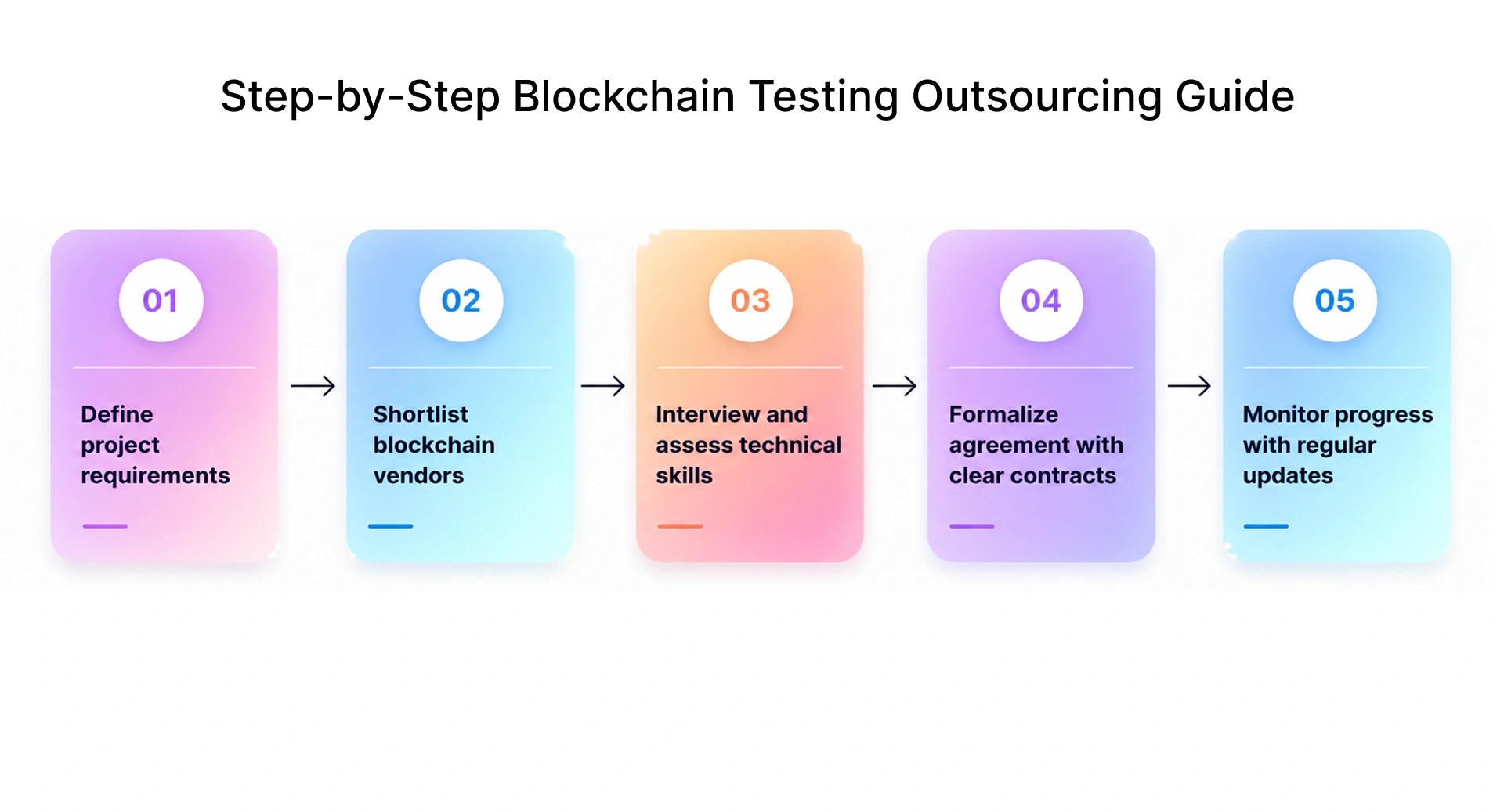
Here's how to structure that process.
Defining Project Scope and Security Requirements
External testers working from a vague brief will cover whatever looks testable, which may have little relation to the workflows that actually matter. Without clear scope definition, they lack the institutional context that internal teams build over time.
Before bringing anyone on, define what needs to be tested and how thorough the security review needs to be.
Key Areas to Define at the Start:
- Product components: Specify whether testing covers smart contracts, wallets, APIs, admin panels, mobile apps, or full blockchain apps.
- Testing priorities: Decide if the focus is functional validation, application security testing, performance checks, regression, or release readiness.
- Security expectations: List required vulnerability reviews, access control checks, penetration testing, or security audit needs.
- Networks and environments: Mention whether the product runs on Ethereum, smart contract platforms, testnets, private chains, or enterprise setups such as Hyperledger Fabric.
- Success metrics: Define expected deliverables such as defect reports, risk ratings, retest cycles, or target test coverage.
Evaluating Vendors by Experience and Certifications
A vendor with a solid track record in traditional software testing may still be the wrong choice for blockchain. The failure modes are different. A misconfigured wallet, a flawed token flow, a smart contract with a reentrancy bug these aren't caught by standard QA instincts. They require someone who's seen them before.
Price matters, but it's the wrong filter to lead with. A cheap vendor who's never touched decentralized infrastructure will cost more in the long run than a pricier one who has.
When evaluating partners, five areas are worth looking at closely.
- Relevant blockchain experience: Look for past work involving exchanges, DeFi apps, NFT platforms, wallets, or other blockchain use cases.
- Smart contract expertise: Check whether the team has experience with smart contract solidity, contract testing, or audit support across leading ecosystems.
- Security credentials: Ask about certifications, internal security processes, or experience in cyber security testing and vulnerability assessments.
- Testing capability: Review their use of qa testing tools, automation processes, and reporting standards.
- Team structure and communication: Understand who will handle delivery, escalation, timelines, and day-to-day collaboration.
Integrating External QA Teams into Agile and CI/CD Workflows
External testers added at the end of a release cycle find bugs at the worst possible time when fixing them means reopening work everyone thought was done. The testing itself isn't the problem. The timing is.
Plugging QA into sprints and CI/CD pipelines from day one changes that. Issues surface earlier, when they're cheaper and faster to fix, and the external team builds enough context to actually be useful rather than just running test scripts against a finished build.
How Successful Integration Usually Works
- Sprint planning participation: External testers join backlog discussions, priorities, and release planning so testing begins early.
- Shared test ownership: Internal developers and external QA teams align on responsibilities, timelines, and acceptance criteria.
- Automated pipeline checks: Regression suites, API validations, and smoke tests can run automatically during each build using test automation frameworks.
- Continuous feedback loops: Defects are reported quickly through Jira, Slack, or shared dashboards, allowing faster fixes.
- Release readiness support: Before deployment, testers validate high-risk workflows, recent changes, and production-critical journeys.
Best Practices to Follow When Outsourcing Blockchain Testing
Outsourced testing delivers when the unstructured aspects are handled correctly: clear processes, realistic expectations, and defined ownership. Most outsourcing failures occur due to unclear ownership, undefined scope, or weak communication structures.
- Choose vendors with proven blockchain testing experience.
- Define scope, timelines, and deliverables early.
- Set clear security and access control rules.
- Request detailed reports with risk priority.
- Retest fixes before approving closure.
- Use continuous testing for updates and releases.
- Keep regular communication through shared channels.
- Treat the external team as an extension of your internal team.
Key Takeaways: Why Outsourcing Blockchain Testing Creates a Strategic Advantage
Outsourcing blockchain testing helps the team ensure security, increase release readiness, and benefit from the expertise of professionals without having to grow an extensive QA department internally. Outsourcing blockchain testing is especially beneficial for those organizations that are planning to launch their Web3 product on a very short notice.
The development of blockchain technology includes increased operational risk due to its nature, which implies the use of smart contracts, wallet integration, transaction processes, and many other components that make up the infrastructure of the project.
Improve Security, Reduce Launch Risk, and Scale Faster with Frugal Testing
Frugal Testing helps engineering teams improve product quality through flexible qa testing services, security-focused validation, and scalable release support for modern blockchain platforms.
In practical delivery environments, a common challenge is balancing rapid product development with the deep testing required before launch. External QA support helps teams increase test coverage, validate critical user flows, and maintain release momentum without overloading internal resources.
Based on Frugal Testing’s software quality assurance service engagements, many growing product teams use outsourced testing models to strengthen security checks, reduce release bottlenecks, and scale validation efforts during high-priority launches.
With the right outsourcing strategy, businesses can launch faster, reduce avoidable risk, and keep internal teams focused on product innovation.
People also ask for (FAQs)
1How long does outsourced blockchain testing usually take for a typical project?
Outsourced blockchain testing usually takes one to two weeks for focused validation projects. Larger products involving smart contracts, APIs, wallets, and performance testing may require several weeks depending on scope and complexity.
2.What types of blockchain platforms can external QA teams test?
External QA teams can test a wide range of blockchain platforms, including Ethereum, Layer 2 networks, DeFi apps, NFT marketplaces, Binance Smart Chain, and Hyperledger Fabric. Testing may also cover wallets, APIs, and smart contracts.
3.Can blockchain testing be outsourced for startups with limited budgets?
Blockchain testing can be outsourced for startups with limited budgets through project-based engagements, milestone-based support, or targeted release testing. This allows smaller teams to access specialist QA expertise without maintaining a full in-house testing team.
4.How often should blockchain applications be tested after launch?
Blockchain applications should be tested after every major update, smart contract change, wallet integration, feature release, or infrastructure modification. Ongoing regression and security checks help reduce production risk over time.
5.How do companies measure the success of an outsourced blockchain testing engagement?
Companies usually measure success through fewer critical defects at launch, improved test coverage, faster release cycles, timely reporting, stronger remediation closure rates, and fewer production incidents after deployment.



.webp)