

Plugin automation looks cheap on day one. Install a tool, wire it into your test automation framework, and ship. Fast. But the real invoice arrives later buried in maintenance sprints, broken pipelines, and engineering hours that should have gone toward actual test coverage.
The hidden costs? Dependency conflicts. Brittle pipelines. Tool silos. Cloud execution waste. Custom integrations that only two people understand.
MCP automation changes the model entirely. It gives QA teams a governed workflow layer where AI agents, tools, files, APIs, and test context all operate through controlled MCP servers without every team rebuilding the same integrations from scratch.
For QA leaders, the question is not whether MCP is newer. The question is whether your current test automation platform is creating maintenance debt faster than release confidence.
The five hidden costs of plugin automation:
- Dependency conflicts and maintenance tax from plugin version drift.
- Brittle pipeline failures that mimic real product defects.
- Tool silos that block AI agents from accessing shared context.
- Cloud execution bloat from scaling runners instead of fixing root causes.
- Custom integration complexity that concentrates release risk in a handful of engineers.
Why Test Automation Is Getting More Expensive, Not Less
Consider a typical mid-size QA stack: Playwright for browser tests, a Jira plugin for defect sync, a Slack integration for alerts, a separate cloud runner for CI, and a reporting dashboard that needs its own connector. Each one has a version dependency. Each one can break on a framework upgrade. The productivity gain from adding any one of these tools is real but so is the maintenance overhead that arrives with it six months later.
The dark side of plugin sprawl only surfaces once large language models enter QA. These general purpose AI systems can assist with test design, browser use, API calls, Bash commands, and command-line interfaces but only when the workflow has enough context and safe permission modes to support them. Test automation best practices now demand architecture that supports AI-assisted QA without constant rebuilding from scratch.
5 Hidden Costs of Plugin-Based Test Automation
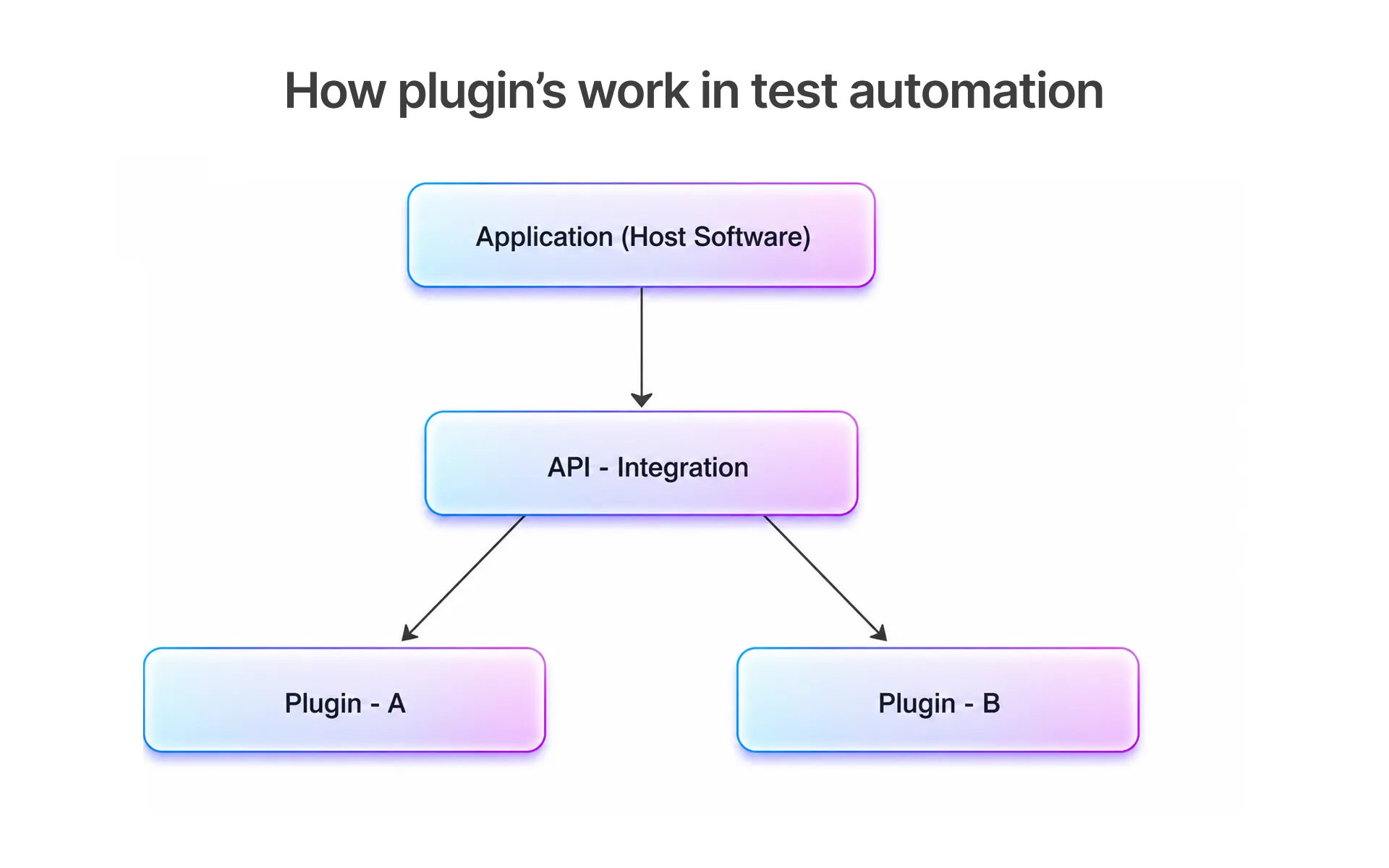
Cost 1: Dependency Hell and the Never-Ending Maintenance Tax
Whether the team uses an open-source or commercial test automation framework carries a dependency tree. Specific runtimes. Browser drivers. IDE extensions. API contracts.
One team upgrades VS Code. Another bumps a test runner. A third changes the file layout. That dependency drift turns minor upgrades into multi-sprint incidents. Teams that rely on test automation services whether in-house or through an external partner find senior engineers consumed by version conflicts instead of improving coverage.
Across a full ui test automation framework, the tax becomes structural:
- A plugin that takes only a few hours to implement can often require significantly more effort over time as teams manage version upgrades, browser driver compatibility issues, dependency updates, and CI/CD pipeline maintenance.
- Version conflicts multiply across every tool in the stack.
- Framework upgrades become events, not routine tasks.
Cost 2: Brittle Pipelines That Fail for All the Wrong Reasons
For teams running DevOps test automation across multiple pipelines, a single unreliable plugin can degrade release trust faster than ten genuine product defects.
Plugin-heavy pipelines fail because:
- A UI action shifted by a few pixels.
- A browser extension timed out under load.
- A sign-in token expired overnight.
- A cloud runner lost access to a tool-specific secret.
None of these are product defects. But they look exactly like them in your test automation reporting dashboards. Every false failure triggers an investigation cycle. Engineers spend time proving the product still works not because it broke, but because the infrastructure broke.
When this spreads across CI/CD, test automation metrics stop reflecting release risk and start reflecting automation noise. Teams add more parallel runners to average out the flakiness. The bill grows. The trust doesn't. Codeless test automation tools and plugin-driven frameworks rarely help teams tell real risk from infrastructure churn.
Cost 3: Fragmented Tooling Silos That Kill Team Velocity
One squad uses GitHub Copilot in VS Code. Another tests with a browser plugin. A third reviews results via a separate CLI tool. Each has its own context window, file change view, and permission model. No-code test automation tools deliver real value within their own scope the fragmentation cost appears at the boundaries, where tools need to share context but cannot. The fragmentation cost lives at the seams where tools need to share context but can't.
In AI-driven test automation workflows, this becomes a real problem:
Picture a Copilot suggestion that refactors a login test after a locator change it looks correct in isolation, passes locally, and ships. But the same login flow has an open defect in Jira that the AI assistant never saw, because its context window stops at the IDE. The test passes. The defect ships. That is what tool silos cost in practice not abstract "systemic risk", but a specific failure mode that only surfaces in production.
Cost 4: Cloud Execution Bloat That Scales Your Bill, Not Your Tests
Test automation as a service platforms make horizontal scaling easy. That ease becomes a trap. Teams add more runners to compensate for slow, flaky, or redundant automation instead of fixing root causes. The bill scales. Confidence doesn't.
Good test automation metrics must separate real coverage gains from repeated execution noise. Lean test automation solutions route tests based on risk signals, not habit. That discipline requires architecture not just more runners.
Cost 5: Custom Integration Complexity That Only Two People Understand
Frugal Testing's delivery team calls this the two-engineer risk: when both people who understand a custom integration are unavailable at the same time, the release pipeline becomes a guessing exercise.
Picture this:
- A Bash command wired to a webhook.
- A local helper script checking a Google Drive folder.
- An undo button someone added after the last incident.
- A sign in flow that breaks silently every third Friday.
Test automation benefits are supposed to compound over time. Custom integration complexity ensures they don't. When the path from commit to test evidence is held together by undocumented conventions, every release calendar inherits the availability risk of the two engineers who understand it.
Vacation, attrition, or a promotion becomes a deployment event. Any test automation company pitching enterprise automation without addressing maintainability is selling you the first year not the third.
Modern test automation software decisions must account for this explicitly.
What Is MCP and Why Is It Built Differently
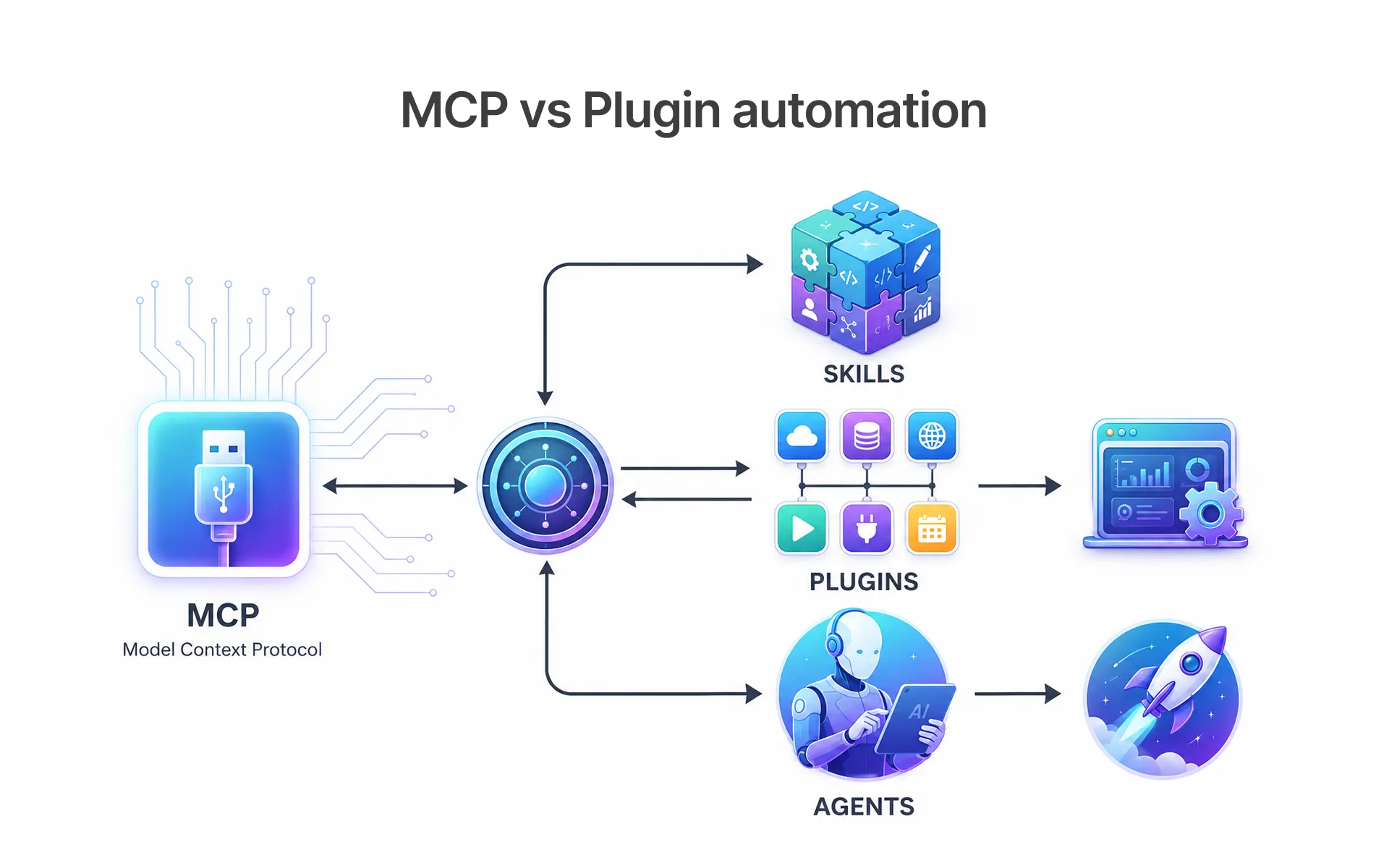
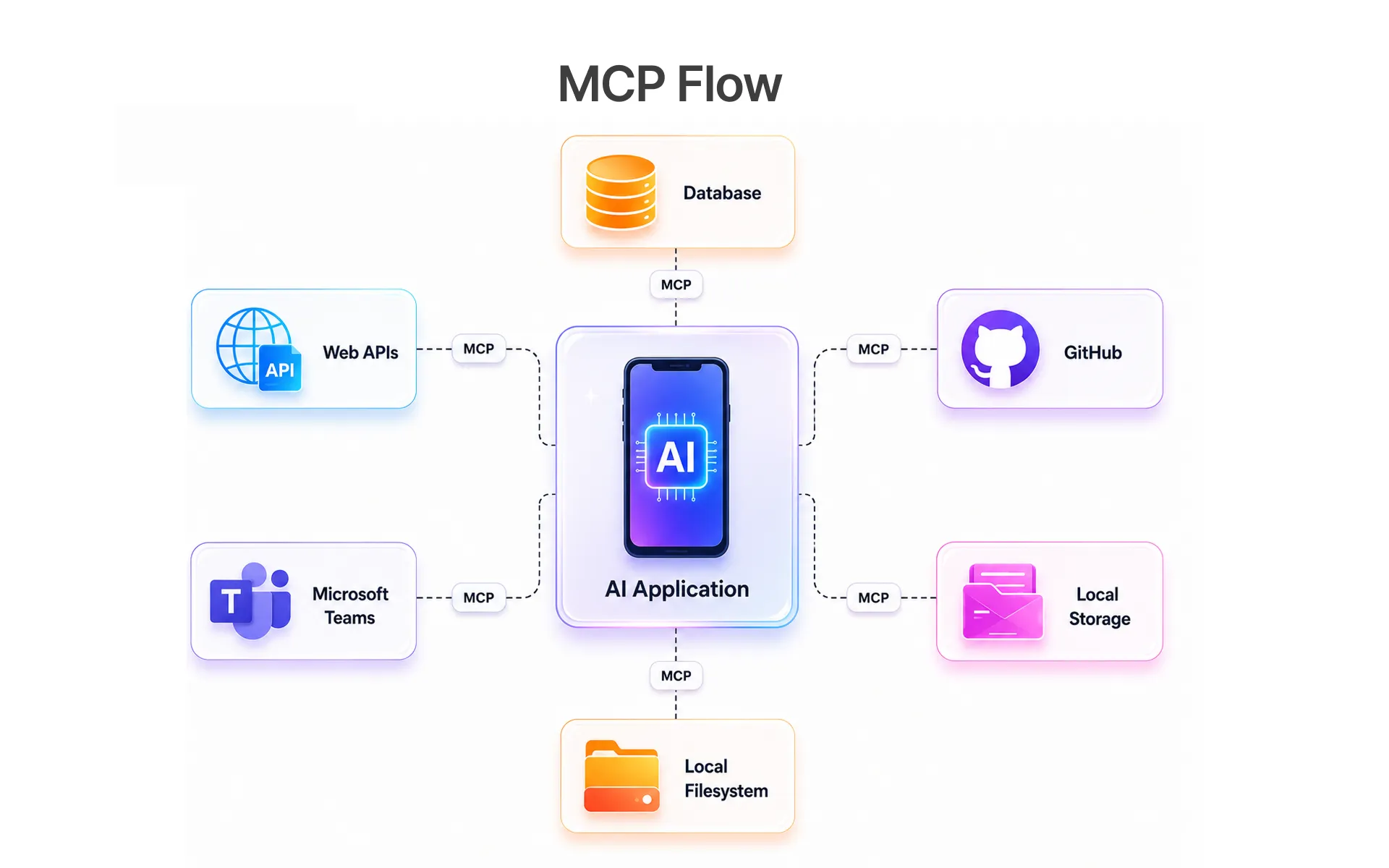
Model Context Protocol (MCP) is a standard way for AI systems to connect with tools and data sources through governed MCP servers. Instead of every assistant building its own integrations, MCP gives AI systems a standardized way to connect with external tools and data sources. Auditability and permission controls are real advantages but they depend on how the MCP servers, clients, and enterprise policies around them are implemented, not the protocol alone.
MCP vs API: A traditional API defines how two systems exchange data. MCP defines how an AI agent discovers and uses capabilities across multiple systems with access controls and audit trails built in by design.
MCP vs A2A: MCP is the protocol layer. Agent-to-agent orchestration sits on top of it. For enterprise test automation framework teams, MCP creates a shared foundation that individual plugin chains structurally can't match.
Tools like Claude Code, Claude Skills, Claude Cowork, GitHub Copilot, and ChatGPT Plus have pushed QA teams toward one governance question: How do we give an agentic AI test automation assistant enough context without granting it unsafe access to production systems?
How MCP Directly Fixes Each of These 5 Costs
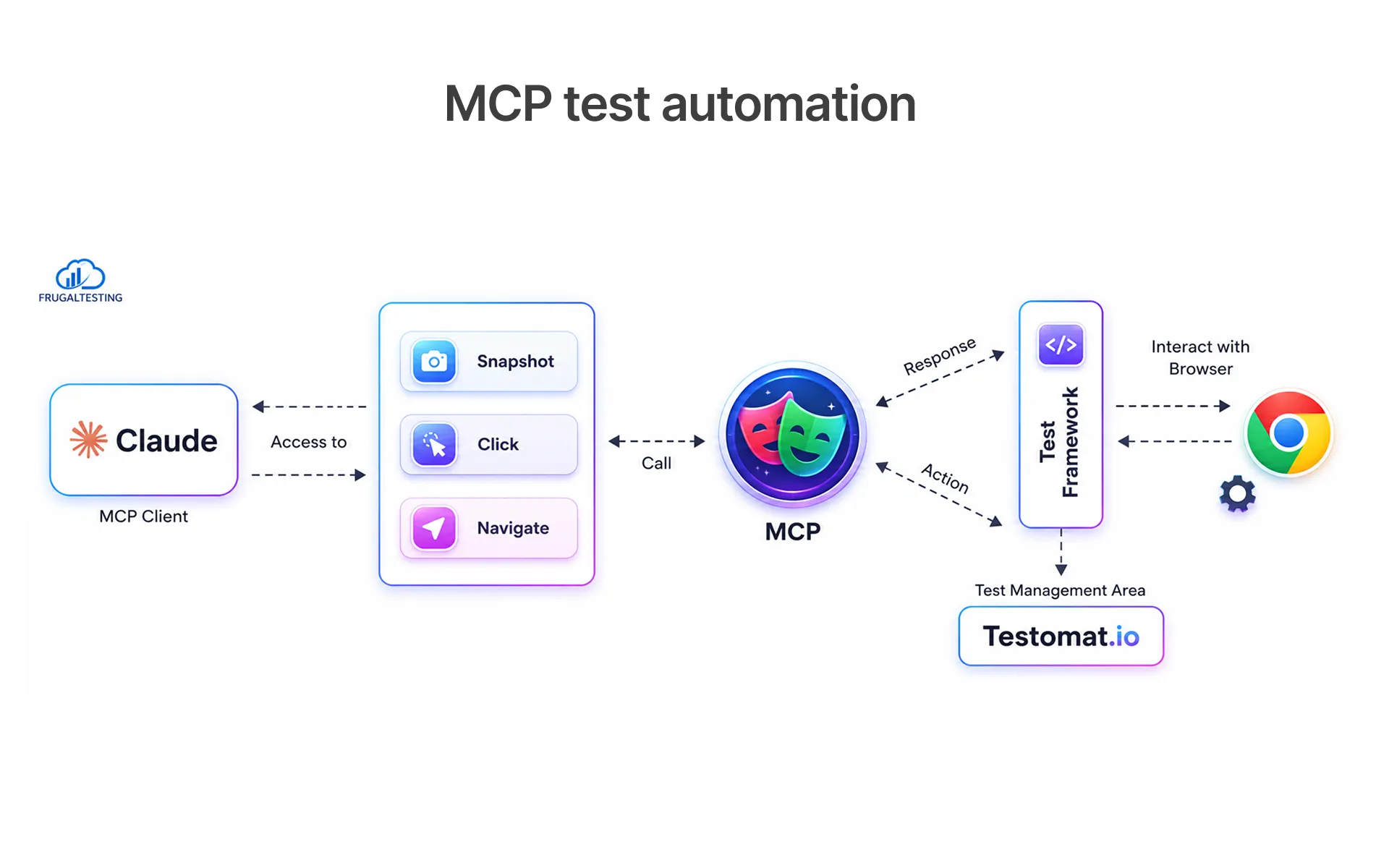
For teams adopting AI test automation as a managed capability, MCP provides the governance layer that makes agent-assisted QA safe to operate at scale.
One Unified Integration Layer Instead of Plugin Sprawl
The core MCP example for QA teams:
Instead of each squad maintaining its own plugin chain for repository access, API connectivity, and test reporting those capabilities are exposed once through shared MCP servers with documented ownership.
An AI model operating through MCP can connect to the development environment, test reports, repositories, and logs through a single governed layer. No per-IDE plugin required. The test automation platform stops depending on every IDE carrying every integration.
The economics are simple:
- First team configures the shared server → pays the full setup cost.
- Every team after that → near-zero marginal cost to gain the same capability.
Plugin sprawl shrinks because the protocol handles integration at a level of consistency and control that plugins simply can't match.
AI-Driven Self-Healing That Stops False Failures Before They Spread
AI test automation tools operating through MCP can support genuine self-healing because they access reliable, multi-source evidence.
An AI-driven test automation agent can compare a failed UI test against recent file changes, live API responses, browser execution logs, and known locator drift patterns all through governed MCP server calls.
The value isn't blind auto-repair. It's better triage.
AI test automation platforms built on MCP reduce the investigation burden slowing devops test automation cycles without removing the human judgment enterprise QA governance requires.
Shared Context That Eliminates Tool-Switching Overhead
A single defect can involve:
- Source code changes.
- API call logs.
- Test data fixtures.
- Browser screenshots.
- Release notes from three different systems.
Test automation using AI shouldn't require engineers to manually paste fragments between tools to reconstruct that picture. MCP gives an AI agent one controlled path to request all of it.
For agentic AI test automation at enterprise scale, context assembly must be governed and repeatable. That's where real test automation benefits emerge: less copying, fewer missed dependencies, faster investigation, and AI recommendations grounded in complete context not fragments.
Leaner Execution Architecture With Predictable Cloud Spend
MCP doesn't automatically lower your cloud bill. What it does: give teams the architectural clarity to make costs visible and manageable. Through MCP access to coverage data and CI/CD signals, teams can route only the highest-risk checks into expensive parallel execution.
That's how test automation solutions cut cloud spend without cutting release confidence.
A Standard Protocol Any Engineer Can Learn and Maintain
Engineers joining an MCP-based team can learn:
- How servers expose tools?
- How permission modes work?
- How API keys are scoped and rotated?
- How tool calls are logged and reviewed?
MCP configurations carry design intent that documentation can accurately describe. That's where test automation best practices for governance belong:
- Who registers new MCP servers?
- Who approves permission changes?
- How do audit trails connect tool calls to the decisions they supported?
Build those answers in and you build something maintainable.
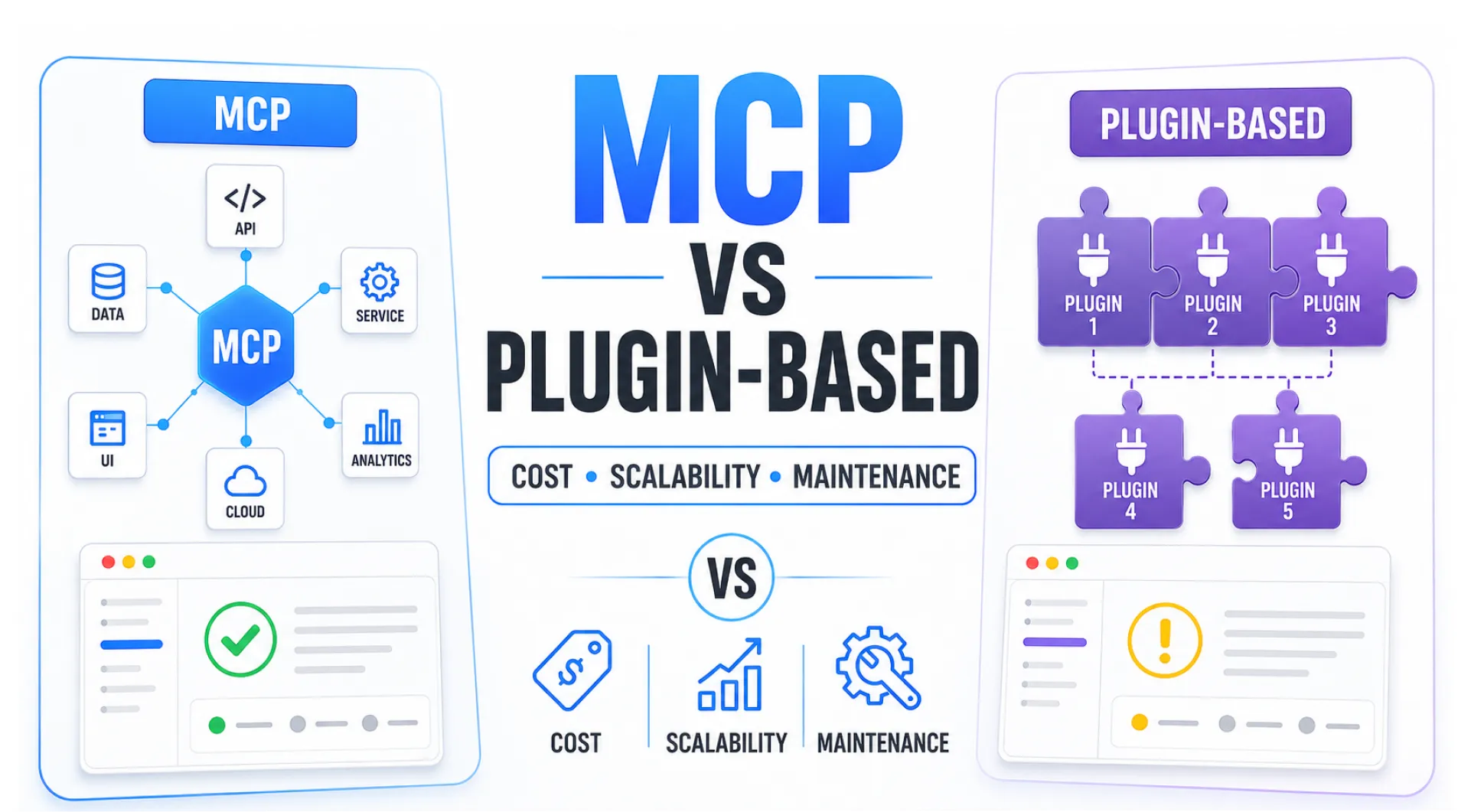
MCP vs Plugin Automation: A Direct Comparison
The table below compares MCP and plugin automation across four decision areas that determine fit for enterprise QA teams.
Setup Cost and Time to Value
Plugins win on day-one setup. Install, authenticate, connect, start. No code test automation tools deliver fast individual productivity without a platform rollout. MCP takes longer server definitions, access policies, API key management, and operating rules before any agent can use them.
But MCP wins the multi-team, long-term comparison: one integration layer supporting five squads costs far less than five independently maintained plugin stacks.
Long-Term Maintenance Effort
Plugin maintenance grows with every tool update every version bump, browser release, and framework change is a potential regression event in your test automation framework architecture. MCP maintenance concentrates around server ownership and permission governance. When responsibilities are clearly assigned, MCP is significantly cheaper to maintain at scale.
For enterprise test automation framework management, centralization creates leverage but only with observable, documented governance behind it.
Scalability Under Real-World Load
Plugins scale by repetition. MCP automation scales through shared infrastructure one well-governed server supporting many teams simultaneously. Test automation metrics must include governance health alongside coverage data.
A platform that scales execution without scaling oversight isn't building quality. It's building risk.
Should You Migrate to MCP in 2026?
Based on MCP migration projects Frugal Testing has led, teams that move primarily to follow the technology trend see slower return than teams that move because they have already identified a specific governance or context-sharing pain point in their current stack.
Stick With Plugins If This Describes Your Team
- Stack is simple: One test automation framework, one repository pattern, limited cross-tool context needs.
- Risks are low: No sensitive test data pipelines, no complex API access chains, no cloud execution bloat demanding orchestration.
- Team needs speed: A plugin delivers measurable gains without a full platform rollout.
Move to MCP If You Recognise These Signs
- You need shared context: Test failures require correlating files, APIs, logs, and CI/CD evidence to investigate accurately.
- You need governed AI: Agentic AI test automation must operate through permission modes, audit trails, and reviewed tool calls not unsupervised file access.
- You need scale: Multiple squads need consistent workflow layer capabilities without rebuilding integration inside every plugin.
A rigorous competitive analysis should filter for architectural fit and governance readiness not demo performance.
Teams that evaluate on features alone discover their real costs eighteen months into adoption.
Conclusion The Framework You Choose Today Determines the Debt You Pay Tomorrow
Plugin automation isn't dead. For narrow, framework-specific, low-governance work it remains a valid, cost-effective choice. For enterprise QA automation specifically, these costs do not stay isolated each one accelerates the next.
But MCP becomes the stronger test automation strategy when QA teams need:
- Shared context across tools and repositories.
- Governed AI agent access with documented permission boundaries.
- Predictable cloud execution tied to real risk signals.
- A maintainable workflow layer any engineer can operate.
These five costs are not theoretical they surface predictably in sprint boards, cloud invoices, and post-mortems, and the only fix that holds across all five is an architectural one, not another plugin added to an already-fragile stack.
Frugal Testing helps engineering teams evaluate automation choices through the lens of release confidence, maintainability, and test coverage.
People Also Ask (FAQs)
Q1. What is the main difference between Model Context Protocol (MCP) and custom QA plugins?
Ans: MCP provides a standard protocol for AI systems to connect with tools through governed MCP servers. Plugins solve tool-specific problems inside individual IDEs or frameworks. MCP connects many systems. Plugins extend one.
Q2. How does MCP reduce test automation maintenance costs?
Ans: By replacing scattered plugin integrations with shared servers that have clear ownership, documented permission rules, and reusable tool access plus better triage evidence to eliminate false failures faster.
Q3. Can MCP-based test automation scale across legacy enterprise applications?
Ans: Yes when legacy systems are exposed through controlled APIs or read-only connectors. Start with a limited pilot. Legacy access carries real data security and reliability risk that needs careful review before any AI agent gets tool call access.
Q4. What are the data security implications of using MCP-based AI testing?
Ans: Key concerns include:
- API key management and rotation
- File system access scope
- Test data exposure
- Command execution boundaries
- Audit logging completeness
Start with least-privilege access. Require engineer review for sensitive tool calls. Standard test automation best practices for security apply fully here.
Q5. How does Frugal Testing implement Model Context Protocol for client automation?
Ans: Implementation starts by mapping the client's test tools, repositories, CI/CD workflows, data boundaries, and governance needs.MCP servers are then designed to expose only what each workflow requires with permission modes and audit configurations matched to the client's risk profile.Specific client implementation details should be confirmed with the Frugal Testing delivery team before publication.

.webp)